
4.9. Fundamentals of Aqueous Geochemistry II#
Professor: Nick Tosca (Department of Earth Sciences)
Learning objectives:
Introduce the expression of solubility equilibrium with respect to a solid phase.
Introduce the major controls on the composition of natural waters.
Introduce the chemical and physical processes driving the formation of alkaline lakes, which are relevant to origins of life scenarios on the early Earth.
The goal of this lecture is to finish introducing key principles which we can use to understand and predict the chemistry of natural waters on Earth, and discuss general controls on the composition of natural waters, focusing on a system of relevance to the origins of life on Earth.
Introduction#
In the first lecture, we introduced some thermodynamic tools used to describe aqueous solutions at equilibrium. Here we will introduce one more important tool: the expression of equilibrium between an aqueous solution and a solid (or mineral). This is important because interactions between minerals and aqueous solutions are responsible for much compositional variation in natural waters, and these relationships also help place constraints on conditions through which natural minerals could form (or become destabilised).
Aqueous solutions: mineral-water equilibrium reactions#
The chemistry of natural waters is strongly controlled by reactions between water and naturally occurring solid phases (i.e., minerals).
The solubility of these solid phases is a concept we often encounter. We can dissolve table salt (NaCl) in water and we know it will dissolve. We can express this through the reaction:
If this reaction goes to completion, the NaCl will completely dissolve. We also know that if we continue to add NaCl to water, we will eventually reach a point where no more will dissolve (even with stirring). In this case, the solid NaCl and Na and Cl ions are in equilibrium and the water is saturated with sodium chloride.
When a solid is placed in water and dissolves, the process is referred to as dissolution. When dissolved constituents combine to generate a solid phase, the process is referred to as precipitation.
Example: anhydrite solubility
We can use the principles above to determine the solubility of anhydrite, the anhydrous calcium sulfate mineral CaSO\(_{4}\). The appropriate reaction is:
By convention, and for mathematical convenience, dissolution and precipitation reactions are always written with the solid on the left hand side.
Using the Gibbs free energies of formation (introduced in the last lecture), we can calculate the standard state Gibbs free energy change for our reaction (\(\Delta G_{r}^{o}\)):
Using tabulated Gibbs free energy of formation values for ahydrite, Ca#^{2+}\(, and SO\){4}^{2-}\( ([see an example compilation here](https://www.cambridge.org/highereducation/books/thermodynamics-of-natural-systems/5E09A0A8D3BEC5ACBF67C871D18CDBF1/standard-state-thermodynamic-properties-of-selected/016BE203A0D6311CC6B0449233A9F4A2)), we get \)\Delta G{r}^{o} = 23560$ J/mol. From this we can calculate the equilibrium constant for the dissolution reaction (called the solubility product) using:
which yields a value of \(10^{-4.13}\) at 298.15 K (\(25^{o}C\)). The activity of solid substances is set equal to 1 as long as they are pure (i.e., contain no appreciable quantities of other elements); this is a standard state convention that makes the mathematics easier. Recalling our definition of the equilibrium constant (the solubility product is just a specific type of equilibrium constant for solubility reactions), the solubility product constant can be written in terms of the activities:
Thus, whether anhydrite will dissolve or precipitate from a water depends on the concentrations (or activities) of calcium and sulfate (specifically the product of those activities). This simple tool allows us to examine mineral-water reactions across a wide range of conditions. We’ll walk through some conceptual examples below.
Controls on natural water chemistry#
The chemistry of natural waters is controlled by many different processes, but we will touch upon a handful of the most important, and in the remainder of the notes for this lecture, we will consider one example system of particular relevance to origins of life scenarios on the early Earth.
Some of the most important processes influencing natural water chemistry near the Earth’s surface (many of these are applicable to the surfaces of other rocky planetary bodies where liquid water may be or may have been present) are:
Interactions with atmospheric components. This generally involves the transfer and equilibration of gaseous components with aqueous fluids. This includes gases such as: CO\(_{2}\), SO\(_{2}\), H\(_{2}\)S, O\(_{2}\), H\(_{2}\), CH\(_{4}\), NH\(_{3}\) and many others. In general, the dissolved concentration of gaseous constituents is expressed using Henry’s law constant, which simply relates the dissolved concentration of a gaseous component with its partial pressure in the gas phase with which the aqueous solution is in equilibrium.
Chemical weathering. This process, which is really a combination of other processes, refers to the interaction between waters and minerals in rocks and soils. In general, the presence of atmospheric CO2, which results in the formation of carbonic acid (a weak acid), leads to the dissolution of minerals present in rocks and sediments. These minerals dissolve incongruently (meaning that their constituents do not enter the water in the same proportions as they are contained in the mineral), which eventually results in the formation of new minerals such as clay minerals and (hydr)oxide minerals, and the release of several different cations into the water (e.g., Na\(^{+}\), K\(^{+}\), Ca\(^{2+}\), Mg\(^{2+}\), etc.). The result is generally to increase the pH of the fluid as the protons (H+) in the initial fluid are exchanged for cations. Because the rates of mineral dissolution are strongly dependent on pH, they typically reach a minimum when pH increases above about 7 or 8. The rates of this process, as well as the minerals formed and the resulting composition of the fluids, is dependent on the minerals present in the rocks/soils, the flow rate of new water through the system, and the rate of physical weathering (that is, the generation of fresh reactive mineral surfaces).
Evaporation. Evaporation of waters near Earth’s surface generally result in increases in the concentration of dissolved constituents. This in turn increases the saturation state of the water with respect to several minerals, and eventually new minerals crystallise. These minerals are often relatively soluble (referred to as “evaporite” minerals or salt minerals), and the type and sequence can depend on the chemistry of the dilute water before it evaporates. The resulting concentrated fluid is referred to as a brine.
Adsorption/desorption. This class of reactions involves the transfer of dissolved components to and from a mineral surface. These reactions may proceed through electrostatic interactions or involve the formation of stronger covalent chemical bonds (as in the case of oxyanion interaction). These reactions are often reversible with minimal change to the mineral surface, and so fluctuations in variables such as pH, solution concentration, or fluid flow velocity can result in adsorption or desorption of certain components.
Interactions at high temperature/pressure. Fluids circulating through portions of the Earth’s crust may experience increases in temperature and pressure with depth. In general, this can result in large changes to the chemistry of the fluid because essentially all of the reactions described above exhibit dependencies on temperature and to a lesser extent, pressure. This generally results in highly concentrated fluids at high temperature, which become buoyant and rise upward to cooler regions of the subsurface. This in turn results in the precipitation of minerals and large changes to fluid chemistry. The most well-known and well-studied examples are hydrothermal vent fluids derived from the circulation and heating of seawater as it descends through the oceanic crust, and then rises upwards to interact with cold seawater again.
Biological interactions. Although we will place less focus on this, processes such as photosynthesis and respiration result in significant changes to acid/base chemistry and the concentration of different metabolites. Biological interactions, especially those driven by microbial organisms, can trigger the precipitation or dissolution of minerals, and result in changes to the oxidation state of different components in the water (i.e., the conversion of SO4 to H2S through microbial sulfate reduction, which then may result in the formation of sulfide minerals such as pyrite, FeS2).
Case study: Alkaline lakes on the modern and prebiotic Earth#
One environment that has received significant attention in recent years is alkaline lakes. Alkaline lakes are referred to as such because they have high concentrations of alkalinity, which is defined as the charge concentration of titratable bases present in solution. In natural waters, these bases are typically dominated by dissolved carbonate species, and so a simple definition for alkalinity (sometimes called carbonate alkalinity) only takes these into account:
Alkaline lakes are attractive to origins of life scenarios because they (1) tend to concentrate components upon evaporation, which is required for many prebiotic processes; (2) they are typically characterised by elevated pH (on the early Earth they are thought to have ranged between pH 6-8), which is ideal for many, but not all, prebiotic processes; (3) alkaline lakes on the early Earth may have promoted the formation of ferrocyanide salts, which might have served to “stockpile” key feedstock molecules such as HCN, which is generally only derived from the atmosphere; (4) alkaline lakes on the early Earth may have promoted high concentrations of dissolved phosphate, which are required for many high-yielding prebiotic syntheses; (5) lakes afford access to UV radiation from sunlight, which is a powerful agent in selecting and purifying products of prebiotic syntheses.
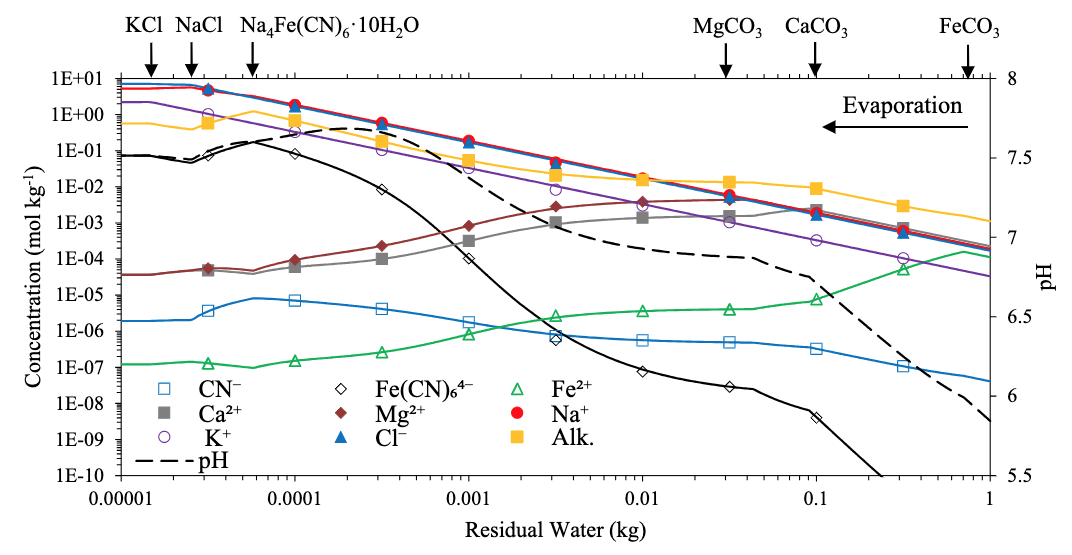
Fig. 4.71 Evaporation calculations showing the progression from a dilute surface water to a concentrated alkaline brine under atmospheric conditions relevant to the prebiotic Earth. As evaporation progresses (from right to left), major minerals are formed, including unusual ferrocyanide salts which are thought to play an important role in concentrating cyanide for later prebiotic synthesis reactions. From Toner & Catling (2019).#
How do alkaline lakes form? In general, they form through evaporation, because this increases the concentration of alkalinity. However, in order for alkalinity to increase, it must be present at a concentration that is greater than 2 x the concentration of Ca\(^{2+}\) or Mg\(^{2+}\). The reason is that as evaporation proceeds, the precipitation of CaCO\(_{3}\) minerals, which happens quite early in the evaporation process, consumes CO\(_{3}^{2-}\), an important component of alkalinity (because it counts for two alkalinity units by virtue of its -2 charge). This leads to three possible processes as evaporation proceeds: (1) when \([Alkalinity] < 2 \times [Ca^{2+}]\), CaCO\(_{3}\) formation consumes all of the alkalinity and pH decreases; an alkaline lake is not formed; (2) when \([Alkalinity ] = 2 \times [Ca^{2+}]\), CaCO\(_{3}\) formation results in no change to alkalinity of pH with evaporation; (3) when \([Alkalinity] > 2 \times [Ca^{2+}]\), there is enough alkalinity left after CaCO\(_{3}\) formation so that it begins to become concentrated, resulting in a pH increase and the production of alkaline lakes.
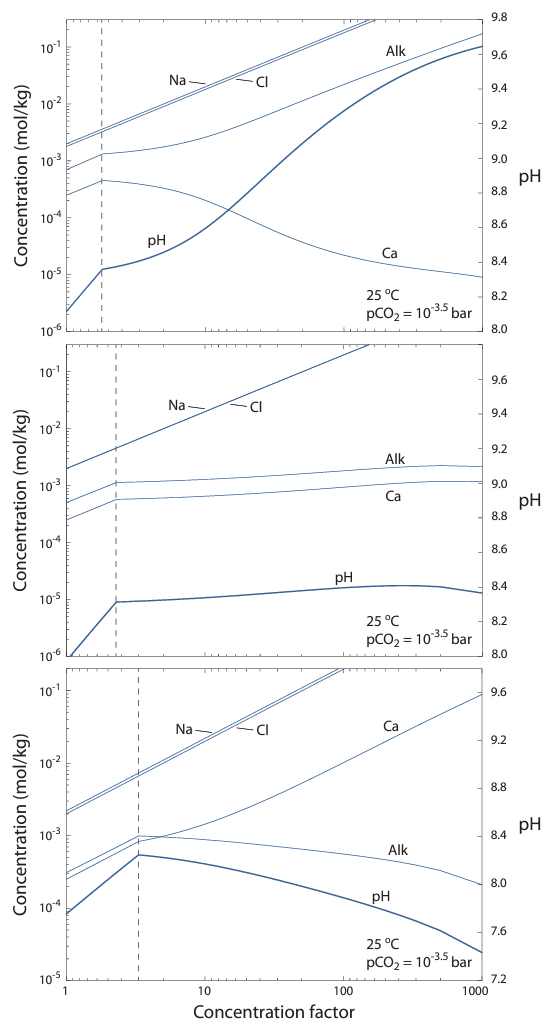
Fig. 4.72 The “calcite chemical divide”, commonly the first step in the generation of alkaline waters. (top) Evaporation of a dilute water with ALK > 2[Ca], where ALK indicates alkalinity. (middle) Evaporation of a dilute water with ALK = 2[Ca]. (bottom) Evaporation of a dilute water with ALK < 2[Ca]. Dashed lines indicate the onset of calcite precipitation. All calculations maintain equilibrium with atmospheric \(pCO_{2} = 10^{−3.5}\) bar and with precipitated calcite. From Tosca & Tutolo (2023).#
The chemical weathering of a large variety of different rocks and soils means that only certain types of waters fulfill this criterion. This is because as chemical weathering proceeds and minerals dissolve, pH increases which results in the transfer of gaseous CO\(_{2}\) to the solution, which results in alkalinity production. However, the amount of Ca\(^{2+}\) released may vary considerably depending on the type of minerals present.
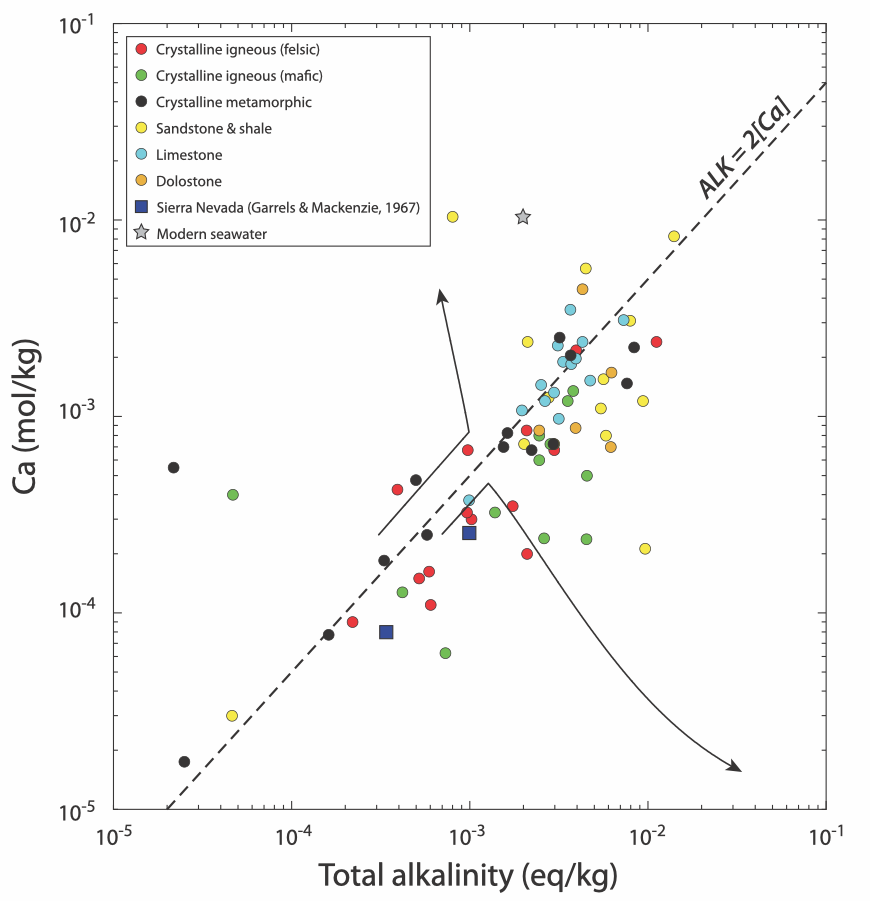
Fig. 4.73 Calcium and alkalinity for dilute subsurface waters formed from various aquifer lithologies. Black curves illustrate evaporation calculations shown in the figure above. From Tosca & Tutolo (2023).#
As waters continue to become extremely concentrated, their chemistry changes considerably as minerals crystallise. This results in a distinct deposit of salt minerals and brine chemistry that could vary considerably depending on the dilute water being evaporated, the concentrations of atmospheric constituents, as well as other factors.
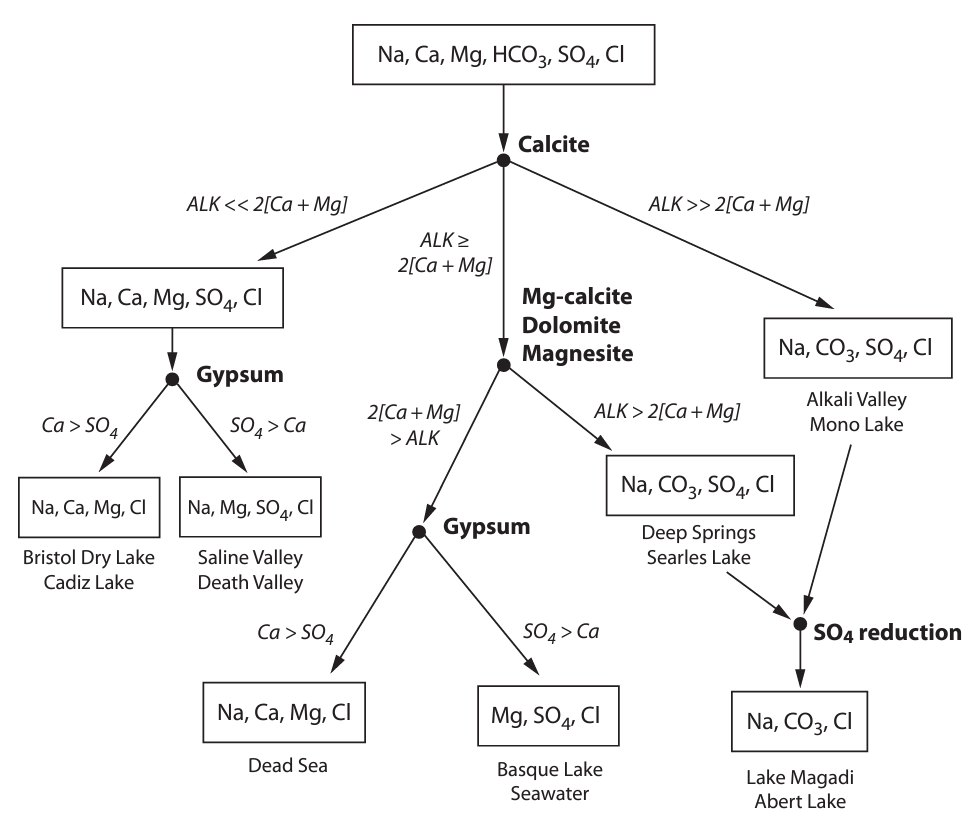
Fig. 4.74 Some possible paths for the evaporation of natural waters. Alkaline waters commonly precipitate Mg-carbonates although the timing of their formation depends largely on the Mg/Ca ratio in the fluid. Poorly crystalline hydrous Mg-silicates (not shown) also form in systems with sufficient dissolved silica, and are possible for most pathways, but the relative timing of their formation is principally dependent on the pH.#
Further reading#
Hurowitz, J.A., Catling, D.C., Fischer, W.W. High Carbonate Alkalinity Lakes on Mars and their Potential Role in an Origin of Life Beyond Earth. Elements 19, 37–44 (2023).
Sasselov, D. D., Grotzinger, J. P. & Sutherland, J. D. The Origin of Life as a Planetary Phenomenon. Science Advances 6, 1–13 (2020).
Toner, J. D. & Catling, D. C. Alkaline lake settings for concentrated prebiotic cyanide and the origin of life. Geochimica Cosmochimica Acta 260, 124–132 (2019).
Toner, J. D. & Catling, D. C. A carbonate-rich lake solution to the phosphate problem of the origin of life. Proc National Acad Sci 117, 883–888 (2020).
Tosca, N. J. & Tutolo, B. M. How to Make an Alkaline Lake: Fifty Years of Chemical Divides. Elements 19, 15–21 (2023).
Tosca, N. J. & Tutolo, B. M. Alkalinity in Theory and Practice. Elements 19, 7–9 (2023).