
2.7. Protoplanetary disks I: Formation and fragmentation#
Professor: Cathie Clarke (IoA)
Learning objectives:
Understand the formation of protostars aand their discs as inherited from the properties of dense molecular cores in the interstellar medium.
The molecular and dust inventory of molecular cores.
The angular momentum budget of molecular cores and the link to disk formation and multiple star formation.
Understand the conditions under which discs can fragment to form planetary mass objects.
Criteria for fragmentation.
Planetary migrationa nd accretion history in the self-gravitating regime.
From the interstellar medium to protoplanetary discs#
The interstellar medium (ISM) is composed of a mixture of gas (chiefly hydrogen) and dust grains (typically sub-micron in size) in the ratio of 100:1 by mass. This gas is a mixture of material left over from previous generations of star formation and elements that have been synthesized within stars and returned to the ISM. This dust-gas mixture forms the raw material from which stars and their planetary systems are formed.
Star forming gas is organized into Giant Molecular Clouds (GMCs), with masses that may exceed \(10^5 M_\odot\) . This gas is highly sub-structured and contains dense molecular cores (with masses of order a solar mass) which are gravitationally bound:
\( E_{pot} +E_{therm} + E_{turb} <0 \)
(i.e. the total of their gravitational potential energy, thermal energy and internal kinetic energy is negative). This requirement is met because the gas is dense (around \(10^5 \times \) denser than the average ISM) and cold (around a few \(\times 10\)K ), such low temperature being possible because the rest of the GMC shields cores from strong interstellar ultraviolet radiation fields.. Their internal (`turbulent’) motions are also weak (i.e. subsonic); these internal motions are however crucial for the formation of planetary systems because measurement of the velocity field within the cores, using the Doppler shifts of molecular emission lines at radio wavelengths, imply that cores are rotating.
We can crudely estimate the effect of this rotation on the evolution of the system: as a core collapses under its own gravity, the angular momentum of the core, \(J_c\), is conserved. The centrifugal acceleration associated with this rotation can be written (for a core of mass \(M_c\), radius R) as:
\( a_{cent} = \frac{J_c^2}{M_c^2 R^3} \)
so that it increases more strongly as the cloud collapses than does the inward acceleration due to gravity:
\( a_{grav} = {{GM_c}\over {R^2}}\)
Consequently there comes a point where collapse in the plane perpendicular to the rotation axis is halted. No such effects halt collapse parallel to the rotation axis. Consequently, an initially spherical core will collapse and form a centrifugally supported disc.
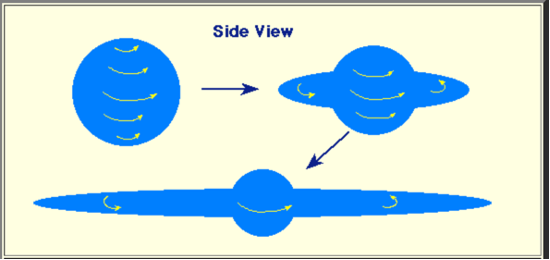
Fig. 2.39 Schematic of disc formation from a rotating cloud core#
We will explore in the next lecture how such a disc evolves, redistributing its mass and angular momentum so that `(almost) all of the mass ends up at the centre while the angular momentum is carried by a small fraction of the mass orbiting at large radius. The mass that ends up at the centre becomes the star (i.e. it collapses under its own gravity until it becomes self-luminous, first due to radiating away the gravitational energy of contraction and then as a result of the onset of nuclear fusion). The material that orbits at large radius corresponds to what is known as the protoplanetary disc, a flattened structure containing most of the core’s initial angular momentum. As this process of segregating the mass and angular momentum in the system proceeds, the mass of material in the disc decreases and accretes onto the central star. Consequently, protoplanetary discs are most massive near the beginning of their lifetimes (around \(10^5\) years after their parent core collapses) and then their mass gradually decreases until they become mainly undetectable (see below) after \(10^7\) years. The lack of significant masses of gas orbiting stars older than this implies that (at least gas giant-) planet formation occurs during this window of time (\(10^5-10^7\) years) but it is still unclear whether planets form early or late during this time frame.
Observational advances in the study of protoplanetary discs#
Observational evidence for discs around other stars was not forthcoming until the 1970s when the advent of infrared satellites showed young stars (already detected at optical wavelengths) were also bright in the infrared. Infrared emission suggested the presence of circumstellar dust but if this was in a spherical cocoon, the optical light would be completely blocked. Only disc geometry can simultaneously explain the fact that many young stars are observed to be bright at both optical and infrared wavelengths.
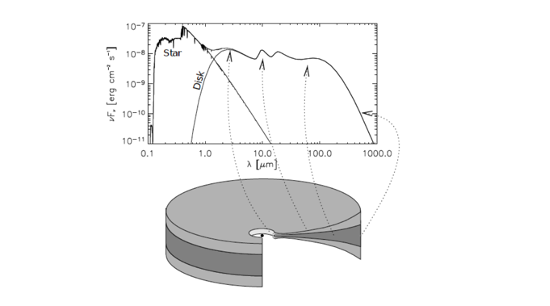
Fig. 2.40 Demonstration of how the spectrum from a star+disc system is generated#
The first actual images of discs were obtained serendipitously through optical studies of the Orion Nebula Cluster using the Hubble Space Telescope in the 1990s. Here discs showed up as dark silhouettes against the bright background nebula.
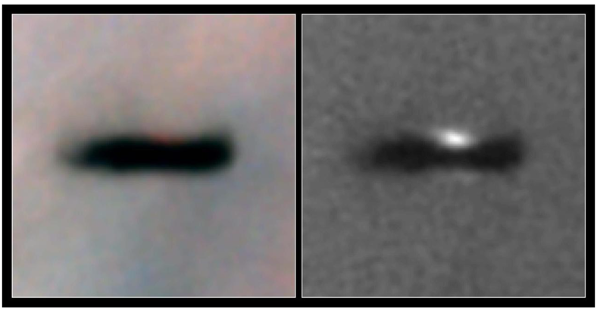
Fig. 2.41 Examples of the silhouette discs in the Orion Nebular Cluster observed by the Hubble Space Telescope. Credit: Mark McCaughrean#
Soon afterwards, discs were imaged in emission at radio wavelengths. Since such studies could measure not only the brightness of the emission but also how the Doppler shift of the emission lines varied across the image, it was also possible to directly prove that these discs are indeed `centrifugally supported’ (i.e. rotating at a rate such that gravitational and centrifugal effects are equal and opposite).
In this state we can write evaluate the circular velocity, \(v_c\), according to
\({{v_c^2}\over{r}} = {{GM_*}\over{R^2}}\)
where \(M_* \) is the mass of the central star. This value of \(v_c\) is known as the Keplerian speed:
\( v_{Kep} = \sqrt{{GM_*}\over {R}}\) which also governs the circular speed of planets. The top left hand panel of Fig. 2.42 illustrates a map of line of sight gas velocity in the HD 163296 disc using the Atacama Large Millimetre Array (ALMA: top right): the red-blue colour map indicates the region of the disc where the flow is away from/towards the observer and the magnitude of the velocities (measured from the Doppler shift) can be used to measure the mass of the star using the above formula.
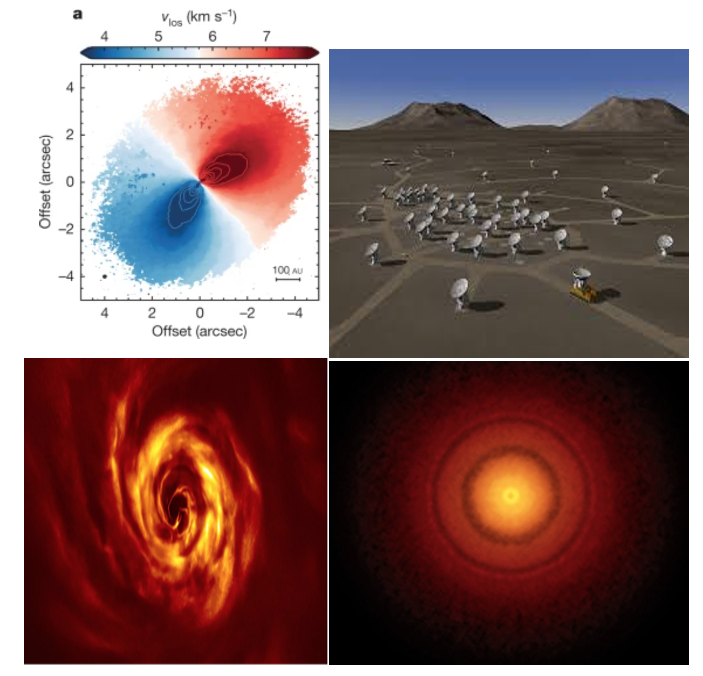
Fig. 2.42 Top left : velocity map measured with ALMA for disc in HD 163296 (Credit R. Teague). Top right: the ALMA array. Lower Left: The disc in AB Auriga measured in scattered light with the Very Large Telescope (VLT) of the European Southern Observatory (ESO) (Credit A. Boccaletti). Lower right: ALMA image of ring-like sub-structure in TW Hydra (Credit S. Andrews).#
The large spatial separation of the ALMA antennae produces excellent resolution, with a capability to resolve substructures in discs on scales as small as 1 AU. The resolving power of a telescope (i.e. the angular separation on the sky, measured in radians, at which two point sources can be separated) is given by
\( R={\lambda\over {D}}\)
where D is the antenna separation and λ is the wavelength of observation (which is around 1 mm in the case of ALMA ).
Such high resolution images of protoplanetary discs have, in the past decade, revealed a wealth of substructure in discs which are interpreted as being signatures of ongoing planet formation. The lower panels show some high resolution disc images where brighter regions (rendered yellow) denote regions of enhanced dust density or temperature.
The disc on the lower left in Fig. 2.42 shows evidence of pronounced spiral structure, apparently similar to that which is seen in images of galaxies. In hydrodynamical simulations, spiral structures are formed in situations where the disc’s self-gravity is important (i.e. where the disc is massive enough that the gas is influenced not only by the gravity of the star but of the disc itself). We shall shortly see that in some situations, the self-gravity of the disc can cause the direct fragmentation of the disc gas and dust into planets.
The disc on the lower right in Fig. 2.42 shows a more common class of sub-structured disc, i.e. where the disc displays a series of dark and bright rings The most popular interpretation is that the dark bands have been carved (i.e. swept clear of dust and gas) by the effect of orbiting planets. In most cases, the planets are not observed directly but simulations can be used to relate the width of the dark bands to the masses of the planets they contain. This exercise gives some crude estimates of the masses of planets and their locations within protoplanetary discs.
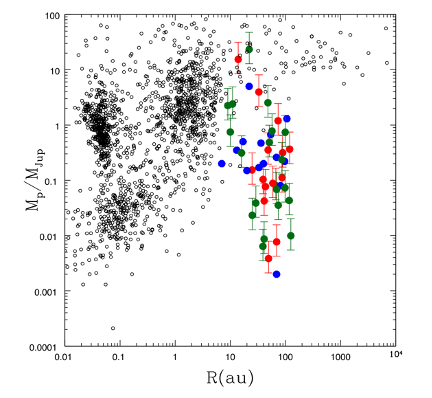
Fig. 2.43 Comparison of orbital properties of exoplanets around mature stars (black) and those inferred in protoplanetary discs from the presence of ring-like substructure. (Credit: G. Lodato).#
Interestingly, these inferred young planets (shown as coloured symbols in the mass orbital radius plane in Fig. 2.43 above) occupy a quite different region of parameter space from the planets found in exoplanet surveys around mature stars (shown in black). Young exoplanets are apparently less massive than those found in older stars at the same orbital radii. It is possible that these inferred Saturn mass planets migrate inwards and form the population of Saturn mass planets detected in old stars at separations of < 1 AU. This is not necessarily the case however, since imaging surveys around older stars would simply not be able to detect a population of Saturn mass planets at 10s of AU. It is an open question therefore how far planets move from their formation sites.
Spiral Structure and the Role of Disc Self-Gravity in Planet Formation#
We now turn back to the issue of how material that is orbiting in a Keplerian disc can collapse under its own gravity and form a protoplanet. Here we need to consider the forces acting on a patch of gas. The gravitational forces generated by such a patch encourage its collapse but this is opposed by two effects.: an outwardly directed pressure force as the gas is compressed and an outwardly directed centrifugal force. It is possible to derive a formal criterion for the gas to be gravitationally unstable by performing a linear stability analysis to find the disc conditions for which perturbations grow exponentially. For a region of the disc where the sound speed is \(c_s\) , the surface density is \(\Sigma\) and the angular velocity is \(\Omega\), the criterion for gravitational instability (GI) is such that the Toomre Q criterion:
\( Q= {{c_s \Omega}\over{\pi G \Sigma}} < 1 \)
The physical content of this expression is linked to the above discussion about stabilization by pressure and centrifugal force (depending respectively on \(c_s\) and \(\Omega\) ) and de-stabilization by self-gravity, dependent on \(\Sigma\). These quantities appear respectively on the numerator and denominator of the definition of \(Q\).
The form of \(Q \) implies that gravitationally unstable discs are cold and dense; high density conditions (and hence instability) are associated with the early stages of protostellar evolution when the disc contains a large fraction of the mass of the parent core .The disc AB Auriga (lower left panel in Fig. 2.42 ,which shows pronounced spiral structure, is only 2 Myr old, as compared to the ~ 10 Myr old disc TW Hydra (right panel) which contains smooth annular structures . It may well be the case that planets are still forming in AB Auriga but have already formed in TW Hydra.
In practice, if Q > 1 planet formation by GI is impossible. For a region with \(Q <1\) , the action of the instability is to heat the disc so that it achieves a condition of marginal stability (Q ~ 1) in which, however, it does not necessarily fragment. Numerical simulations show that in this case , whether a disc can (or cannot) fragment depends on the ratio of the disc’s cooling timescale to the local dynamical time. (This is because collapse `wants’ to occur on a dynamical time but this requires that compressive heating generated by the collapse can be radiated away fast enough to stop pressure gradients halting the collapse). In practice, the requirement of a low ratio of cooling timescale to dynamical timescale is met only in the outermost parts of protoplanetary discs, at radii greater than 50 A.U..
We can also estimate the mass of a planet that could be formed by fragmentation of a gravitationally unstable disc \(M_{frag}\). In addition to the criterion concerning cooling time (which imposes the above restriction on where in the disc such planets are formed), a region that can collapse must have a size \(L\) such that the gravitational collapse timescale, \(t_{coll}\) is less than the sound crossing time of that region, \(t_{c_s}\):
\(t_{c_s} ={{L}\over {c_s}}\).
We can show by dimensional analysis or otherwise that
\(t_{coll} = \left(\frac{L}{G \Sigma}\right)^{0.5}\)
and we therefore require
\( L > {{c_s^2}\over {G \Sigma}} \)
with a corresponding mass scale
\(M \sim \Sigma L^2 \sim {{c_s^4}\over{G^2 \Sigma}} \)
We can rearrange this using the criterion that Q=1 for a gravitationally unstable disc; furthermore substituting values for the Keplerian velocity (\(= R \Omega\)) we arrive at
\( M_{frag} \sim \biggl({{c_s}\over{v_c}}\biggr)^3 M_*\)
This simple formula is important for evaluating the masses of planets formed via GI. At 100 AU from a solar mass star, \(v_c\) ~ 3 km/s; with a typical temperature of ~ 20 K and corresponding sound speed ( ~ 0.3 km/s); in this case \(M_{frag} \sim 10^{-3} M_\odot\) , i.e. around a Jupiter mass. Since a fragment is likely to accrete further gas from the surrounding disc, this is a lower limit to the mass of planets formed by GI. We thus conclude that GI can form objects in the mass regime of gas giant planets (or, if > 13 Jupiter masses, brown dwarfs) and that, in the absence of planetary migration, these objects should be found at > 50 AU.
We will later see that direct imaging of main-sequence stars implies that only a few percent of stars host such giant planets at these orbital radii. At face value, this would suggest that GI is a minor planetary formation mechanism. However simulations show that planets that form at such radii migrate very rapidly inwards, since they are subject to strong torques from spiral arms in the disc. Migration times can be less than 0.1 Myr (i.e. well within the lifetime of the disc). Therefore it is possible that GI + migration may be the formation route for gas giant planets at small orbital radii. It is however hard (without further information about planetary composition) to establish whether this is the case.
SUMMARY:#
Discs (of gas and dust in original ratio 100:1) form around young stars because of the finite angular momentum of the dense molecular cores which are the direct progenitors of young stars.
Discs are commonly observed using millimeter wave interferometry (ALMA) and are found to extend over 10s to 100s of AU from the parent star.
ALMA has revealed annular gaps in discs which may be interpreted as being swept by planets. The inferred masses and locations of gap creating planets occupies a parameter space not probed by planet searches around mature (main-sequence stars).
A minority of discs show strong spiral structure and this is more prevalent in younger systems. Discs that are massive enough to be self-gravitating can form gas giant planets by direct collapse in the outer disc. These planets may migrate inwards and contribute to the gas giant population observed at small radii in older exoplanet populations.
Bibliography#
Kratter, K. & Lodato, G. 2019, Gravitational instabilities in circumstellar discs. Ann. Rev. Astron. Astrophys. 54,271
Rosotti, G. et al 2016, The minimum detectable mass of planets in protoplanetary discs and the derivation of planetary mass from high resolution observations MNRAS 459,2790
Ward-Thompson, D. & Whitworth, A.: An introduction to star formation (Cambridge University Press)