2.12. Debris Disks II: Late Delivery#
Professor: Mark Wyatt (IoA)
Learning objectives:
The probability of debris disk material being accreted onto a planet.
The likely composition and size distribution of the accreted material.
Gas in debris discs as a tracer of volatile composition.
Implications of impacts for the planet (effect on atmosphere, delivery of volatiles and highly-siderophile elements).
Debris disks as a tracer of giant impacts.
The aim of this lecture is understand how a star’s debris disk might influence the conditions on a planet at various points in its evolution.
Outcome of interactions with a planet#
When material from the debris disk ends up on an orbit which may intersect with a planet, the outcome of their potential interactions is probabilistic. The dominant outcome after multiple interactions with the same planet as a function of that planet’s properties is shown in Fig. 2.75 (see Wyatt et al. 2017). The line at which the planet’s escape velocity equals its orbital velocity divides outcomes in which the debris primarily ends up being accreted onto the planet (close to the star) and those in which the debris ends up being ejected from the star (further away). This shows that it is hard to grow a massive planet by accretion of small bodies at large distances from the star, since accretion is inefficient, but that planets close to the star are very efficient at accreting the debris in their vicinity.
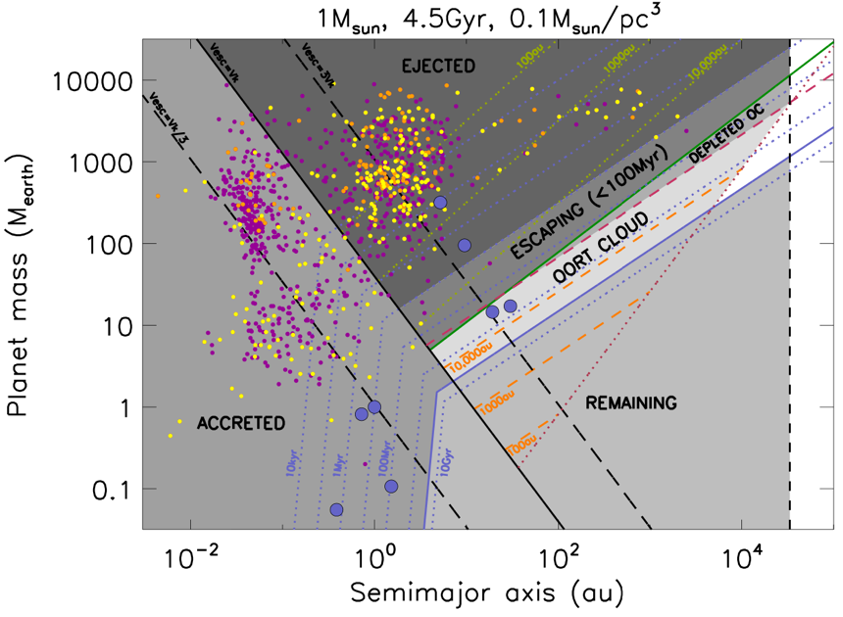
Fig. 2.75 The dominant outcome for debris interacting with a planet on a circular orbit is shown with different shading: it can be “accreted” onto the planet or “ejected” from the planetary system, both interactions could take longer than the age of the system (“remaining”), or the debris could be implanted in the “Oort Cloud”. The coloured dots show known exoplanets or Solar system planets.#
Outcome of planetary impacts#
For the material which is accreted by the planet, its effect on the planet is determined by its size and its impact velocity, since these determine the energetics of the impact (see Wyatt et al. 2020). For example, with our own eyes our experience of watching shooting stars tells us that small enough objects will distintegrate and be incorporated into the planet’s atmosphere. The existence of craters on the Earth shows that larger objects can reach the ground intact, and the example of the dinosaurs shows that this can have devastating consequences for life on the planet. The presence of the Earth’s moon shows that the largest impacts suffered by planets can have even greater global consequences, and can lead to a significant fraction of the impactor being lost by the planet.
A rule of thumb is that impactors smaller than km-size are accreted while larger ones are not. Also, those most efficient at removing mass from a planet’s atmosphere are ~km in size, since smaller bodies do not deposit enough energy in the atmosphere to unbind it, while larger bodies are efficient at removing atmosphere, but only locally to the impact site. Overall when a planet undergoes bombardment from a debris disk its atmosphere could either grow (due to the volatile component of the accreted bodies becoming incorporated into a secondary atmosphere) or deplete, depending on the size distribution of the impactors.
Debris disk size distribution and mass#
What we know about the size distribution of material in a typical debris disk is summarized in Fig. 2.76 (see Wyatt & Dent 2002). This illustrates how observations, which probe dust, are only able to constrain the size distribution in the range of a few \(\mu\)m to a few cm. Larger bodies are in general not required to explain the observations, except in that the collisional lifetime of the cm-sized bodies is usually much shorter than the age of the star and so it is inferred that the collisional cascade must extend up to larger bodies. However, this extrapolation is uncertain, and while it might be inferred that bodies of at least a few km are present to explain the persistence of debris in the face of collisions over ~1Gyr of evolution, there is no information from observations on any even larger bodies which must retain their primordial size distribution. Nevertheless, it is reasonable to consider that the debris disk does not contain \(\gg 100M_\oplus\) of material, since that would exceed the mass available in the protoplanetary disk (Krivov & Wyatt 2021).
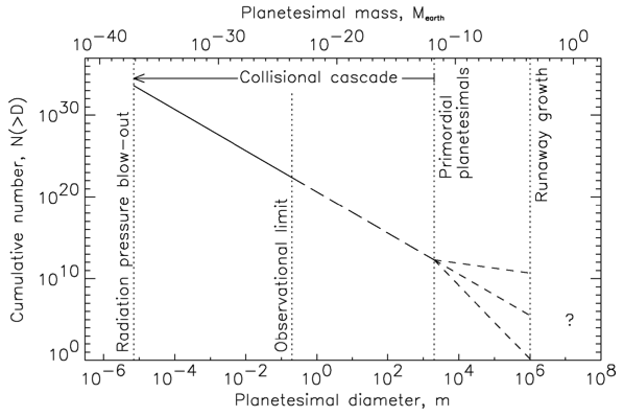
Fig. 2.76 What we know about the size distribution of material in a typical debris disk. The component from a few \(\mu\)m to a few cm can be constrained observationally, while that of larger bodies is an uncertain extrapolation.#
Debris disk composition#
It is straight-forward to envisage from lecture 2.11 how a very crude spectrum with two points on an SED can give the luminosity of a debris disk from which to extract its total cross-sectional area in dust (i.e., \(\sigma_{\rm tot}\)). To create Fig. 2.76 the slope in the size distribution as well as the smallest dust size were also needed, and this can also be gleaned from the SED, but this requires of order 10 datapoints and an image from which to determine the radial location of the dust. These inferences are possible because small dust is inefficient at emitting radiation at wavelengths longer than its size, which causes a departure of the spectrum from a pure black body shape, and causes the emission to be hotter than black body. The amount which the emission is hotter than black body can be inferred by comparing the true disk radius with that inferred from its SED temperature, which is set by the smallest and so hottest dust.
Encoded in the SED is also information about the composition of the dust. Indeed the dust composition contributes to the shape of the SED and so any inferences about the size distribution are degenerate with the composition to some extent. Clues to the dust composition can be gleaned from the scattered light colours of the dust, but these inferences too are degenerate with the dust size. The best way to constrain dust composition is through a high resolution spectrum, if this reveals solid state features (see Fig. 2.77 left; Lisse et al. 2009). For example, the silicate features at around \(10\mu\)m wavelength can be used to infer that silicates are present in some form and that these must be in dust smaller than \(10\mu\)m for the feature to be visible. The shape of the spectrum can be used to ascertain the amorphous vs crystalline nature of the silicates, and in some cases the presence of silica can be inferred, which is particularly telling since it is expected to be created in hypervelocity impacts (see Fig. 2.77 right).
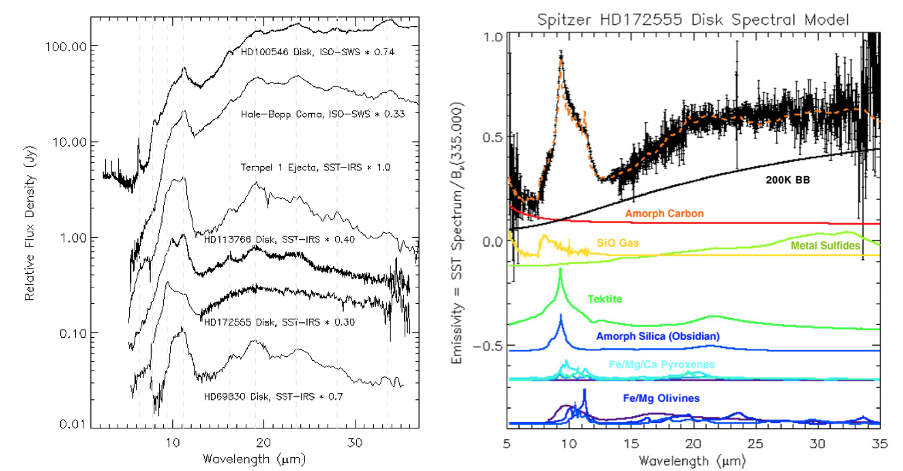
Fig. 2.77 Infrared spectra of debris disks (left) and the modelling of the spectral features in one system to extract the dust composition showing this to have a significant component of silica (right).#
While the \(10\mu\)m silicate feature is very informative, by its very nature it requires detectable emission in the mid-IR, which means that it must be associated with hot dust which is rarely seen, or when detected found to be at low levels relative to the star making a spectrum problematic to obtain. There are also solid-state features at longer wavelengths, and the shape of a forsterite feature at \(69\mu\)m has also been used to infer the Mg vs Fe content of the silicates (de Vries et al. 2012).
Debris disk volatile content#
A debris disk’s volatile content is of particular relevance to planetary habitability, e.g., since cometary impacts (or impact with asteroids that are not completely dry) may have delivered Earth’s oceans. In extrasolar debris disks information on their volatile content comes from an unexpected source: the study of circumstellar gas. The detection of circumstellar gas itself was unexpected since the mantra used to be that debris disks are the gas-poor counterparts to protoplanetary disks (e.g., Wyatt et al. 2015). It is not just that protoplanetary disk gas is expected to be rapidly dispersed, but also that CO is the dominant tracer of gas in a protoplanetary disk and this molecule only survives ~120yrs in the interstellar radiation field before being photodissociated. It persists in a protoplanetary disk due to the high optical depths therein meaning that the molecule is shielded. However, in an optically thin debris disk the molecule should be short-lived and so had not been expected to be present at detectable levels. And yet it was detected in abundance towards \(\beta\) Pictoris (see the images of \(\beta\) Pictoris from lecture 2.11), implying CO is being produced at a rate of \(\sim 0.1M_\oplus/\)Myr. Subsequently CO has been detected towards many other debris disks.
The explanation for this debris disk gas is that it is secondary in origin (e.g., Kral et al. 2017). That is, the planetesimals are not just lumps of rock, but also contain water ice and other volatiles like CO and CO2, just like Solar system comets. If these volatiles are assumed to be released and converted into gas as mass is passed down the collisional cascade, whether that be by heating in the collision or photodesorption by subsequent interaction with stellar radiation, then the rate at which mass is processed in the cascade (which can be inferred from observations of the dust) can be compared with the production rate of gas, to determine the volatile fraction of the planetestimals. The resulting inferences have large uncertainties, but they are consistent with the planetesimals in extrasolar Kuiper belts having a composition similar to Solar system comets. Searches for other molecules (like those seen in comets) have been carried out, but unsuccessfully, likely due to the even shorter lifetime of such molecules due to photodissociation.
Once the CO has photodissociated into C and O, that gas accumulates and viscous processes cause it to spread from the planetesimal belt, eventually to be accreted onto the star. This atomic gas disk has also been detected, and an overabundance of O relative to that expected from CO photodissociation alone was used to infer the water content of the planetesimals (again to be similar to Solar system comets). This gas disk is pertinent, since it would be viscously spreading through the planetary system, and so some of the volatile content of a planetesimal belt may end up being accreted onto those planets in gaseous form, thus altering their composition or replenishing a secondary atmosphere (e.g., Kral et al. 2020).
There have been challenges to the above explanation of circumstellar gas, for example from the few debris disks with very high quantities of CO, approaching protoplanetary disk levels. It was suggested that this gas could be a primordial remnant of the protoplanetary disk. This would have significant consequences for our understanding of protoplanetary disk dispersal and remains a possibility (e.g., Wyatt et al. 2015). However, the high gas levels have also been shown to be consistent with secondary gas production, since if gas is produced at a high enough rate then the CO can be self-shielded, or shielded by the C by-product.
Giant impacts#
There is abundant evidence for giant impacts in the Solar system’s history. The Earth’s moon is thought to have formed in an impact ~50Myr after the Earth formed. Mercury’s high density is thought to arise from a hit-and-run collision which stripped off its mantle. Giant impacts may also explain Mars’ hemispheric dichotomy, Uranus’ tilt and the Pluto-Charon system. Such giant impacts are also expected as part of planet formation models wherein planets grow in their final stages (over 10s of Myr) in collisions amongst planetary embryos. The exoplanet population also supports a giant impact phase, e.g., through the orbital distribution of planets and their proximity to resonance with each other (e.g., Li et al. 2024).
There is also evidence for giant impacts in the debris disk population, because while the impact is certain to have an effect on the planet (e.g., through altering the mass or chemistry of its atmosphere), there will also be a significant quantity of material that becomes unbound from the planet (e.g., Wyatt & Jackson 2016). This debris will form a collisional cascade which will ultimately either reaccrete onto the planet or be collisionally ground down into small dust that is ejected from the system. For reasonable assumptions about the size distribution of debris created in the impact, including vapour condensates, this debris is readily detectable, and can remain so for 10s of Myr. This gives astronomers an opportunity to witness the aftermath of such events, and to estimate their frequency.
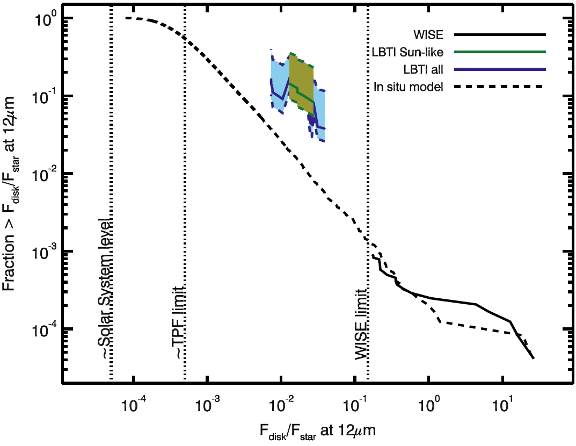
Fig. 2.78 The exozodi luminosity function, i.e., the fraction of stars with fractional excesses at \(12\mu\)m (\(F_{\rm disk}/F_\star\)) above a given level. This has been characterized photometrically for bright excesses with WISE (Kennedy & Wyatt 2013), and for fainter excesses by LBTI (Ertel et al. 2018).#
Fig. 2.78 shows the exozodi luminosity function, which can be interpreted as the fraction of stars with dust levels in the habitable zone above a given level. This shows how photometric studies with WISE found bright excesses towards 1:\(10^4\) stars. These are found predominantly around stars in the 10-100Myr age range, exactly when giant impacts are expected to occur. In some systems there is further evidence for this interpretation, such as the silica composition inferred for the dust (see Fig. 2.77 right) or the detection of circumstellar CO which is thought to be a stripped exoplanetary atmosphere.
Another method for identifying giant impact debris is to search for variability in a star’s infrared emission. This is because the short orbital and collisional timescales mean that variability can be expected to be observed on year timescales or shorter. In this way 10s of stars, all of which <100Myr old, have been found to be variable in ways that characterize the complex and evolving nature of this debris (see Fig. 2.79). In some systems the collisional debris is inferred to pass in front of the star, creating a transit event, allowing further characterization of the debris.
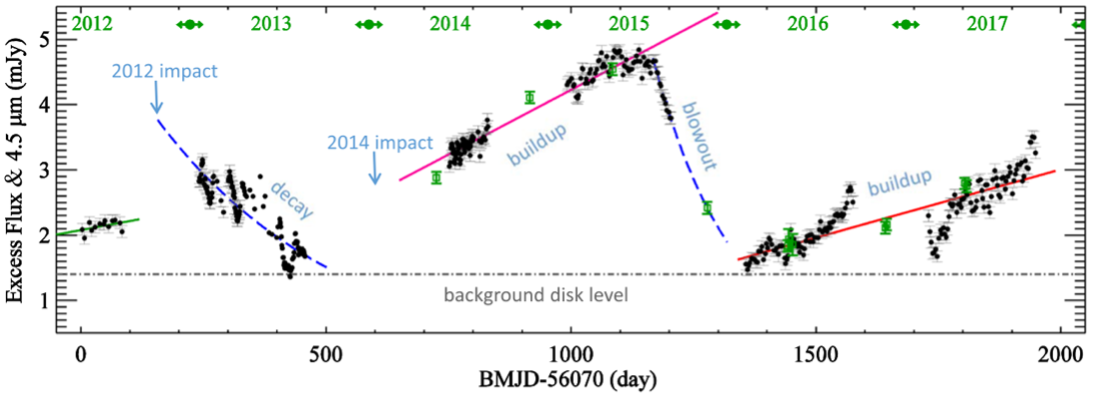
Fig. 2.79 Evolution of the infrared emission towards the star ID8 which is inferred to be undergoing multiple giant impacts in its debris disk (Su et al. 2019).#
Implications for life#
Planets are unlikely to evolve in isolation. Rather they will undergo bombardment from their debris disk throughout that evolution. That bombardment may have taken the form of giant impacts early in the planet’s evolution (up to 100Myr), but bombardment from outer debris will have continued throughout as well. Material may be accreted in the form of planetesimals, which could deplete an atmosphere and deliver ingredients to the planet. It could also be accreted in the form of dust or gas. The composition of material accreted will depend on its origin, but Solar system comets provide a good starting point for consideration of debris in exo-Kuiper belts.
References#
de Vries B. L. 2012, Nature, 490, 74
Ertel S. et al. 2018, AJ, 155, 194
Kennedy G. M., Wyatt M. C. 2013, MNRAS, 433, 2334
Kral Q. et al. 2017, MNRAS, 469, 521
Kral Q. et al. 2020, Nature Astronomy, 4, 1009
Krivov A. V., Wyatt M. C. 2021, MNRAS, 500, 718
Li R. et al. 2024, arXiv:2408.10206
Lisse C. M. et al. 2009, ApJ, 701, 2019
Su K. Y. L. et al. 2019, AJ, 157, 202
Wyatt M. C., Dent W. R. F. 2002, MNRAS, 334, 589
Wyatt M. C. et al. 2015, Ap&SS, 357, 103
Wyatt M. C., Jackson A. P. 2016, SSRv, 205, 231
Wyatt M. C. et al. 2017, MNRAS, 464, 3385
Wyatt M. C. et al. 2020, MNRAS, 491, 782