
4.11. Detecting Biosignatures I#
Lecturer: Savvas Constantinou (Institute of Astronomy)
Key Concepts:
Definition of biosignature
Types of biosignatures including atmospheric and surface biosignatures
Properties of an ideal biosignature gas
Classification of primary and secondary biosignature gases with notable examples
Assessment framework for a biosignature detection
Detecting life elsewhere requires the measurement and inference of aspects of a habitable environment that are produced by life. Such detectable environmental aspects are known as biosignatures. Detecting a biosignature poses a twin challenge. The first is identification, determining what environmental aspect can be considered a biosignature. The second is measurement, i.e. obtaining data of sufficient quality to enable the inference of a biosignature. We will first consider the challenge of identification, establishing what kinds of biosignatures we can look for and how to assess their detection. As the only known example of life is that on Earth, all biosignatures are inevitably motivated by their occurrence on Earth.
Types of Biosignatures#
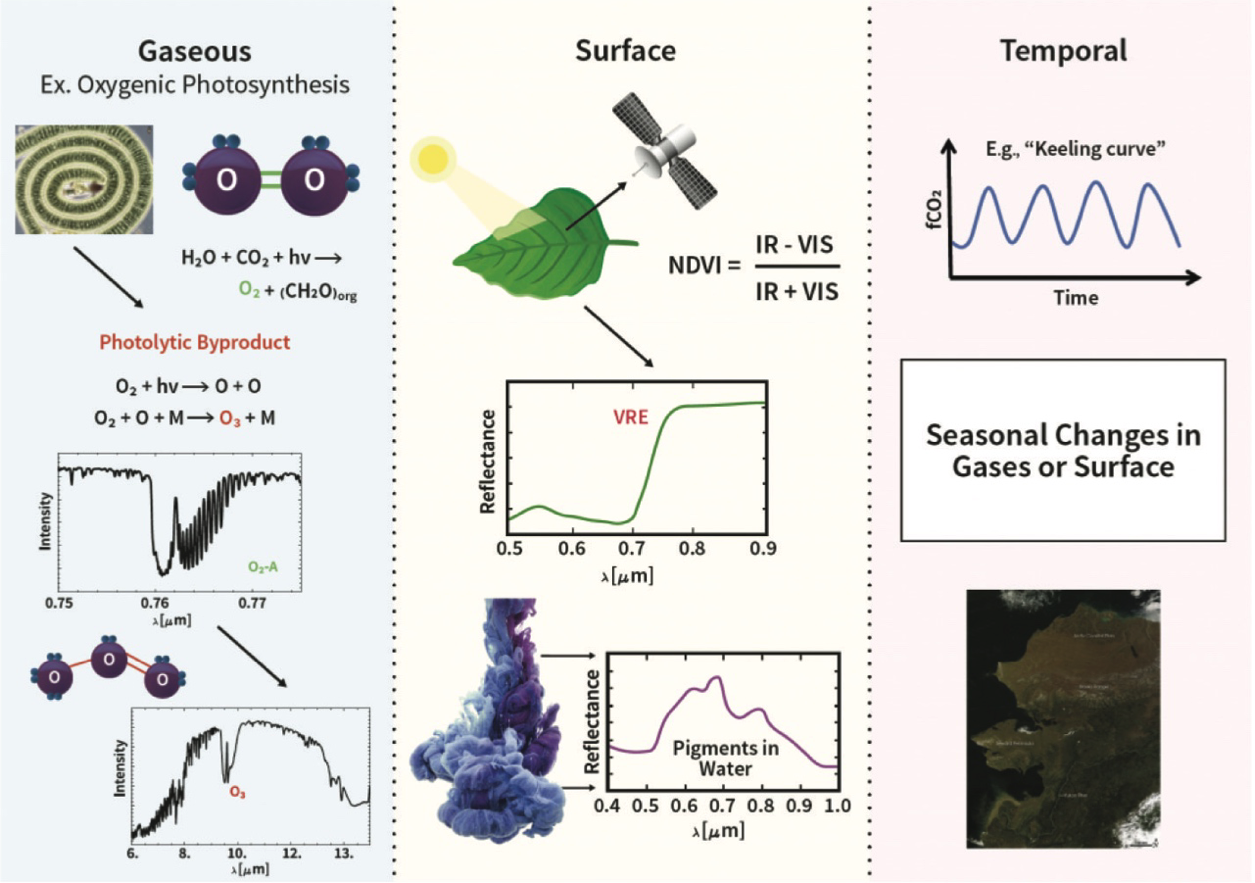
Fig. 4.83 Summary of several biosignature categories (Schwieterman & Leung 2024).#
As defined above, a biosignature is any aspect of a habitable environment that is the product of life. As such, biosignatures can be categorised by which aspect of the habitable environment is affected. The most observationally accessible are atmospheric biosignatures, i.e. changes in the properties of the planetary atmosphere caused by life. Such atmospheric biosignatures include the presence of biogenic gases, known as biomarkers. Other atmospheric biosignatures can include the absence of specific species from the atmosphere, or changes to the abundance ratios of certain species.
Life can also significantly affect the the planetary surface, giving rise to surface biosignatures. Based on the case of Earth, the most prominent surface biosignature is expected to be the selective absorption of incident starlight by chlorophyll in vegetation. This gives rise to a so-called ‘red edge’ in the reflected light spectrum, arising from chlorophyll absorbing red light, between ~0.65-0.7µm and reflecting longer wavelength light at ~0.7-0.75µm (Seager & Ford 2005).
Beyond the above steady-state biosignatures, temporal biosignatures are time-dependent variations in environmental properties arising from life (Schwieterman & Leung 2024). On Earth, \(\sf O_2\), \(\sf CO_2\) and \(\sf CH_4\) vary over the span of a year due to variation in the growth and decay of vegetation and aquatic organisms.
Lastly, technosignatures are any aspects of the environment that is the result of technology constructed by sentient life. This can include radio emissions produced by life, which have been the focus of SETI surveys, as well as atmospheric gases like chlorofluorocarbons. Unlike the above biosignatures which be the product of even unicellular life and were present on Earth for millenia, technosignatures necessitate sufficiently advanced sentient life corresponding to only the last few thousand years of Earth’s history.
From hereon, our focus will be on atmospheric biosignatures and in particular biosignature gases. As such, all subsequent references to ‘biosignatures’ are for biosignature gases unless otherwise noted.
Properties of an Ideal Biosignature Gas#
A planetary atmosphere is comprised of a large number of chemical species. In the case of Earth, atmospheric species are produced and consumed by an immense variety of processes including life. This means that while many prominent and trace species are the products of life, many are not, while others are the result of both biotic and abiotic processes. This places several important requirements when determining whether a given chemical species can be a biomarker:
No abiotic sources,
Produced in large enough quantities to be detectable,
Gives rise to strong spectral features to be observable.
In the case of Earth, the most prominent gases that satisfy the above three criteria are oxygen (\(\sf O_2\)), its photochemical derivative ozone (\(\sf O_3\)) and nitrous oxide (\(\sf NO_2\)). However, care must be taken when extending the modern-day Earth scenario to extraterrestrial settings. For instance, terrestrial planets orbiting smaller, cooler M dwarf stars can have \(\sf O_2\) in their atmospheres from abiotic origins as demonstrated by Meadows 2018.
Primary and Secondary Biosignature Gases#
Biosignature gases may be considered under two broad categories (Seager 2012), depending on how they are produced by life. Primary biosignature gases are the products of basic metabolic functions. Such gases include \(\sf O_2\) from photosynthesis, \(\sf CO_2\) from respiration and \(\sf CH_4\) from methanogenic bacteria. As they arise from primary metabolic processes shared across many forms of life, such primary biosignature molecules are generally simple and can be present in significant quantities in the atmosphere. However, as discussed below, such species can also be produced via abiotic pathways, depending on the environmental context.
Secondary biosignature gases meanwhile are gases produced by secondary metabolic processes, such as those related to stress or fitness. They are not expected to be as abundant as primary biosignatures, and often are more chemically complex. Such gases include Dimethyl Sulfide (DMS), Methyl Chloride and Methanethiol. Most importantly, such molecules are often exclusively produced by life, as discussed below.
Important Examples of Primary Biosignature Gases#
We now consider several primary biosignatures, including their production pathways on Earth and whether they are robust biosignatures for different environmental contexts.
\(\sf O_2\): Molecular oxygen is highly prominent in the Earth’s atmosphere, at a volume mixing ratio of 21%. It is a product of oxygenic photosynthesis, i.e. the redox reaction between \(\sf H_2O\) and \(\sf CO_2\) in the presence of starlight to produce sugars and \(\sf O_2\). As \(\sf O_2\) lacks any significant known abiotic source in Earth-like environments, its detection in another planet’s atmosphere is indicative of the presence of photosynthetic life. Lastly, \(\sf O_2\) has a strong spectral feature at 0.76µm and weaker infrared features at 1.3 and 1.6µm. At first glance, \(\sf O_2\) seemingly satisfies all three critera for an ideal biomarker. However, some studies have demonstrated that in planetary environments different than Earth’s, \(\sf O_2\) may be produced abiotically as well. As such, the reliability of \(\sf O_2\) as a biomarker hinges on whether we can confidently establish that the observed environment is indeed Earth-like.
\(\sf O_3\): Ozone is a direct photochemical product of \(\sf O_2\) at the upper reaches of the Earth’s atmosphere. An \(\sf O_3\) detection therefore would indicate that \(\sf O_2\) is present lower down in the atmosphere. Notably, \(\sf O_3\) has much stronger spectral features than \(\sf O_2\) in the ultraviolet, visible and infrared. Being a direct product of \(\sf O_2\), \(\sf O_3\) suffers from the same problem of only being a robust biosignature in Earth-like environments.
\(\sf CH_4\): Methane has been a prominent biogenic gas in the Earth’s atmosphere from a very early stage, over 3.5 Gyr ago. Notably, \(\sf CH_4\) predates the existence of \(\sf O_2\) in the atmosphere, which became prominent in the Earth’s atmosphere in the Great Oxygenation Event 2.5 Gyr ago. \(\sf CH_4\) is produced by methanogens, considered some of the first forms of simple microbial life on Earth which today thrive in anoxic environments. They can be found in terrestrial and aquatic environments (e.g. swamps) as well as in the digestive tracts of certain animals, especially ruminants (e.g. cows). \(\sf CH_4\) has especially strong spectral features, and as of a year ago has been detected in temperate exoplanets. As such, while \(\sf CH_4\) meets most of the requirements for an ideal biosignature, it can also be produced by abiotic mechanisms, such as serpentinisation on Earth or atmospheric thermochemistry in the \(\sf H_2\)-dominated atmospheres of the exoplanets mentioned above as well as the very early Earth. Much like \(\sf O_2\) and \(\sf O_3\), whether \(\sf CH_4\) can be used as a robust biosignature hinges on a detailed consideration of the overall environmental context it is found in.
\(\sf N_2O\): Nitrous oxide stands as the most robust primary biosignature gas. It produced by microorganisms participating in the Nitrogen cycle, besides anthropogenic sources. Elemental nitrogen is an important bioessential element, but the vast majority is locked in comparatively unreactive \(\sf N_2\) gas which is unavailable to most organisms. Specific microorganisms convert \(\sf N_2\) to other nitrogen-bearing species which are assimilated into other biota and ultimately released into the atmosphere as \(\sf N_2\) and other byproducts including \(\sf N_2O\). There are some minor abiotic mechanisms by which \(\sf N_2O\) may be formed, such as lightning, but they are not expected to be significant. \(\sf N_2O\) is present in the Earth’s atmosphere at a ~0.3ppm level, but it is very spectrally prominent especially in the infrared, as attested to by its significant contribution to greenhouse warming.
Important Categories of Secondary Biosignature Gases#
Unlike primary biosignature gases, which are the product of ecologically important reaction pathways such as photosynthesis and nitrogen fixation, secondary biosignature gases are products of secondary metabolic processes that are not as universal and productive. As such, there is an immense variety of candidate molecular species, but large numbers may not necessarily be present in significant enough abundances to be detectable. Much work has been undertaken to determine what molecules may be promising biosignatures (e.g. Seager 2016). While an exhaustive list is beyond the scope of this course, below are several key caterogies of such molecules:
Sulfur-bearing species: Several sulfur-containing molecular species have been identified as promising biosignatures. One such example is dimethyl sulfide (DMS), which is the dominant sulfur-carrier in the Earth’s atmosphere. DMS is produced by microorganisms in terrestrial and aquatic environments, including phytoplankton. On Earth, DMS is also a key provider of nucleation centres for cloud formation (i.e. cloud seeding), which in turn affects the planetary albedo and climate. Other organosulfur molecules that are exclusively produced by life on Earth are dimethyl disulfide (DMDS) and methanethiol (\(\sf CH_3SH\)). While such sulfur-bearing species are present in relatively low concentrations, they give rise to strong spectral signatures rendering them potentially detectable. These species are also photochemically fragile, which means that their detection would imply a significant continuous production by life. Most notably, there have been tenative indications that DMS might be present in the atmosphere of the habitable-zone sub-Neptune planet K2-18b (Madhusudhan 2023).
Methylated halogens: Molecules such as methyl chloride (\(\sf CH_3Cl\)) and methyl bromide (\(\sf CH_3Cr\)) are uniquely associated with biological processes. In the Earth’s atmosphere, such species are typically present at the ppb level, but like the above sulfur-bearing species they have strong spectral signatures in the infrared. These molecules also have no significant abiotic sources on Earth and are considered to be good biosignatures in exoplanetary environments where they could be present in higher abundances.
\(\sf PH_3\): Phosphine on Earth is uniquely associated with microbial life, typically present at a ppm level. The specific biochemical pathway for its formation however is still not well understood. Like the above sulfur-bearing species, \(\sf PH_3\) is readily consumed in photochemical processes. For oxygen-poor environments like the early Earth and several proposed types of habitable exoplanet (e.g. hycean planets) \(\sf PH_3\) can be longer lived but in these cases may also be produced abiotically. As such its viability as a biosignature is reliant on the environmental context it is found in.
Towards a Biosignature Detection#
For many of the molecular species discussed above, their utility as biosignatures hinges on a robust understanding of the environment they are found in. Robustly determining that life elsewhere has been found therefore necessitates both a highly confident detection of a biosignature molecule, as well as a thorough characterisation of the planetary atmosphere, surface and internal structure, which may be significantly different than Earth.
In the next lecture we will consider how the atmosphere of a habitable exoplanet can be detected and characterised with current state-of-the-art techniques and the detectability of biosignatures. We will consider both what is currently detectable with present facilities as well as proposed future observatories.
Acknowledgements#
The present material is largely based on and adapted from Madhusudhan 2025, Encyclopaedia of Astrophysics, Elsevier.