3.6. Planetary cycles III: Subduction#
Professor: Marie Edmonds (Department of Earth Sciences)
Learning objectives:
Subduction zones are characterized by marked bathymetric features (trenches) and active volcanism and seismicity.
A subduction zone involves oceanic lithosphere sinking and sliding beneath another plate.
Hydrated oceanic lithosphere heats up during subduction and releases fluids into the overlying mantle, triggering melting and volcanism.
A large part of Earth’s buoyant continents were ultimately formed in subduction zones.
Subduction returns carbon from the surface to the planetary interior and is an important moderator of climate on long timescales.
In this lecture, we will begin by outlining the key observations we can make at subduction zones, and then we will explain them using physical and geochemical models to illustrate how subduction zones work. We will finish the lecture by looking at how subduction zones have regulated climate over long timescales to ensure that the planet has maintained an equitable temperature; and how they may have played a role in generating a breathable atmosphere.
Observations of subduction zones#
In the last lecture you learned about plate tectonics and the kinds of observations that led to our understanding of plate movements and what drives them. A striking feature of the ocean floor is its dramatic range in bathymetry. Vast trenches exist at some plate boundaries. An example of this is shown below: a section of the Mariana Trench, where the ocean depth exceeds 10,000 metres. Similar (although not quite as dramatic) features exist offshore western Central, North and South America, off the eastern shore of Japan and New Zealand, among others. These features are part of the surface expression of subduction zones (more on this later).
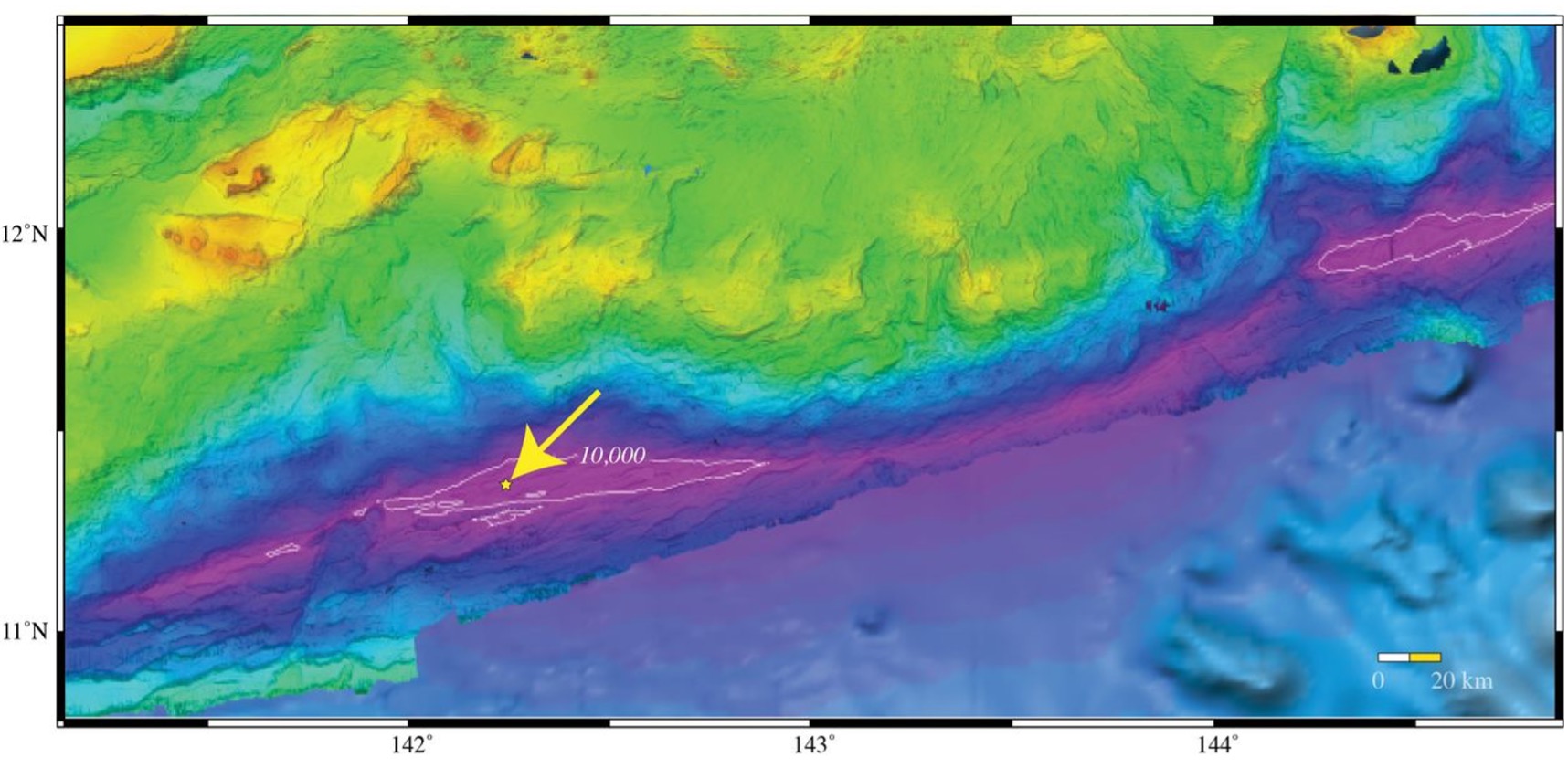
Fig. 3.47 Map view of bathymetry of southern Mariana Trench Challenger Deep area. Arrow points to circle that identifies the location of the deepest sounding in the trench (10,994 meters). White contours are 10,000-meter isobath. Credit: University of New Hampshire Center for Coastal and Ocean Mapping/Joint Hydrographic Center#
We also observe that volcanoes occur along the plate margins characterised by subduction zones. It is particularly evident, for example, that active volcanoes occur all along the Pacific ‘Rim of Fire’. If we visit these volcanoes and study their eruptive activity and the lavas produced, we further observe that these volcanoes are highly explosive in nature, and typically erupt silica-rich, gas-rich magmas. Typical hazards are Plinian eruption columns and pyroclastic flows as well as extensive ash fall (more on this in the next lecture). Sometimes these volcanoes produce some of the largest eruptions to occur on our planet that have severe consequences for environmental degradation and climate e.g. Toba Volcano in Indonesia, which erupted ~74 ka and was recorded as sulfate spikes in polar ice cores.
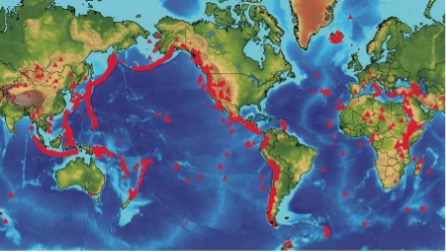
Fig. 3.48 Locations of volcanoes, which mostly occur along plate boundaries. Some intraplate volcanoes occur (e.g. Hawaii) and are linked to mantle plumes. Global Volcanism Program, Smithsonian Institution.#
It is remarkable that the overall composition and density of the continental crust, which makes up the subaerial land mass of our planet, bears a remarkable similarity to the volcanic rocks produced in subduction zone settings, implying that the formation of the continents is linked to the process of subduction. Our continents (at least the topmost layers) are approximately the composition of granite (i.e. they are silica-rich), which has a density that is lower than that of the rocks making up the oceanic crust (basalt) (2.6-2.8 g/cm3 versus 2.9 g/cm3). The lower density of the continents makes them buoyant and able to achieve greater crustal thicknesses and higher altitudes above sea level than oceanic crust.
We also observe that the composition of the continental crust in terms of trace elements (those for which concentrations are expressed as parts per million) is very similar to subduction zone-related volcanic rocks (arc basalt shown in the figure). Both the basalt and the continental crust are depleted in the elements Nb and Ta, and both are enriched in the fluid-loving elements e.g. Ba. The continental crust is overall more enriched in all elements because it is more silica-rich than basalt, which was achieved by crystallisation. Note that mid-ocean ridge volcanic rocks are highly depleted in melt and fluid-loving trace elements, because these rocks are derived from melts extracted from portions of the upper mantle that have been melted and stripped of these elements over billions of years.
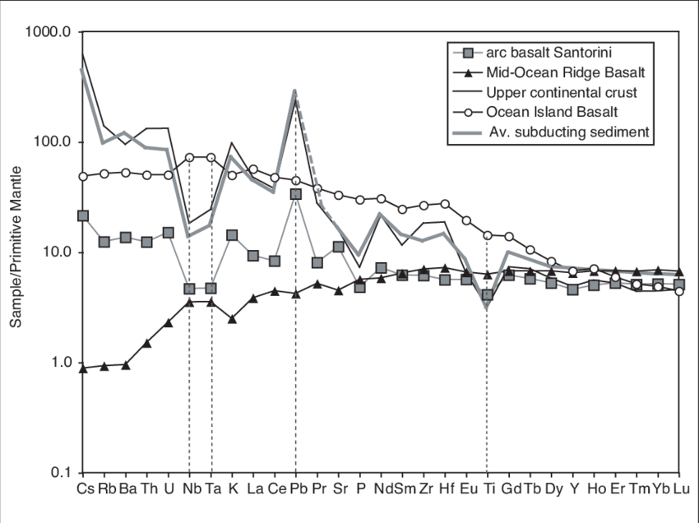
Fig. 3.49 Trace element composition of various kinds of rocks that make up the crust of the Earth, normalised by that of pristine or ‘primitive’ mantle (mantle that has not undergone much melting). Fluid-loving elements are on the left hand end (Cs, Rb, Ba, Th, U). Elements that partition strongly into a liquid as the mantle melts include these and also the elements from K to Nd.#
We observe that large earthquakes occur in subduction zone settings, up to magnitude 8-9. A global compilation of earthquake locations illustrates that earthquakes in subduction zones occur deeper than in other tectonic settings and there is a relationship between earthquake depth and distance to trench.
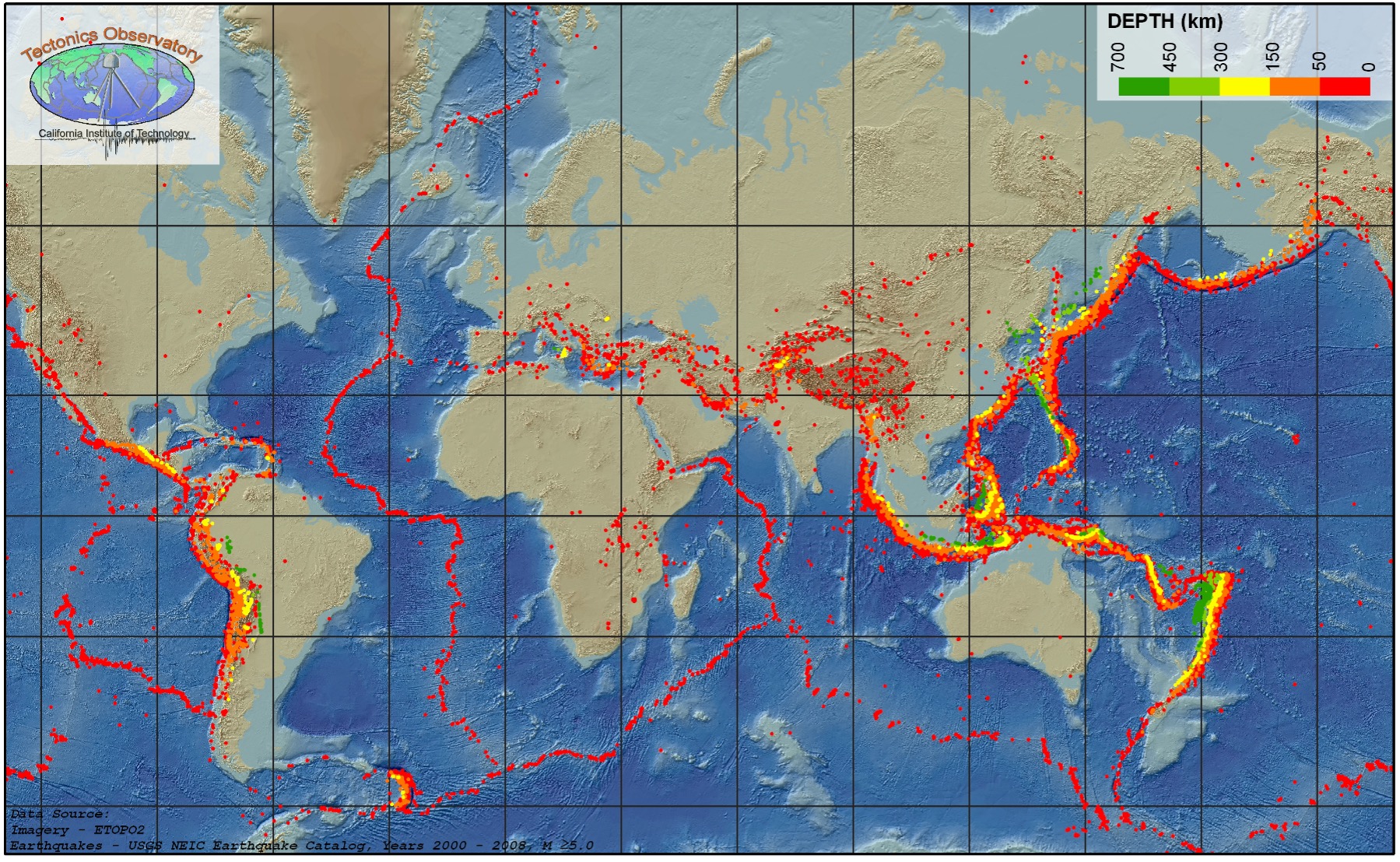
Fig. 3.50 Map to show locations and depths of earthquakes from 2000-2008 with a magnitude of >5. California Institute of Technology.#
On 11 March 2011 a Mw 9.0–9.1 megathrust earthquake occurred in the Pacific Ocean, 72 km east of the Oshika Peninsula of the Tōhoku region, Japan. The earthquake was associated with slip across a large area of the subducting slab at a depth of around 35 km. The earthquake caused rupture of the sea floor, which in turn caused a tsunami and great loss of life and property.
So-called ‘megathrust’ earthquakes occur in subduction zones as part of a cycle whereby the downgoing slab becomes locked to the overlying plate. Continued movement of the plate downwards eventually causes the locked portion to rupture, which is an earthquake. Rapid movements of the overlying plate towards the trench and vertically occurs during the earthquake, which may be captured by instrumentation e.g. a network of Global Positioning Satellite receivers.
Tsunamis occur when the earthquake rupture intersects the sea floor. The rapid upward movement of a block of the seafloor displaces seawater by the same amount, causing a long wavelength perturbation to migrate outward from the source. The wavelength of the tsunami is typically on the order of 100 km, which is much greater than the water depth.
Reconciling observations: how subduction zones work#
Models of subduction zones attempt to explain all of these observations. A general model is shown below. Hydrated oceanic lithosphere is subducted beneath continental lithosphere. Sediments may be scraped off the oceanic plate as it sinks down, forming an accretionary wedge. The down-going plate may get locked against the overriding plate, which may cause an earthquake when it eventually ruptures as plate movements continue. As it sinks, the down-going oceanic crust and mantle heats up and releases water-rich fluids, which rise up and trigger melting in the overlying mantle. These melts are typically silica- and water-rich and ascend into the crust, crystallising further, before erupting at the surface through volcanoes.
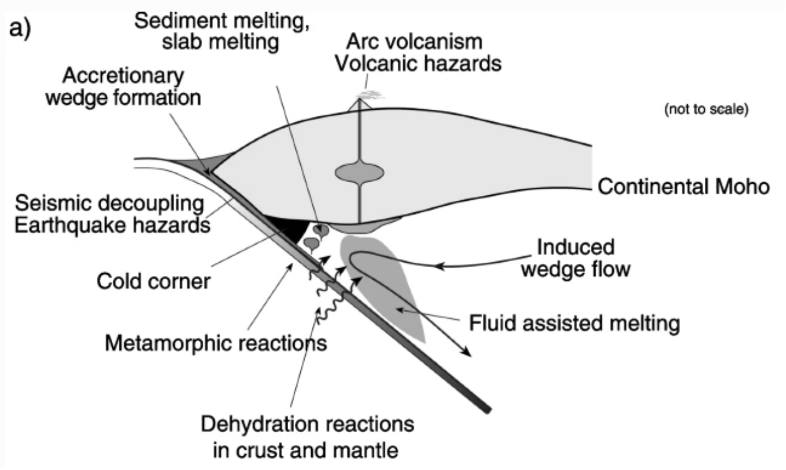
Fig. 3.51 A general model to show the structure of a subduction zone.#
Let us now look at these processes in detail. The first issue to explain is how water becomes locked into the oceanic lithosphere. In order to explain this, we must go away from the subduction zone and back to the mid-ocean ridge. Here, circulation of seawater through hot basalt hydrates the ferro-magnesian minerals such as olivine and pyroxene, through a process called serpentinization:
Serpentine, which has water structurally bound within it, has a lower density than olivine, so this reaction is accompanied by expansion and fracturing of the rock, which causes further fluid ingress and reaction. The methane and hydrogen provide ‘food’ for chemosynthetic bacteria at the ridge. Further serpentinization may occur as the oceanic plate bends and fractures as it starts to subduct. The bulk water content of the oceanic crust as it begins to subduct typically ranges from 1 to 6 wt%.
As the slab heats up, serpentine (and other hydrous minerals) becomes unstable. The depth at which this occurs depends on the thermal state of the subduction zone (i.e. on convergence rate, age of the downgoing slab and slab dip). If the fluids are released into a suitably hot part of the mantle wedge, then hydrous melting can occur (whereby the solidus is lowered by adding the hydrous fluids).
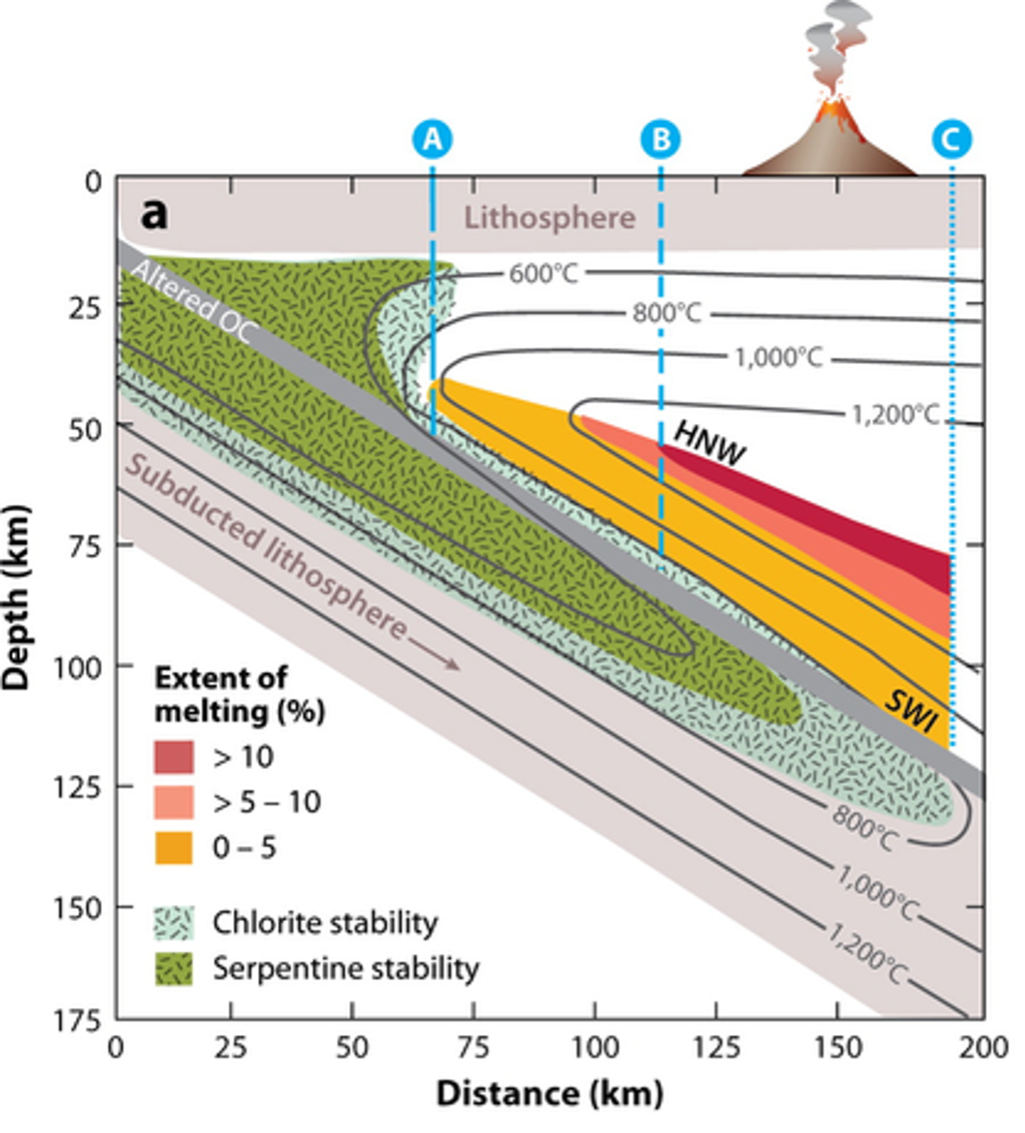
Fig. 3.52 A schematic of the subduction zone, showing the stability fields of the hydrous minerals serpentine and chlorite, and the hot nose of the wedge (HNW) where maximum amounts of melting may occur.#
The magmas produced by hydrous melting in subduction zones are typically rich in water and silica, rich in fluid-loving elements e.g. Ba, and poor in the elements Ta and Nb, which are retained by high T minerals on the slab and returned to the mantle.
What makes subduction so important for Earth’s habitability?#
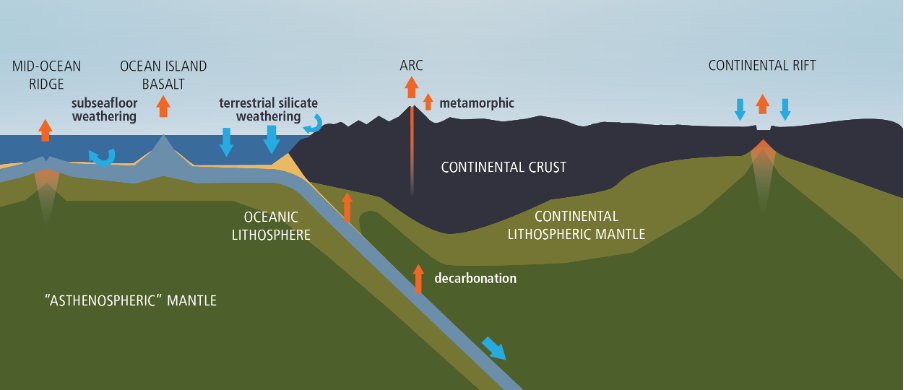
Fig. 3.53 Cartoon to show the features of a subduction zone that feed into habitability: an equitable climate, a breathable atmosphere and stable buoyant continents to act as a platform for complex life.#
There are at least three important ways in which subduction has allowed Earth to become and equitable and habitable planet.
Subduction magmatism produces buoyant continents to provide a land surface for life
Subduction locks carbon away in the planetary interior to prevent a ‘runaway greenhouse’
Subduction of organic carbon may have allowed atmospheric oxygen levels to rise, allowing life to proliferate.
Formation of our buoyant continents#
Subduction produces water- and silica-rich magmatic rocks, which leads to high and thick continental crust, with its buoyancy protecting it from subduction and destruction. This feature of the continents has led to the formation of ancient continental cores (cratons). The continents have undergone cycles of supercontinent formation and rifting through geological time (Wilson cycles).
The mineral zircon is very useful for reconstructing continental growth in Earth’s deep past. Zircon only forms in silica-rich rocks like those formed in subduction zones. Zircons are also very robust, and can survive multiple cycles of weathering and remobiisation. Zircons contain U but tend to exclude Pb, which makes them ideal for U-Th-Pb dating, as any Pb detected in the zircon can be assumed to have been produced by radioactive decay.
Zircons in the geological record suggest the continental crust began to form early, around 3.5 Ga, and crustal thickness underwent a large increase 3-2 Ga. Many fragments of very ancient crust contain zircons with high Th/Nb ratios, suggesting they were originally formed by a subduction-melting process.
Subduction and the carbon cycle#
Carbon is removed from the atmosphere through silicate weathering and transferred to the oceans, where it may be laid down as inorganic carbonate (e.g., limestone) or organic carbon (e.g., shales/mudstones). Over geological timescales, the amount of CO2 outgassed by volcanoes and tectonic regions is balanced by the amount of carbon returned to the deep mantle by subduction, thereby regulating the amount of CO2 in the atmosphere (pCO2). The deep mantle is a huge carbon reservoir compared to the atmosphere and oceans, and small variations in outgassing flux or subduction flux tend to have large consequences for pCO2.
Perturbations to the geological carbon cycle have occurred in the past e.g., large igneous provinces, asteroid impacts into limestone, which may have raised pCO2. The largest perturbation in modern times is caused by carbon emissions linked to the burning of fossil fuels and other activities, which has given rise to a perturbation too large to be corrected by the natural long-term geological carbon cycle on the time frame of human CO2 emission.
Planets with active volcanism and no subduction may undergo CO2 build up in the atmosphere, leading to a runaway Greenhouse effect.
Tectonic controls on atmospheric O2#
There may also be a role for subduction in creating an oxygenated atmosphere. The Great Oxidation Event, beginning around 2.5 Ga, occurred in two stages, with the later stage occurring shortly before the onset of the Phanerozoic. The first stage of the GOE occurred as the granitic, subduction-related continents were becoming established. The lower Fe content of these silica-rich continents over basalts had less oxidative capacity, ie they drew down much less oxygen, which may have contributed to the conditions required to allow O2 to grow in the atmosphere. Later, as the continents were fully established, they may have locked away carbon in their ancient interiors, effectively taking it out of the carbon cycle for Ga timescales and allowing O2 to rise further in the atmosphere.