Origin and detection of life (C3)#
Module leader: Paul Rimmer (Physics)
Created with help from: Alex Archibald (Chemistry)
Context#
We return to the Drake Equation from the Course Introduction, with slightly different terms:
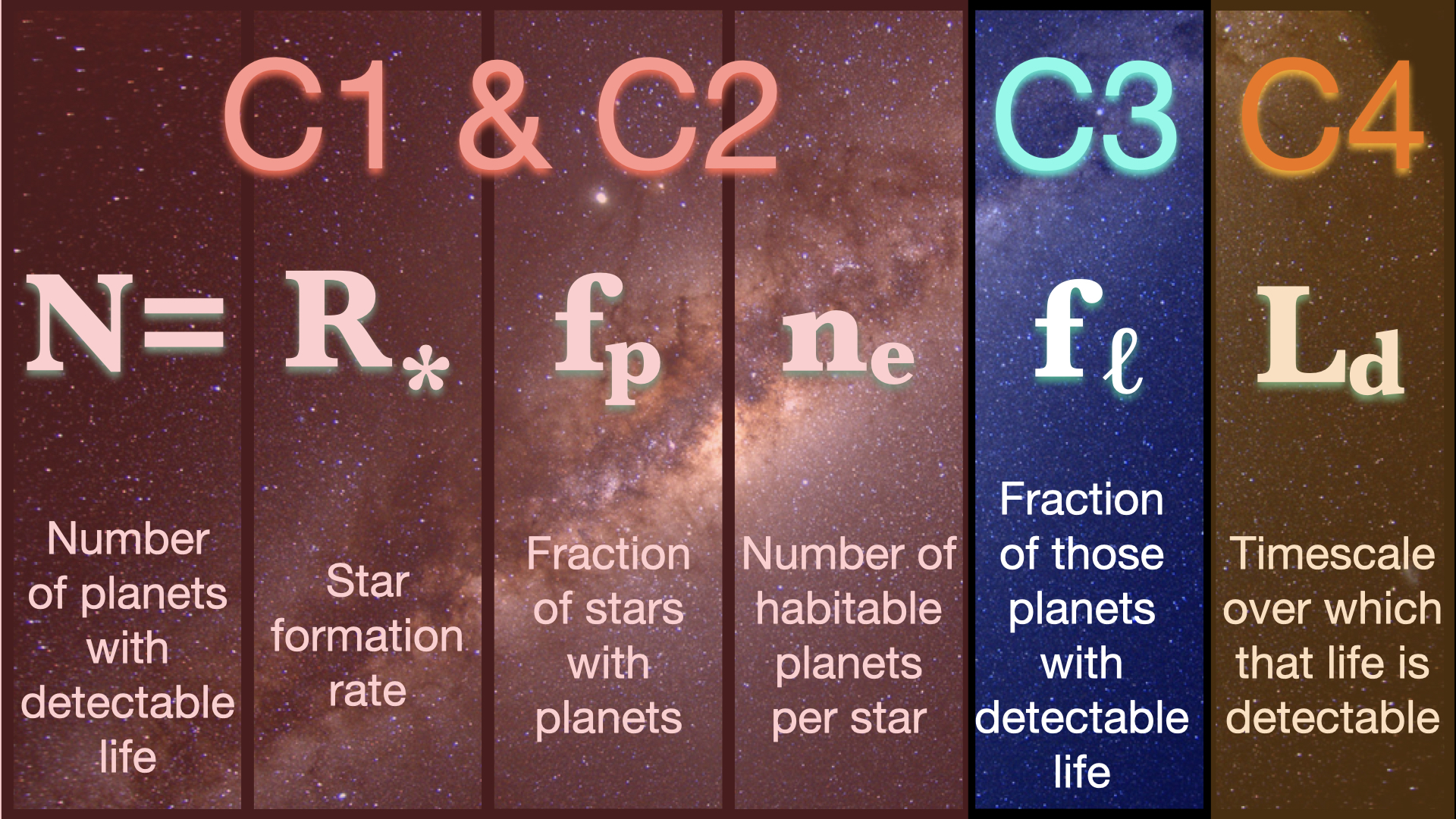
Fig. 1.19 The Drake Equation, cast to emphasize detectablility of ``pond scum’’ life, highlighting which parts of the Drake Equation are most emphasized by which components of the Core Course.#
Here, \(N\) represents the number of planets with detectable life, which equals the star formation rate \(R_* \; ({\rm y^{-1}})\), the fraction of those stars with planets \((f_p)\), the average number of habitable planets per star \((n_e)\), the fraction of those planets that have detectable life \((f_{\ell})\), and the lifetime over which the planet remains detectable \((L_d, \, {\rm y})\).
As the above figure highlights, in a somewhat oversimplified way, the first three terms of this equation, \(R_*\), \(f_p\) and \(n_e\) have already been covered in C1 and C2. The timescale over which a planet has detectable life is covered by C4, which will address questions of how long it takes life to evolve into a detectable form, depending on the technique used to detect that life, and how long that life will be detectable in such a way.
The 12 lectures in C3 will center around the quantity \(f_{\ell}\), the fraction of habitable planets that have detectable life. This term can be further broken down into two more terms:
Here, \(f_i\) is the fraction of planets with any life at all, and \(f_d\) is the fraction of those planets where the life can be detected here on Earth, a fraction that will depend on the distance to the planet, our detection techniques and observational capabilities, the kind of life and the signatures that life will produce. \(f_i\) can be further expressed in terms of two more fractions: \(f_o\), the fraction of habitable planets where life originates and \(f_s\), the fraction of habitable planets on which life has been seeded. Since these probabilities are prima facia independent, they are related by the expression:
The purpose of this course is to provide a scientific context for \(f_o\), \(f_s\) and \(f_d\); mostly \(f_o\) and \(f_d\). Since all life is chemical, this context will predominently, but not exclusively, sit within the discipline of chemistry.
Learning objectives:
Prebiotic chemistry in a planetary context.
Chemistry in ancient aqueous and atmospheric environments.
Some basics of organic and reaction chemistry relevant for prebiotic synthesis.
Our astrochemical origins.
The chemical and spectral properties of atmospheric biosignatures.
This lecture introduces you to the C3 module “Origin and Detection of Life”. The course will start with bridging the concepts from C1 and C2 - the astronomical, planetary and geochemical dimensions of global habitability - with hypothetical settings and sequences of reactions that might lead to emergent biochemistry. You will learn about the chemistry of aqueous planetary environments, and how these environments are shaped by, and also can contribute to shaping, the global geochemistry and planetary atmosphere.
You will then learn the basics of organic chemistry: how atoms fit together, how to tell if molecules are the same or different, organic chemistry in water, and why chemical reactions happen. You will learn about atmospheric chemistry and how it relates to the potential for prebiotic synthesis, and how life and the atmosphere evolve together.
This will follow with a foray into astrochemistry, from the interstellar medium to comets, to the possibliity of cometary and meteoritic delivery initiating prebiotic chemistry, other consequences of impact-sculpted environments, and the role of stellar ultraviolet light in prebotic synthetic chemistry.
C3 will conclude with an overview of atmospheric biosignatures, which really is a combination of the astronomical: star-planet interactions, and the atmospheric: the evolution of atmosphere and life.
How C3 links to the course’s major questions#
The link between C3 and the course’s major questions can best be drawn from the Context above, and comparing that with the Learning Objectives. In brief, this course will address:
How did life emerge on Earth? |
How do we find life elsewhere? |
|---|---|
\(f_i\) |
\(f_d\) |
What local environments are likely to exist on young planets? |
What do atmospheres of lifeless planets look like, compared to the atmospheres of planets teeming with life? |
What chemistry is possible in those environments, and can that chemistry lead to the building blocks of life? |
What counts as a biosignature? |
What can the discovery of life on another planet say about life’s origins? |
What does prebiotic chemistry imply about the probability of life elsewhere in the universe, or life on a particular habitable rocky planet? |
C3 will deal with these questions from a Chemistry perspective. We will now go over the broad conceptual framework within which we will explore the above topics.
Discovering Life’s Origins or (Re)Inventing Life’s Origins#
The origin of life cannot be ‘discovered’, it has to be ‘re-invented’.
– Albert Eschenmoser (2007, Tetrahedron, 63(52), 21821)
Most of the moleucules of life are fragile. They fall apart after not too long a time, especially compared to the time the Earth has existed. Sometimes these molecules can leave an imprint, in fossilized remains imbedded in rocks, or in the elemental and isotopic composition of the rocks themselves. Life’s extraordinary property of making copies of itself also means that, though the specific chemistry of an organism that lived millions of years ago is lost, that chemistry has been copied, and the copies retain a sort of “molecular” fossil record of ancient life. These kinds of records allow us to see the extinction of the dinosaurs, the origin of animal life, the origin of eukyriotic life, the great oxygenation event, and the last universal common ancestor (LUCA): the population of species from which all known life arose.
Before life began, molecules could not make copies of themselves, or at least not very reliable copies. The separation between the first self-replicating molecular assemblies and LUCA spans millions of years, and an apparently impassible chasm of chemical evolution. LUCA is chemically virtually identical to the modern bacterium, and includes metabolic sophistication the origin of which would be unimaginable outside of millions of generations worth of evolution.
Even rocks don’t live forever, and none of the rocks that were around when life originated on Earth still exist, as far as we know, even assuming life originated on Earth. We still have some minerals (e.g. zircons) from around the time life started on Earth. The few elements that haphazardly got locked inside their crystalline matrices only provide the vaguest hints of what life was like, even when life first started, on Earth; or what Earth was like during this period.
Maybe discoveries on Mars will help, given Mars has a much better-preserved geological record. Or maybe we will find hints of life in the atmospheres of young exoplanets. None of these will really answer how life started on Earth, but may help to show how life could have started on rocky planets.
There is always a chance the only substantive discovery on Mars, icy moons, or exoplanets will be that life is (relatively) rare. What should we do in that event? What should we do now, before these discoveries are made?
We can explore the chemical possibility space of life. We can try to re-invent life’s origins, compare our re-inventions to the few but significant bits of information we know about ancient planetary environments, and iterate toward a solution, or hopefully several different solutions, for how life could have originated. Until we come up with even a single solution, an eventuality that is a long way off in my opinion, we should remain humble and open to different ideas and ways of thinking about life’s origins.
This chemical possibility space has some lodestones. There are basic properties of molecules, both molecules of life and molecules present in abundance in lifeless environments, that determine how they behave and what possible functions they can perform. One fundamental chemical property of molecules is the oxidation states of their atomic constituents. There are already hints about the chemical properties of life and its origins contained within this single property, as is shown strikingly in the below figure.
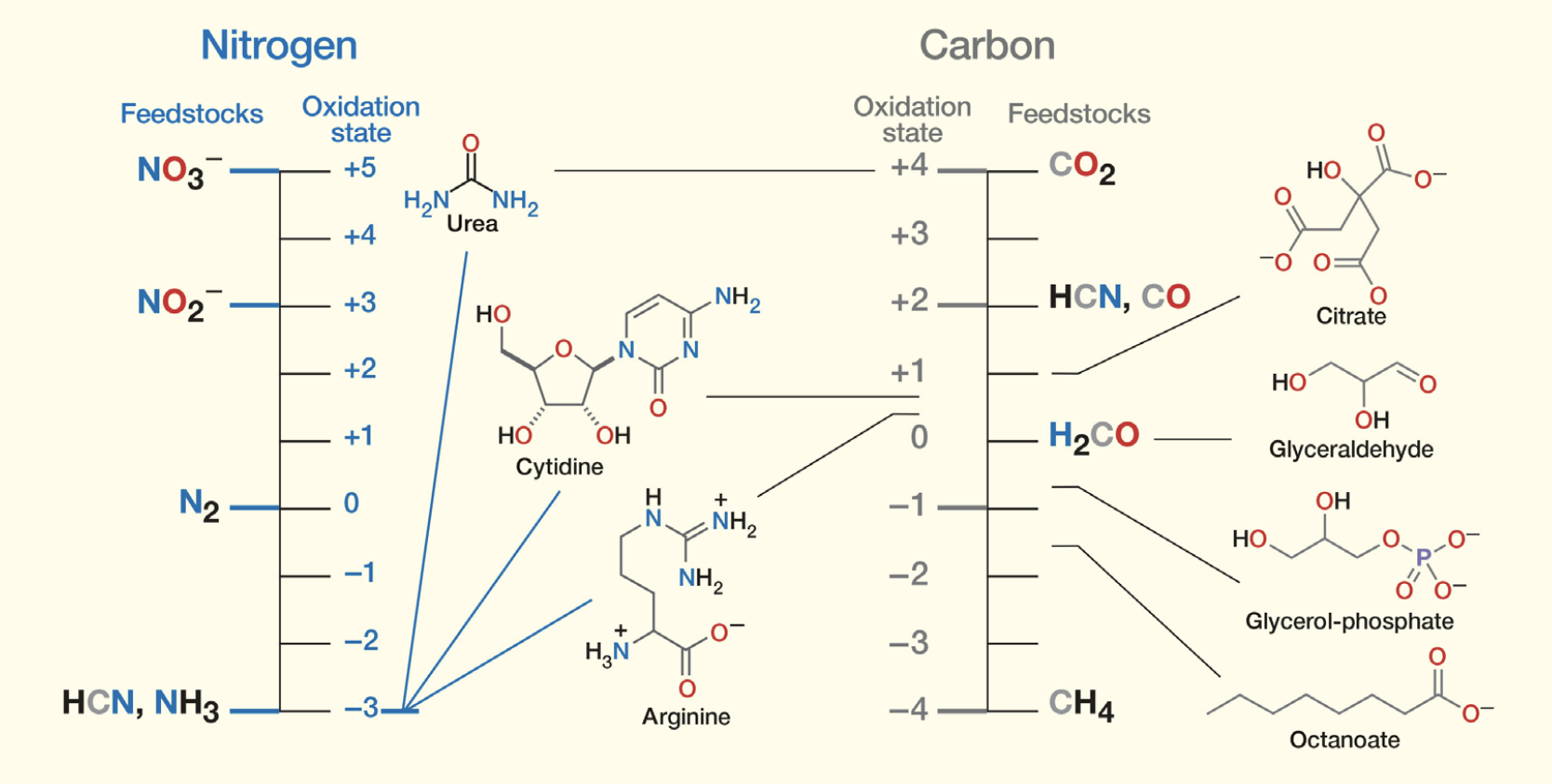
Fig. 1.20 Illustration of carbon and nitrogen oxidation states for the molecules used by life, compared to molecules available in a wide range of geochemical environments. This figure illustrates a deep link between fundamental chemical properties and the functional behavior of the molecules of life. Taken from Figure 1 of Sasselov et al. 2020.#
Our progress in reinventing, or maybe rediscovering (?), life’s origins, can be conceptualized by tracking the change in ‘alivenesss’ over ‘time, or chemical complexity’, as shown in the figure below. And as you can see from this figure, we don’t know a lot and have a very long way to go to get answers. This is part of what makes this research area so exciting! That and the progress in this field is currently accelerating. You will learn about how quickly progress is accelerating in the field of origins of life during these C3 lectures.
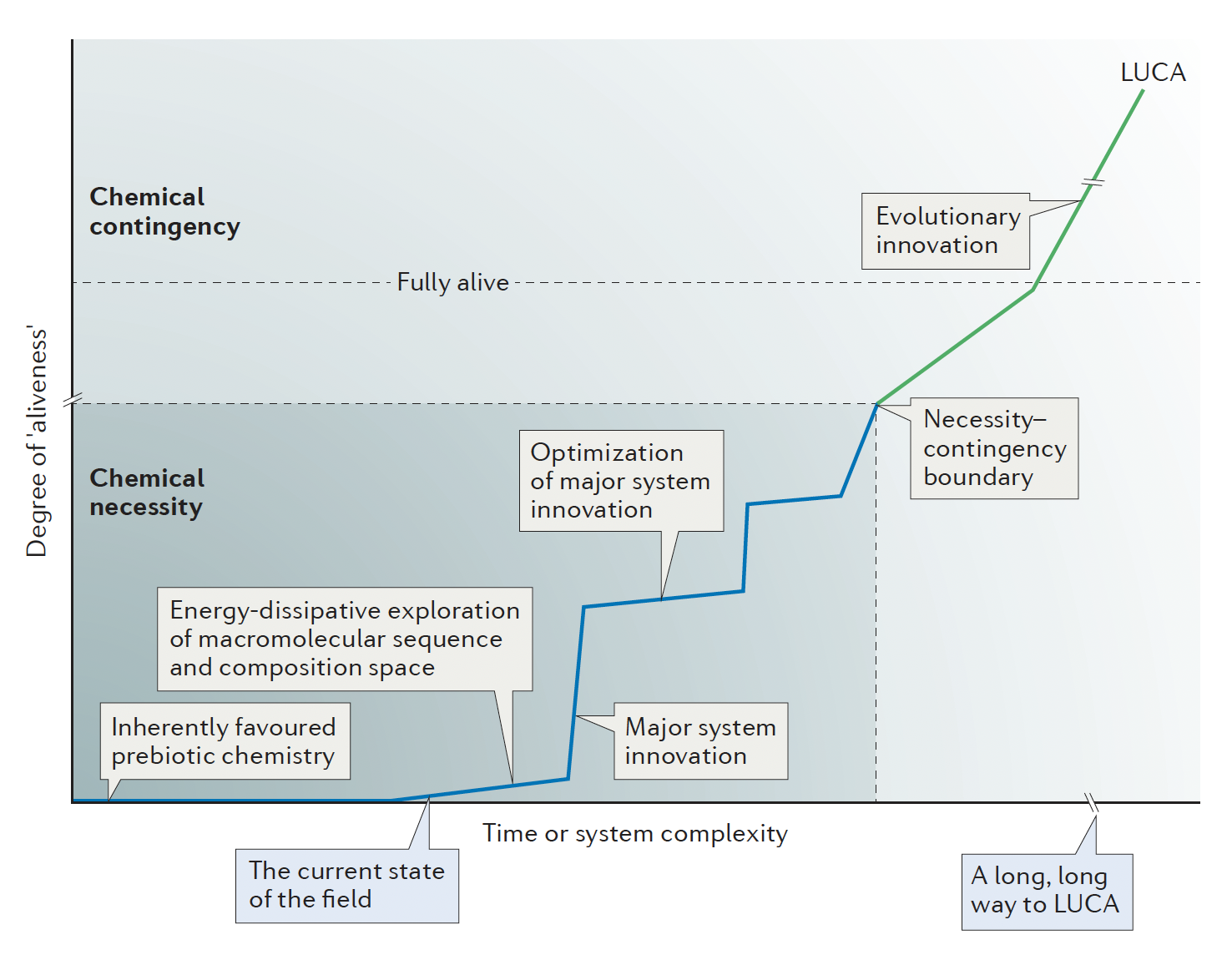
Fig. 1.21 Transition from non-life to life as a measure of a “Degree of ‘aliveness’” vs. “Time or system complexity.” This is not presented to be the definitive pathway to life; as indicated, most of the trajectory is still undiscovered. This is merely to show that such a transition is not likely to be a single step, but will likely involve ‘phase-transition-like’ behavior at certain key points, called here “major system innovations”. This also proposes that the transition from non-life to life is preceded by a transition from sequences of reactions driven by chemical necessity to the contingency of random genetic drift and mutation, winnowed by natural selection. Fig. 3 from Sutherland 2017.#
Space, Atmosphere, Surface: From Frozen Dust to Warm Little Ponds#
Because little is known about life’s origins, we are not constrained yet in where or how life originated. Exploring a wide range of possibilities in humility requires a trandisciplinary approach that involves astrochemistry, atmospheric chemistry, geochemistry, and last-but-not-least, biochemistry (it’s important to know what we are aiming to explain the origins of!).
Below are three figures showing examples of how origins of life could be connected to astrochemistry (chemistry… in space!), atmospheric chemistry, and aqueous geochemistry, all of which you will learn about in upcoming lectures.
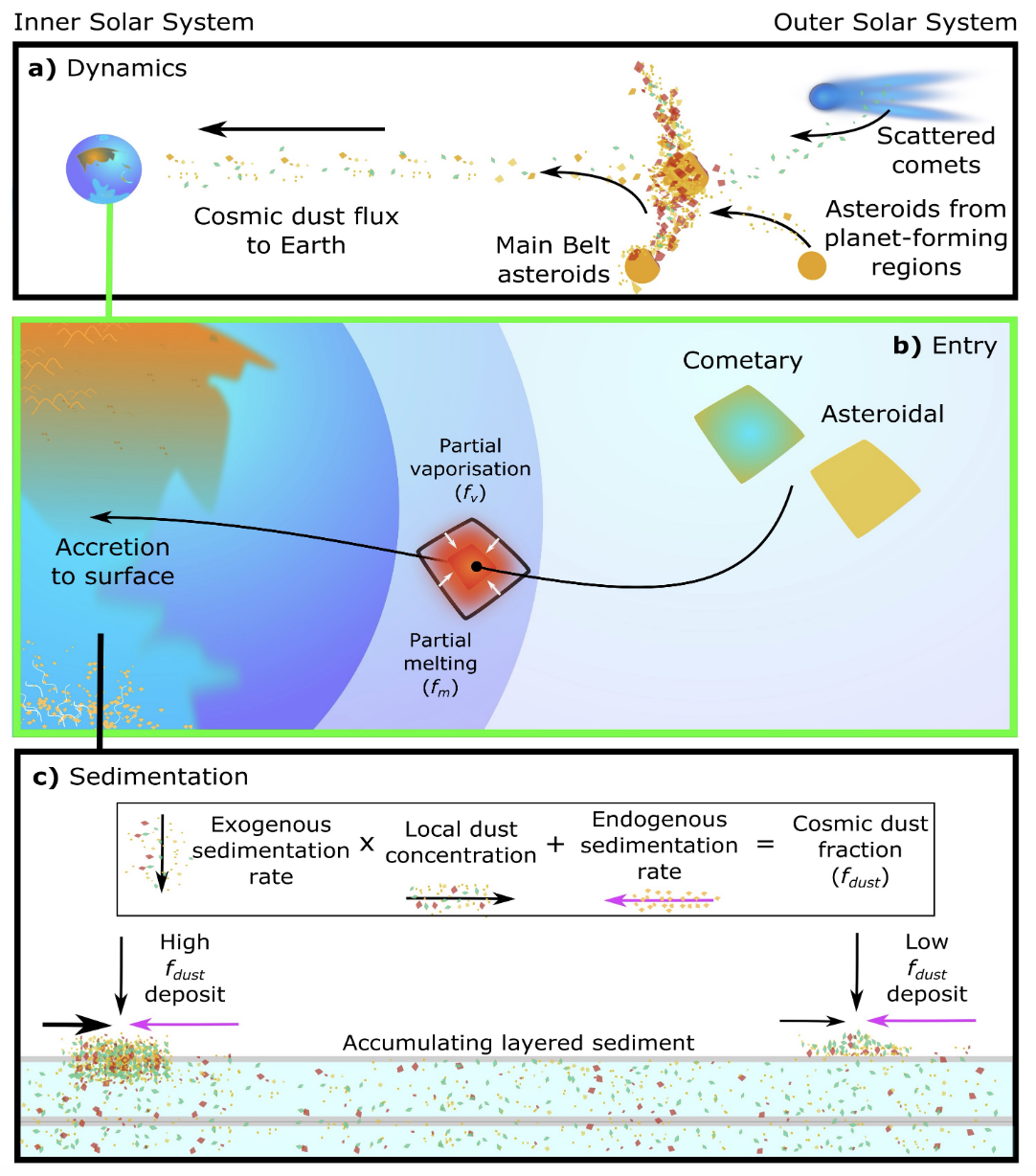
Fig. 1.22 An example of how astrochemistry could inform the origins of life, from interstellar dust to cometary and asteroidal dust, some of which would be delivered more-or-less prestine to certain glacial regions on Earth where they could be preserved until ready to undergo yet further chemical reactions on a planet’s surface. Taken from Figure 1 of Walton et al. 2024.#
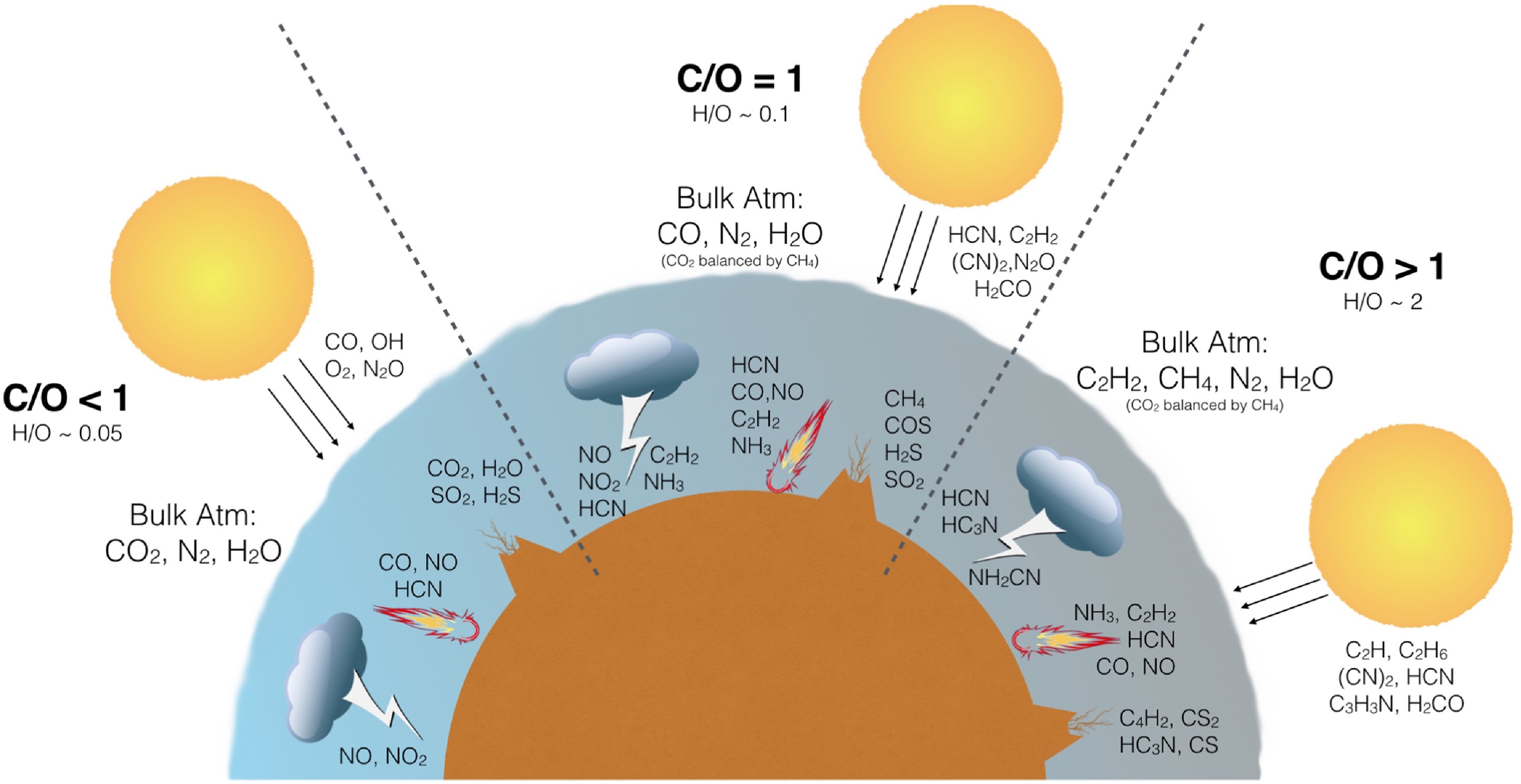
Fig. 1.23 An example of how atmospheric chemistry can inform origins of life, with the production of HCN and other prebiotic molecules, dependent on the background atmospheric composition. Taken from Figure 1 of Rimmer & Rugheimer 2019.#
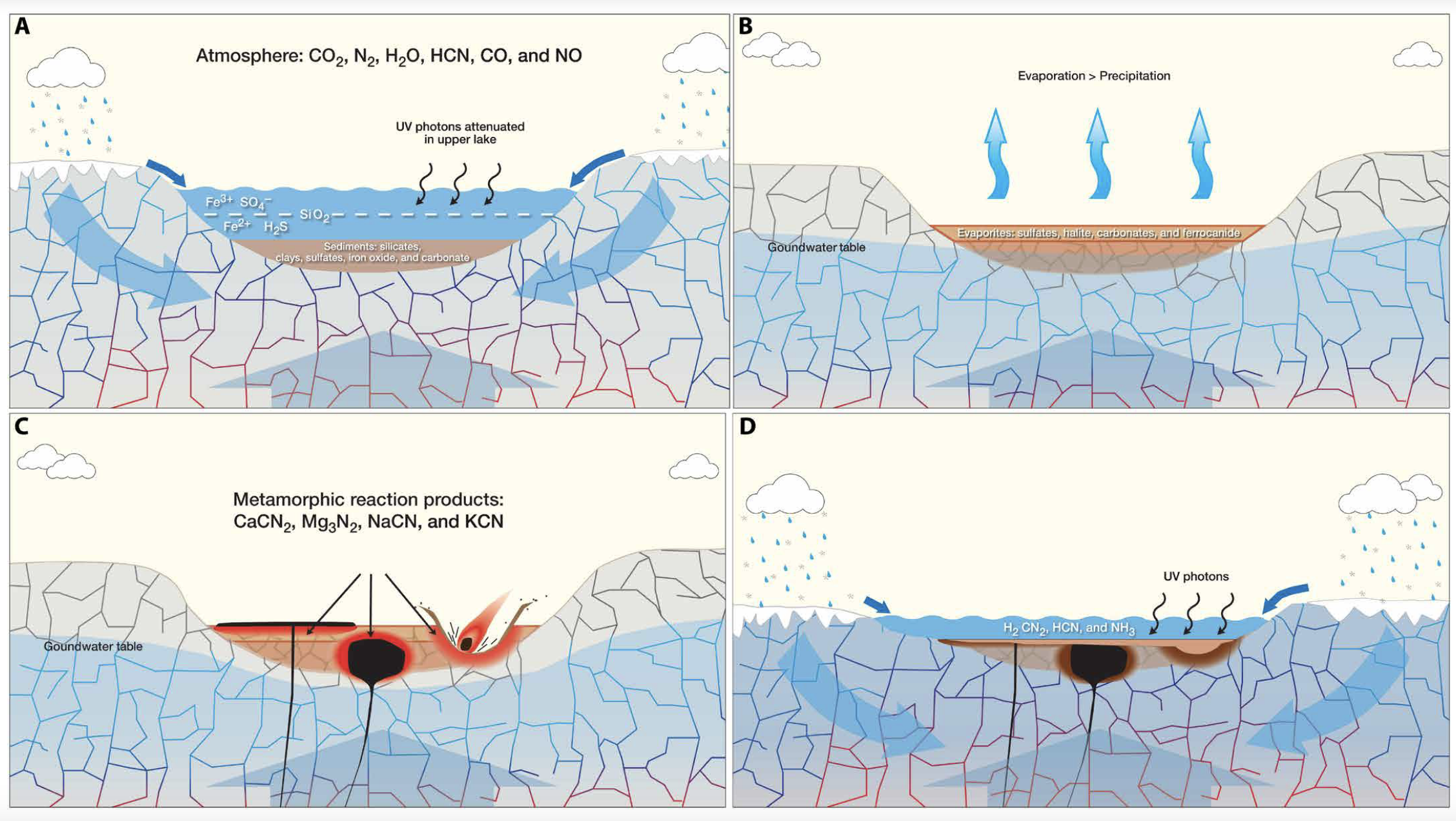
Fig. 1.24 A proposed aqueous environment on a young planet conducive to the origins of life. Taken from Figure 2 of Sasselov et al. 2020.#
Life’s Origins and the Search for Life on Rocky Exoplanets#
One of the most exciting developments in the field of life’s origins is connected to one of the most exciting developments in the field of exoplanet science. We may be able to find evidence of life on other planets in the coming decades, if life is sufficiently ubiquitous. Knowing whether this discovery is believable requires a better understanding of the planetary and astronomical context of that life, including its origins. Some of the claimed chemical signatures of life relevant for exoplanet atmospheres are shown in the figures below.
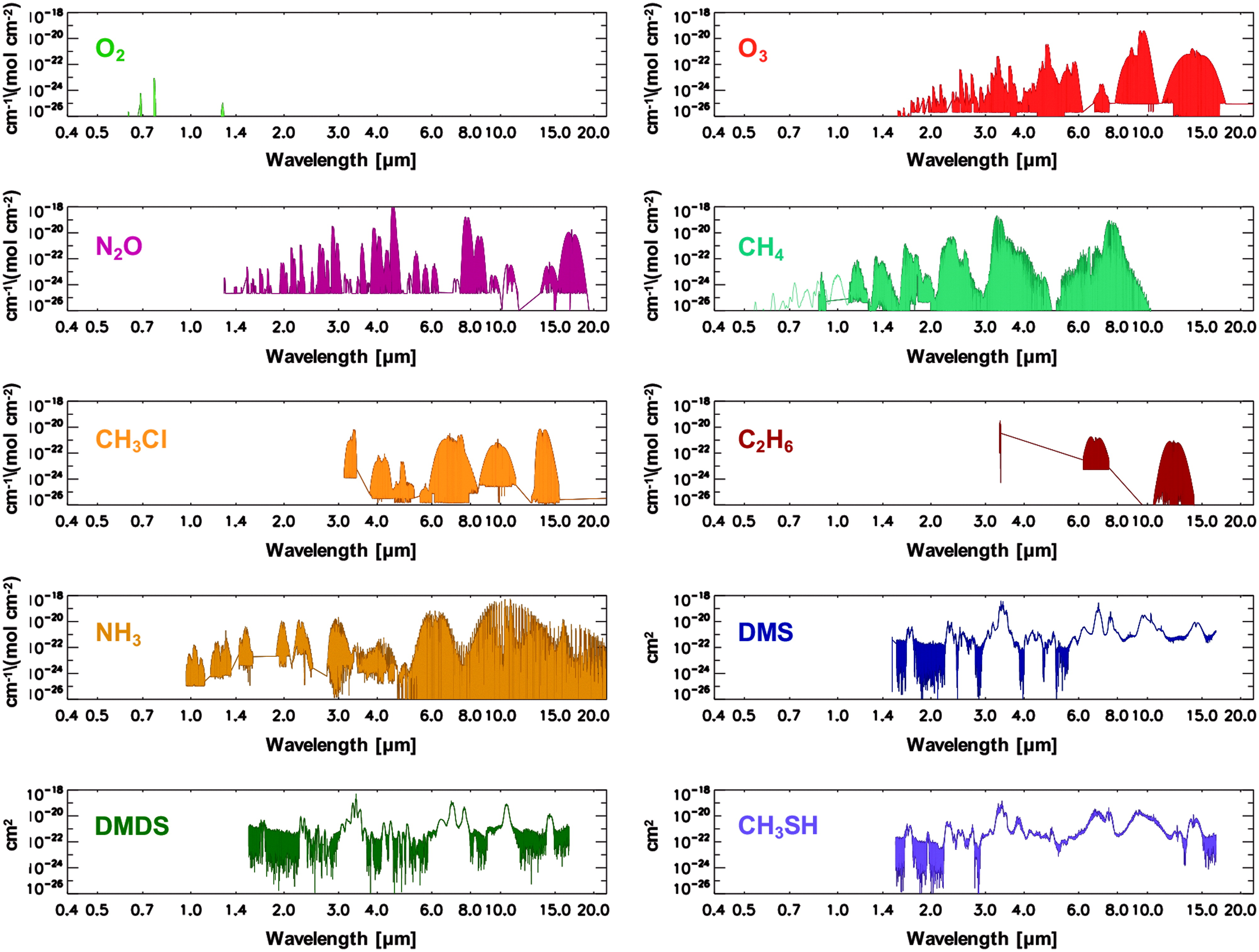
Fig. 1.25 Infrared spectra of some biosignature gases (atmospheric signatures of life, depending on context). Within the range most relevant for JWST. Taken from Figure 6 of Schwieterman et al. 2018#
Conversely, if we have evidence of life on other planets, and also empirical correlations between certain envrionmental conditions relevant for prebiotic chemistry and those planetary environments on which life was discovered, we can work backwords from biosignatures (along with prebiosignatures, see the below figure), to make an empirical case for how life most likely arose on rocky planets. In other words, maybe we can get beyond “re-invention”, and apply astronomical and planetary data to those re-inventions to someday genuinely discover how life most likely originated on Earth.
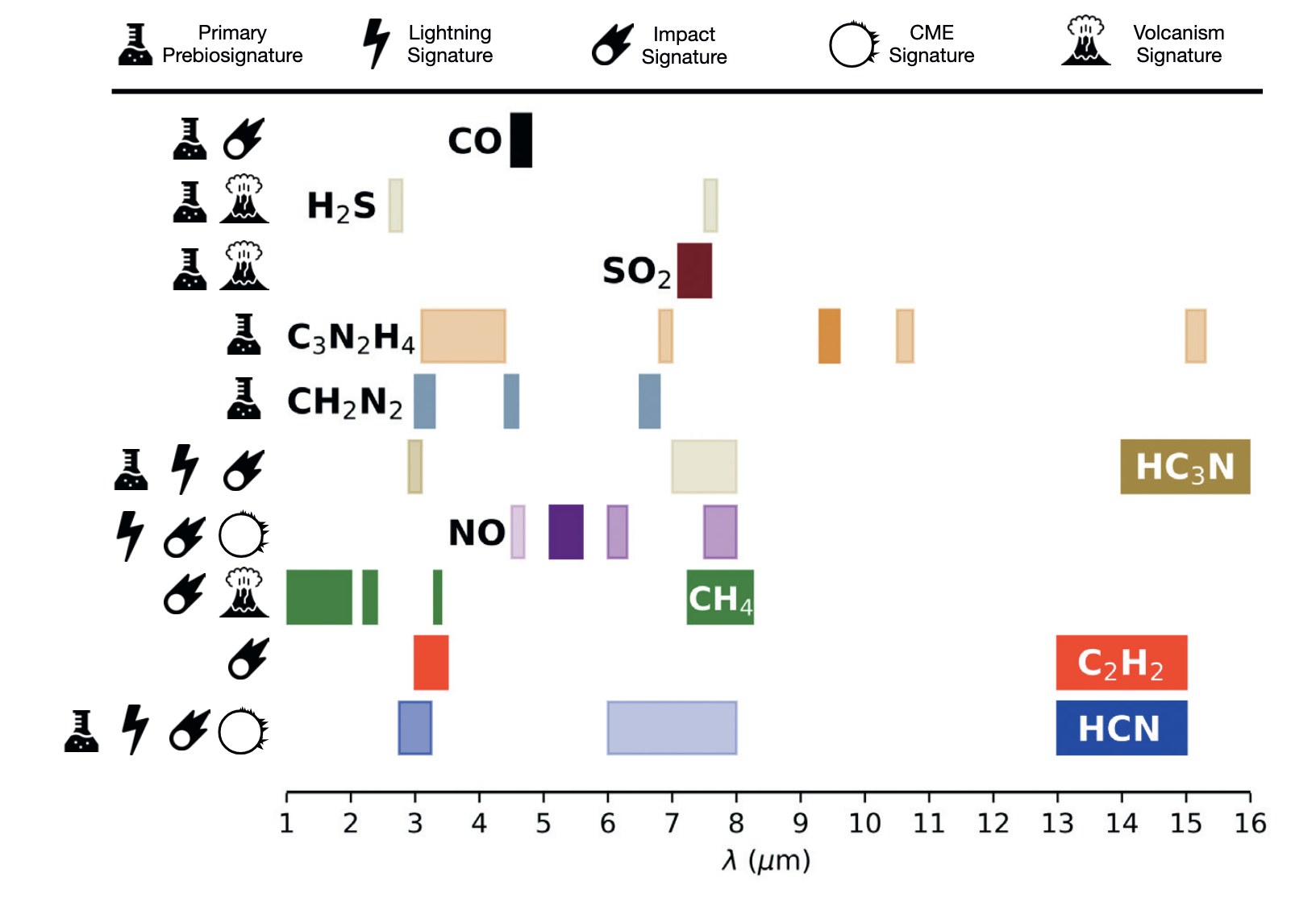
Fig. 1.26 A list of prebiosignatures (signatures of environments where life is more likely to emerge), highlighting strong spectral features within the range observable by JWST. Taken from Figure 2 of Rimmer et al. 2021#