3.7. Planetary cycles IV: Volcanism#
Professor: Marie Edmonds (Department of Earth Sciences)
Learning outcomes:
Volcanoes on Earth occur at plate boundaries and within plates, linked to various modes of mantle melting.
Observations suggest magmas crystallize, mix and degas as they are stored in the crust and ascend, and complex feedbacks between magma ascent rate and magma rheology control eruption style.
Volcanoes produce new substrate on which life can become established and proliferate. Volcanoes provide unique habitats for a range of microbial life.
Some aspects of volcanism are toxic: acid rain, thick ash fall, heavy metals. Volcanoes also provide fertile, organic-rich soil and nutrients.
Volcanic outgassing is the principal input to our secondary atmosphere over geological time.
Volcanic gas composition at a planetary surface is highly dependent on oxidation state and pressure.
In this lecture, we will begin by outlining the key observations we make on volcanoes, and then we will explain how volcanoes work. We will discuss how volcanoes can produce habitable environments and new substrates where microbial life may take hold in both terrestrial and submarine environments. Finally, we will discuss the formation of our secondary atmosphere through volcanic outgassing and the impact of different planetary conditions on the composition of volcanic gases.
Why do volcanoes occur where they do?#
Volcanoes occur at plate boundaries (e.g. mid-ocean ridges, subduction zones) and within plates, associated with mantle plumes (or ‘hotspots’). At mid-ocean ridges, mantle upwells passively at the plates diverge, and the hot upwelling mantle crosses the solidus at a shallow depth, causing a degree of melting that is sufficient to form ~7 km thick basaltic oceanic crust.
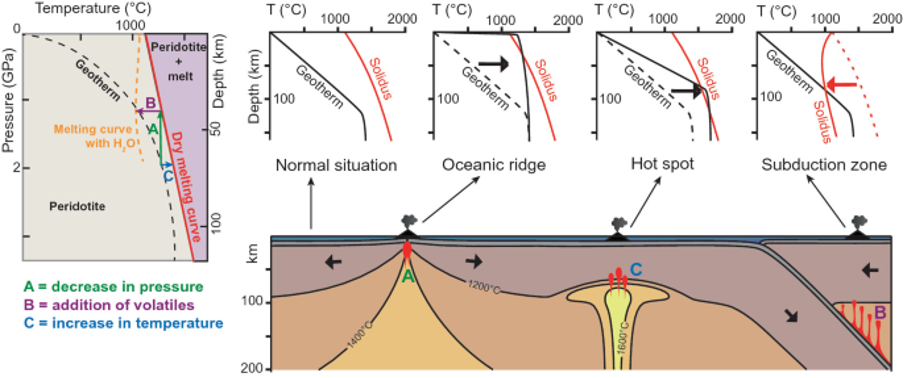
Fig. 3.54 Mechanisms of melting at different tectonic settings. The solidus (red) is the temperature at which the mantle begins to partially melt. The geotherm (black) is the ambient temperature of the mantle, and tends to increase rapidly with depth through the lithosphere, and less rapidly through the asthenosphere. Melting can be triggered by decompression (e.g. at mid-ocean ridges), by adding water (at subduction zones), by increasing the mantle temperature (e.g. associated with mantle plumes).#
Melting at subduction zones is triggered by the ingress of fluids to the overlying mantle wedge, related to the breakdown of hydrous minerals on the slab, as discussed in the last lecture. Addition of water to the mantle lowers its solidus temperature and triggers melting. Melting can only occur here if the thermal structure is just right: if the slab is too hot, the hydrous minerals breakdown too early, and do not intersect with the hottest part of the wedge. If the slab is too cold, the hydrous minerals may not dehydrate until the slab is too deep.
Mantle plumes are up to a few hundred degrees hotter than ambient mantle, and sometimes this is enough to exceed the solidus temperature and trigger melting. If there is lithospheric stretching and thinning, this can increase the degree of melting. This melting mechanism is associated with the large igneous provinces that have occurred sporadically through the Phanerozoic (and likely before), which have been associated with mass extinction events.
Observations of volcanoes#
We may use a wide range of different types of observations to understand how volcanoes work. Seismicity may be used to detect pathways of magma migration in the crust as well as zones of storage. The ground surface around a volcano tends to inflate when magma is injected into shallow reservoirs, which can be measured using e.g. GPS receivers or satellite-based radar instruments. The nature and magnitude of ground deformation may be a reliable eruption forecasting tool, e.g. in the case of the ongoing Reykjanes Peninsula eruptions in Iceland. The erupted products of volcanoes (lava, pumice, ash) can be scrutinised at a range of spatial resolutions to observe which phases are present, the crystal zoning patterns and the compositions of crystals and glass. This information may be used to reconstruct magma storage conditions, ascent rates and magma volatile concentrations. Finally, we can measure the flux and composition of volcanic gases, which vary with magma composition, tectonic setting and pressure.
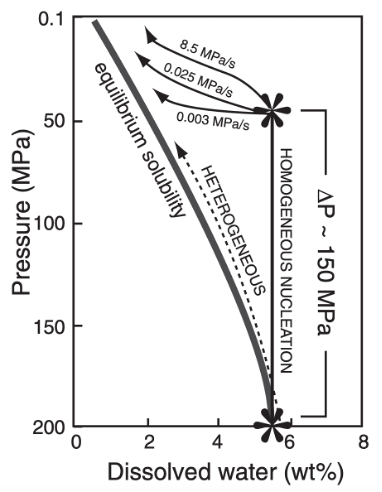
Fig. 3.55 Silicate melts degas water as they decompress, as the solubility of water in silicate melts decreases with pressure. The presence of bubbles increases magma buoyancy and accelerates magma towards the surface. If crystals are present, bubbles tend to grow on them (heterogeneous nucleation). If the melt is crystal-free, bubbles may be inhibited energetically, leading to supersaturation and homogeneous nucleation.#
Magmas are generally stored in sub-surface reservoirs where they may degas, crystallise and mix with other magmas. Eruptions occur when the magma reservoir pressure exceeds some critical value, which breaks rock and allows the magma to rise up to the surface. As magmas ascend, they degas water and other volatiles. If the ascent rates are slow, magmas degas in equilibrium and may erupt effusively (quietly). If ascent rates and melt viscosities are high, overpressure may build in growing bubbles as the melt cannot relax on a fast enough timeframe, which may result in explosive eruption. As magmas degas, they also crystallise due to the solidus temperature rising as water is lost. Crystallisation increases bulk magma viscosity, which further exacerbates the slow relaxation response of the melt to bubble growth and promotes explosive eruptions.
Volcanoes provide substrate and habitat for life#
Barren volcanic rocks may be colonised as a result of orographic rainfall and dispersal of spores and seeds on the wind. Primary succession has been studied on a number of volcanoes where either large destructive eruptions have taken place or because a new island was created (e.g. Mount St Helens, USA; Surtsey, Iceland). Over hundreds of years, primary succession consists of mosses and lichens, followed by grasses, shrubs and perhaps trees.
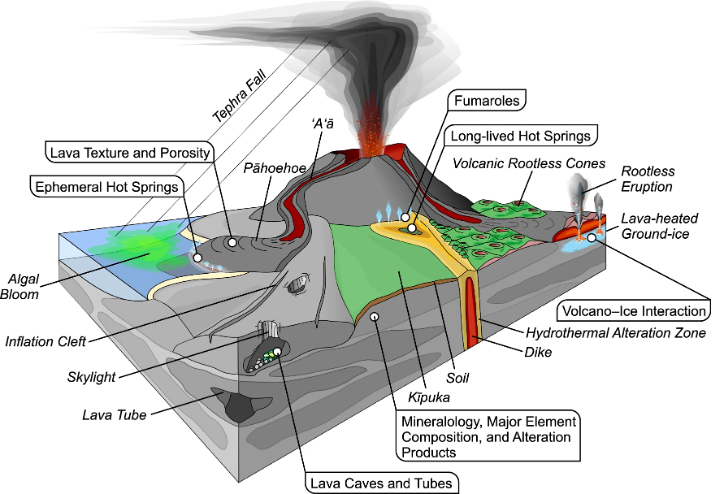
Fig. 3.56 Habitats that might be suitable for micro-organisms on volcanoes. Hadland et al., 2024.#
Volcanoes on land and in submarine environments provide a rich variety of potential habitats for life, from fumaroles, warm ponds to lava caves, to submarine vents. For example, at Yellowstone Volcano, USA a mantle plume impacts the base of the lithosphere, causing melting. It is thought that there is a transcrustal system of magma storage beneath the caldera, which is capable of the largest kinds of super-eruptions. Eruptions here can involve 1000s km3 magma and ash which blankets the entirety of North America. Yellowstone has a high heat flux, and many geothermal features such as hot pools and geysers. The vivid colours of Grand Prismatic Springs are caused by extremophile bacteria that use photosynthesis to obtain energy.
Submarine volcanoes also produce nutrient-rich environments by rising abruptly from the seafloor and forcing nutrient-rich water to rise, or through hydrothermal vents. Chemosynthetic bacteria at hydrothermal vents may use hydrogen sulfide as ‘food’, converting it to carbohydrate in the presence of oxygen and water.
Volcanoes produce both nutrients and toxic hazards#
Volcanoes produce ash, gases and aerosols which may contain soluble metal salts including elements such as Pb, Se, As, Hg and Bi. Very fine particulate matter less than 10 microns in dimension is a hazard to human health and when combined with toxic elements the health implications are very poorly understood. Volcanic gas plumes can impact groundwater and agriculture when plumes deposit soluble salts via rain. Many volcanoes emit large quantities of SO2 gas, which may be oxidised to sulfate and sulfuric acid, i.e. acid rain. In Hawaii, this phenomenon is referred to as ‘vog’ or volcanic smog, and there are local systems in place to forecast when human populations may be impacted due to ongoing eruptions and wind direction.
Thick ash fall can lead to plant death if the plant’s ability to take up minerals and photosynthesis is impaired. Over longer timescales (100s years) however, volcanic ash weathers and absorbs organic carbon, making fertile soils. The weathering process draws down atmospheric CO2 through the reactions:
It has been recognised that sometimes lava flows or ash fall into the sea can lead to phytoplankton blooms, by disrupting water flow and/or introducing Fe and other elements. A good example is the phytoplankton bloom that was recently observed offshore Hawaii during the 2018 East Rift zone eruption of Kilauea, where lava flowed into the sea, causing upwelling of deep, nutrient-rich water.
Volcanic outgassing produced our secondary atmosphere#
Volcanic gases from modern volcanoes are rich in H2O, CO2 and SO2, in that order of abundance. However the relative proportions of these gases, for a typical magma, vary with pressure as they have different solubilities or partitioning behaviours in silicate melt. For example, CO2 solubility is relatively low, so volcanic gases equilibrated at high pressures are typically CO2-rich.
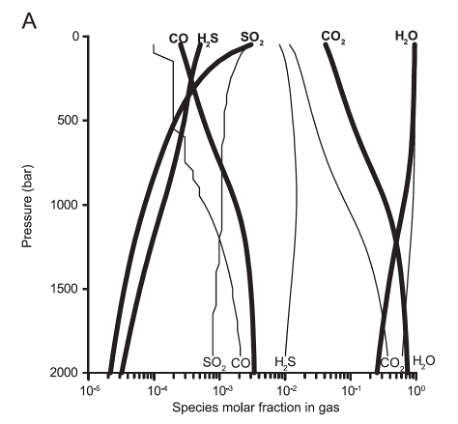
Fig. 3.57 Evolution of volcanic gas composition with pressure in a closed system at 1000 C for basalt. Bold and thin lines are outputs from two slightly different models, outlined in Burgisser et al., 2015.#
In the early Earth, the Earth’s atmosphere would have been affected by cometary and chondritic contributions, loss to space and exchange with the magma ocean. As Earth’s core differentiated, which removed elemental Fe and oxidised the mantle, and plate tectonics stabilised, volcanoes became the dominant mechanism by which the atmosphere was fed. Subduction began to remove carbon from the surface environment, and the formation of continents may have locked some carbon away over Ga timescales, allowing pO2 to rise. Nitrogen outgassed early in Earth’s history by volcanoes would have largely remained in the atmosphere and built up, due to its inert nature. The evolution of the biosphere would have modulated and altered the atmospheric feedbacks, creating additional carbon sinks.
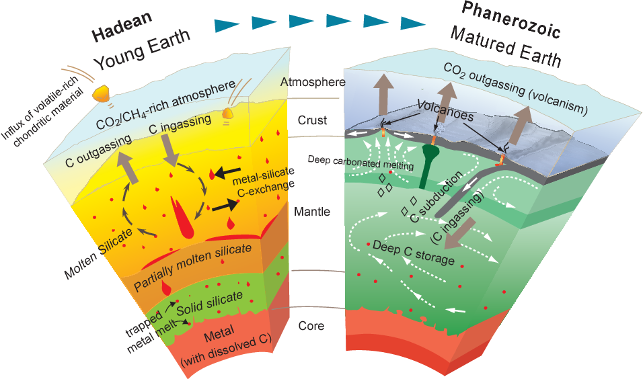
Fig. 3.58 Cartoon depicting various possible processes that may have occurred in early in Earth’s history to the those occurring today, such as plate tectonics, and the effect on volatile elements and atmospheric composition. Dasgupta, 2013.#
It is possible that volcanic gases earlier in Earth’s history (prior to the Phanerozoic) may have been more reduced, ie with higher concentrations of H2, H2S and CH4. Whether or not the mantle has become more oxidised with time is difficult to evaluate, as evidence from the geological record is scant and difficult to interpret. It is also possible that the emergence of volcanoes above sea level as the continents formed 2-3 Ga caused gases to change from H2S to SO2-dominated, perhaps contributing to the rise of pO2. Volcanic gas composition at a planetary surface is highly dependent on surface pressure, mantle composition and oxidation state, and the presence of surface water.