
3.8. Mars I: Geological history#
Professor: Nick Tosca (Department of Earth Sciences)
Learning objectives:
Major sources of observational data on Martian geological evolution
Construction and limitations of the Martian geological time scale
Timing and conditions of major geological processes occuring through Martian history
Key uncertainties in the interpretation of Martian geological data
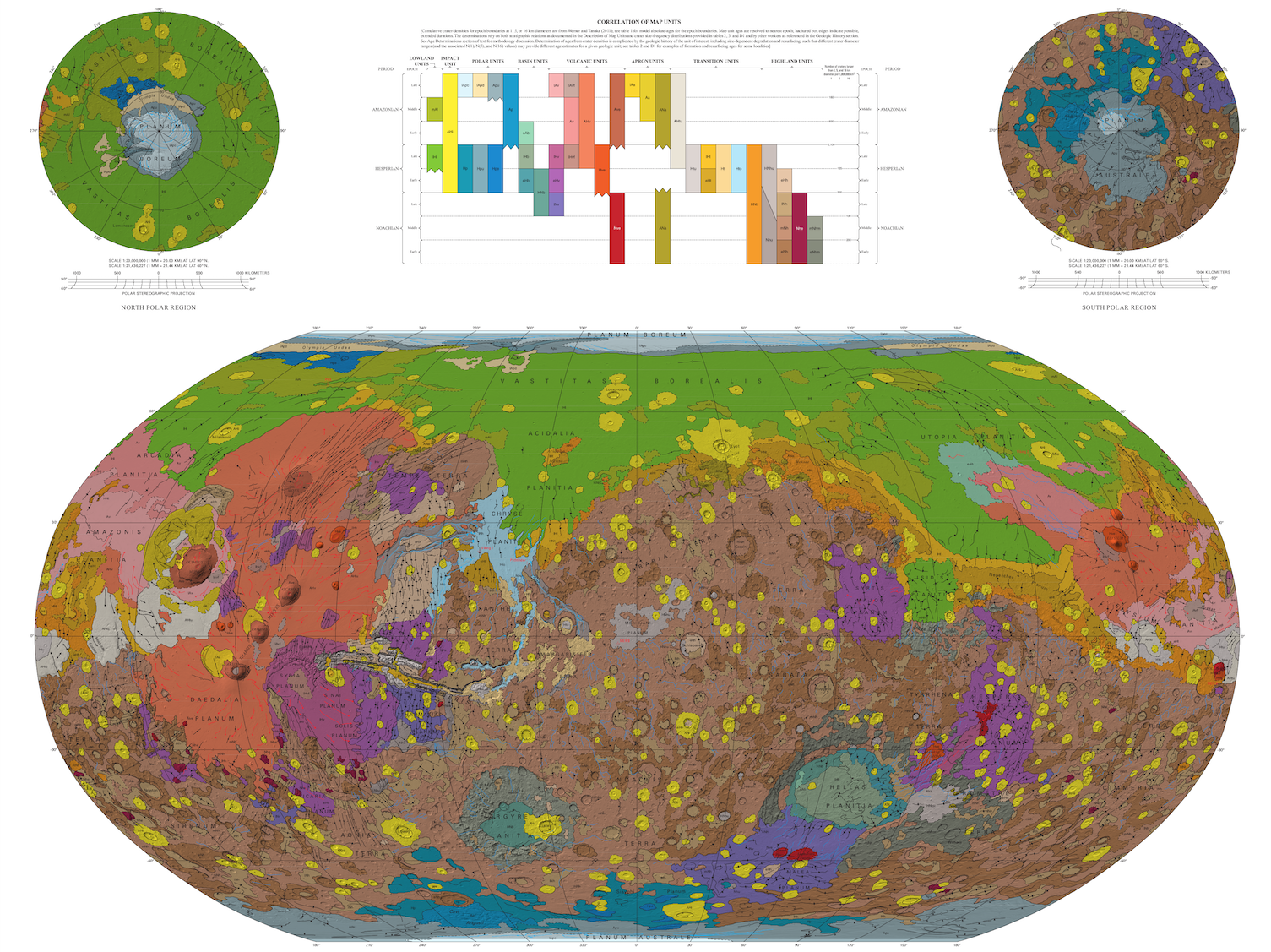
Fig. 3.59 A geologic map of Mars, with map units of different ages (on the basis of cratering statistics) distinguished by colour. Purpleish-brown colours dominating the southern hemisphere largely represent units of Noachian age, with Hesperian-aged Tharsis province illustrated in reddish orange. Credit: US Geological Survey.#
The goal of this lecture is to discuss the major features of the geological record preserved on Mars and what it tells us about the processes and events that have shaped the long-term evolution of the red planet.
Sources of data#
There are three principal sources of data on the Martian geological record. It is not important to remember each and every mission, but rather the major differences in the information obtained from each of the three major data sources, as well as their limitations.
Orbiting satellites. Over the last two decades at least a half a dozen orbiting satellites have returned (or are returning) datasets that constrain the chemical and mineralogical composition of rocks and sediments exposed at the Martian surface. Some have returned geophysical data (i.e., gravity and magnetic data; thermal properties of the surface).
Constraints on the geological record have improved as the resolution of orbital imagery has increased. In addition, some orbiters have been equipped with spectrometers that simultaneously acquire the visible/infrared spectrum of the surface materials, which place important constraints on mineralogical make-up. A major drawback is that not all minerals exhibit distinctive spectra at these wavelengths and without information on mineral textures (which constrain the timing of mineral emplacement) it can be difficult to relate orbital mineral signatures to unique geological processes.
Notable missions include:
Mars Global Surveyor (1996); operated for 10 years
Mars Odyssey (2001)
Mars Express (2003)
Mars Reconaissance Orbiter (2005)
MAVEN (2013)
Landers. They come in two varieties: landers (i.e., immobile) and rovers (i.e., mobile). In general, the sophistication and detail of the data returned from landers has increased with time. The rovers in particular (NASA’s MER, MSL, and Mars 2020 rovers) have returned enormous amounts of geochemical, mineralogical, and sedimentological data from hundreds of targets. This has enabled the development of detailed hypotheses relating to the geological histories of the landing sites. A drawback is that this detailed information exists for only a literal handful of sites on Mars, and each of the missions were equipped with slightly different instrumentation that makes comparisons difficult.
Notable missions include (with launch year):
Viking (1976)
Pathfinder (1997)
Mars Exploration Rovers (two sent to different locations; 2003)
Phoenix (2007)
Mars Science Laboratory (2011)
InSight (2018)
Mars 2020 (2020)
Meteorites. As of 2023, we have 262 meteorite samples confirmed to have originated from Mars through at least 11 distinct ejection events. Detailed analysis on Martian meteorites has placed important constraints on the bulk composition of Mars, its differentiation and evolution, the heterogeneity of the Martian mantle, and aqueous alteration at the near Martian surface. A drawback of data gleaned from meteorites is that the samples represent a biased sampling of the surface (many from one specific region) with completely unknown locations, thus they lack geological context (although their absolute ages are well-known).
Chronology and Martian time scale#
The Martian surface exhibits a number of distinctive first-order features some of which were first recognised with early Earth-based telescopes. Most notable among these are: (1) several large volcanic centres, notably the Tharsis province, which includes the solar system’s largest volcano, Olympus Mons, (2) several very large (>1000 km diameter) impact basins (notably Hellas, Isidis and Argyre), and many impact craters concentrated throughout the southern hemisphere, (3) a large dichotomy in global topography, with the northern highlands lying at significantly lower elevation than the (much more heavily cratered) southern highlands, (4) geomorphic evidence for liquid water, in the form of outflow channels, valley networks, and other features indicating rapid erosion over large spatial scales.
Relative age constraints
The primary means of deriving ages of surface or geomorphic features on Mars is to measure their superposed crater size frequency distribution. Craters are presumed to accumulate in a spatially random process (under the assumption that impact craters are derived from primary impactors and not secondary impacts, or those derived from broken up material from the impact itself); areas with higher spatial densities of craters are interpreted to be older.
If a model for the rate at which craters accumulate on the Martian surface can be derived, absolute ages can be estimated. However, this means that such ages are model dependent and not generally regarded as definitive. Regardless of potentially large absolute error, cratering statistics can provide a robust constraint on relative ages of surface features on Mars.
Absolute age constraints
Absolute ages exist for Martian meteorites because geochronometers (i.e., the U-Pb system) can be applied through analysis in Earth-based laboratories. However, the locations of these samples is unknown, so they do not place constraints on Martian chronologies derived from cratering statistics.
NASA’s Curiosity Rover measured cosmogenic & radiogenic noble gases of a mudstone deposited in Gale Crater (the Sheepbed mudstone) in the first ever direct geochronologic measurements on Mars (Farley et al., 2014). Two ages were derived:
One age based on ^3^He, ^21^Ne, and ^36^Ar. The age (78 +/- 30 Ma) was interpreted to reflect the time elapsed since the mudstone was excavated through physical erosion and exposed on to cosmic rays bombarding the Martian surface
One age based on the K-Ar system, calculated as 4.21 +/- 0.35 Ga. This age was interpreted to reflect a mixture of sedimentary particles derived from older crater rim material, and younger components in the mudstone which represent chemical precipitation from fluids that interacted with the rock after it was deposited.
These ages represent the first ever direct age measurements from Mars, and they were used as calibration points in the development of a new relative chronology based on cratering statistics. Here, crater size-frequency measurements were obtained from the geological unit from which the Sheepbed mudstone was exposed, and also from terrains associated with the formation of Gale Crater (Werner, 2019)
These constraints show that the majority of the Martian surface is very ancient. In fact, it preserves in tact volcanic, sedimentary (and metamorphic) rocks that are far older than anything preserved on Earth. For this reason, exploration of the geological record of Mars offers an opportunity to understand the early history of the planet. The Martian relative timescale is divided as follows; the absolute ages for all are uncertain:
Noachian: approximately 4.1-3.7 Ga
Hesperian: approximately 3.7-3.0 Ga
Amazonian: approximately 3.0 Ga
Constraints on the long-term evolution of Mars from the geological record#
Data from orbiters, landers, and meteorites place detailed constraints on the early history of Mars, and its long-term evolution. However, some big questions remain.
Accretion and core formation
Most attempts to constrain core formation use the Hf-W system. The idea is that Hf is a lithophile element, which means it partitions strongly into silicate material (and not metallic material).^182^Hf decays (with a ~9 Myr half-life) into ^182^W, which partitions strongly into Fe-rich metallic material. Much of a planet’s primordial W is partitioned into its core, so any ^182^W produced from ^182^Hf decay after core formation is complete remains in the mantle, giving rise to “extra” ^182^W in rocks derived from it. Thus, formation timelines require a good estimate of the Hf and W abundances in bulk silicate Mars (BSM; that is, mantle + crust). Also, the Martian mantle could be heterogeneous in its Hf and W concentrations, which may be reflected in Martian meteorites.
Most early analyses of Hf-W systematics in Martian meteorites were interpreted to indicate that core formation happened within a few million years of the solar system itself, implying that Mars accreted much more rapidly than Earth.
Recent work suggest a more complicated story. For example, work that has combined dynamical N-body simulations of accretion with geochemistry shows that Mars must have accreted most of its mass within about 5 million years of solar system formation, but it could have continued growing for over 50 million years. Several different accretionary histories can satisfy available Hf-W data, depending on, for example, giant impactors and the compositions of their cores, redox conditions within the interior of the accreting body, and the concentration of other elements than can partition into the core.
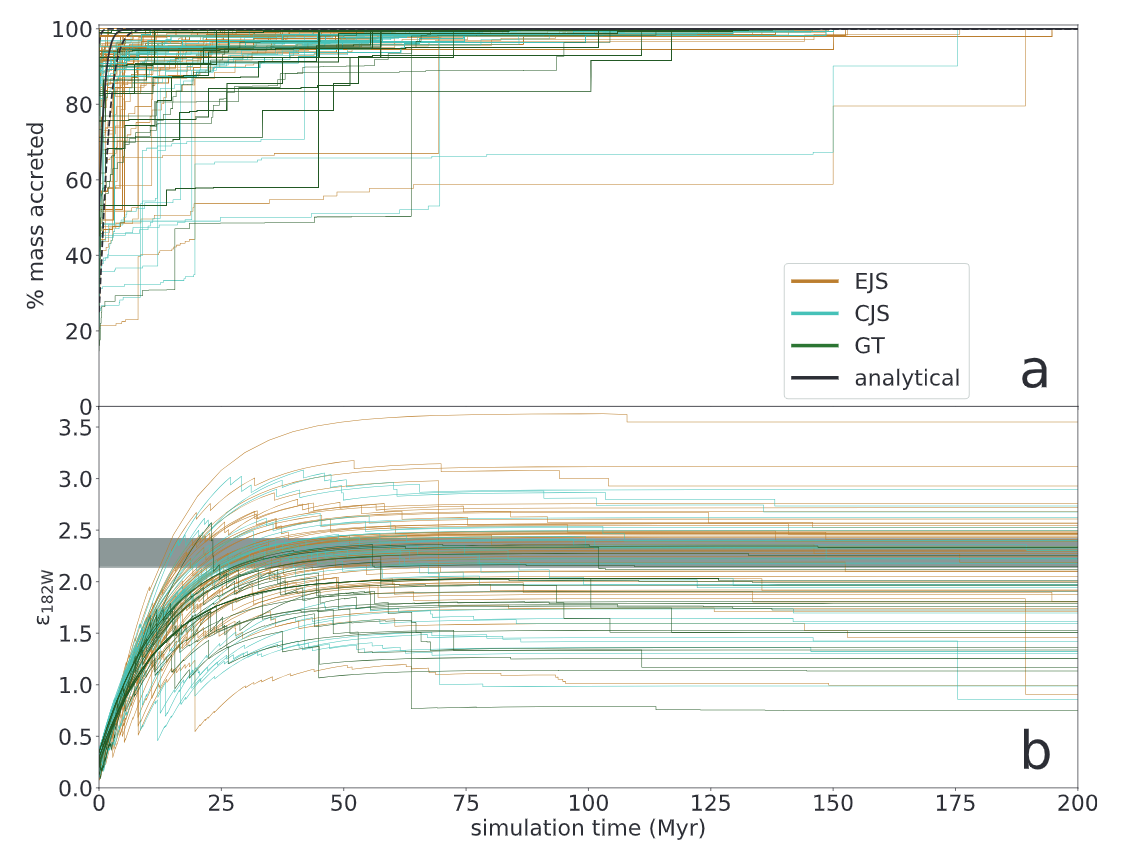
Fig. 3.60 Simulations of planetary growth under conditions relevant for Mars, showing evolution of mass (a) and epsilon-182W (b), or the “extra” 182W present in the Martian mantle relative to CHUR, or the chondritic uniform reservoir. 182W anomalies are dependent on factors such as redox conditions within the planetary interior, the partitioning of other elements into the core, and the geochemical properties of impactors. The shaded bar indicates the observed epsilon-182W of Mars. Credit: Brennan et al. (2022) Geochim. Cosmochim. Acta, 316, 295-308.#
Martian dynamo & cessation of the magnetic field
Mars currently lacks a global magnetic field. However, the Mars Global Surveyor magnetometer, and later higher-resolution studies by the MAVEN magnetometer, showed crustal magnetic anomalies over much of the surface with strong anomalies concentrated in the southern highlands. These imply the existence of a core dynamo (and thus active global magnetic field) on Mars during its early history. Understanding when the dynamo ultimately ceased is crucial to underatanding Mars’s long-term history, because dynamo loss is believed to accelerate atmospheric loss.
Orbiting magnetometers also showed that very large impact basins record weak magnetic anomalies, leading to the suggestion that Mars’s dynamo terminated very early - perhaps before 4.1 Ga. However, younger volcanic rocks are magnetised and new data from the ALH 84001 meteorite suggest that the Martian dynamo exhibited reversing polarity. Thermal and magnetic simulations of large impact events indicate that a reversing dynamo and conditions associated with large impacts can lead to weakly magnetised characteristics, leaving open the possibility that Mars’s dynamo persisted for longer than previously thought.
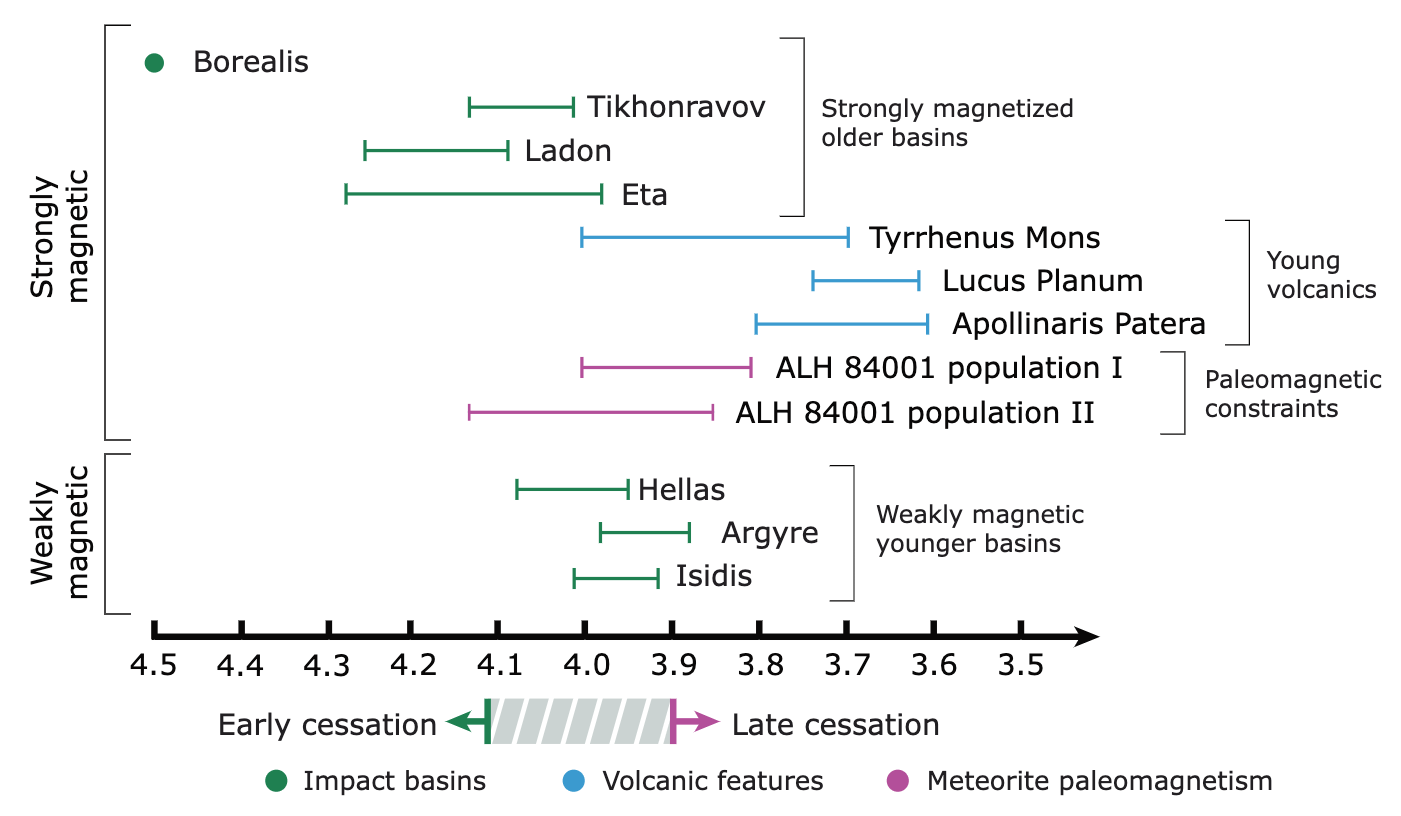
Fig. 3.61 Summary of constraints on Mars’s magnetic history. The longevity of the Martian dynamo is inferred from magnetically characterised impact basins (green), young magnetised volcanics (blue), and paleo-magnetic analysis of the ALH84001 meteorite (pink). Although some large basins formed after 4.1-4.0 appear demagnetised, young volcanics and ALH84001 may require an active dynamo as late as 3.6Ga. Credit: Steele et al. (2024) Nature Communications, 15, 6831.#
The early evolution of the Martian crust-mantle system
A variety of evidence suggests that volcanism may have impacted the long-term climate evolution of Mars. This is because volcanic eruptions liberate volatile species from the planetary interior to the atmosphere. So understanding the timing of volcanism, especially the vast and ancient Tharsis volcanic province, is critical to models of Martian climate history.
Geologic mapping, cratering statistics and geophysical arguments (specifically the relation between Tharsis, the underlying lithosphere and the orientation of younger valley networks) indicate that the bulk of Tharsis was emplaced very early (i.e., the mid-Noachian or even before).
Geologic evidence acquired from orbiters also shows that Mars was volcanically active through the Hesperian and into later geological intervals. These data show that the emplacement of large volcanic plains in the northern lowlands occurred over an estimated 30% of Mars in the Hesperian period.
Although volcanic rocks on Mars are generally basaltic in composition, orbital spectrometers, data acquired from rovers on fresh igneous rocks, and the discovery of the meteorite NWA7034 have revealed significant diversity in igneous compositions, which provides clues on the style of magmatism on early Mars. The most important finding is that “alkaline” rocks (i.e., those enriched in the alkalis Na and K) and related components are preserved on Mars. Also, highly differentiated igneous rocks (i.e., those that have formed from residual liquids that have been modified by physical/chemical processes) have been identified.
The occurrence of differentiated igneous rocks has led to the suggestion of a continental crust similar to that of the Earth, but most of the igneous lithologies are readily explained by a process referred to as fractional crystallization from basaltic melts (i.e., the extraction of liquid after significant crystallisation to form a new melt with a different chemical composition). This may reflect a style of magmatism that tended to occur in a relatively thick crust where pockets of melt might have stalled or were staged in the crust and then erupted after crystallisation had started.
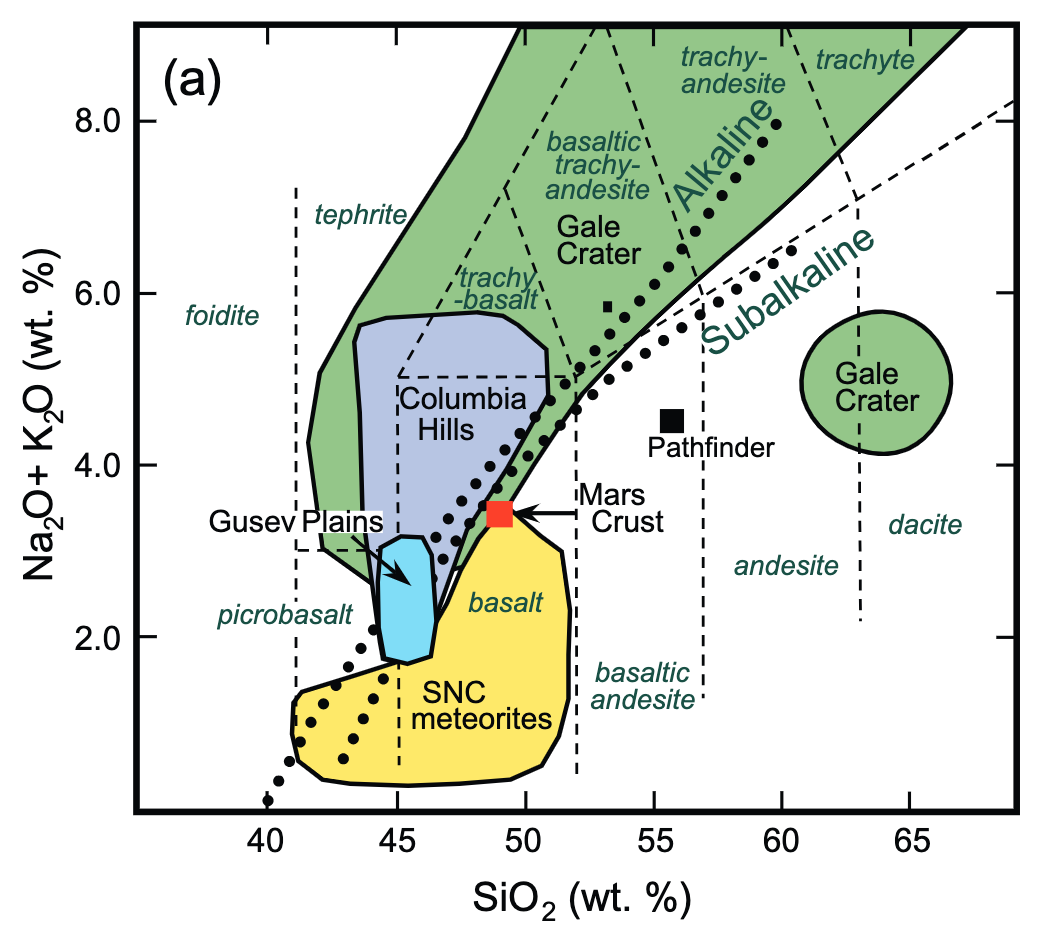
Fig. 3.62 A plot of (Na2O + K2O) versus SiO2 showing the range of igneous compositions observed on the surface of Mars by various rovers, and in the bulk composition of Martian meteorites. An estimate of the average composition of the Martian crust is also shown. Credit: McLennan (2022) Chapter 8. Composition of planetary crusts and planetary differentiation, in: Planetary Volcanism Across the Solar System. 287–331.#
Conclusions#
Cratering statistics, in combination with the first-ever direct geochronological measurements made by the Curiosity rover, have been combined to generate a calibrated relative timescale for Martian geological history; this timescale carries significant uncertainties in absolute age, but is generally reliable in determining relative ages.
The last two decades of orbital and landed Mars exploration, along with analysis of meteorites, has revealed a detailed geological history:
Mars accreted most of its mass within ~5 million years after solar system formation, but it could have continued growing for 10’s of millions of years. Core formation also happened relatively early, but the exact timing is unclear because of factors that can complicate the Hf-W system.
Mars had a global magnetic field but it ceased sometime later. When exactly this happened is critical to understanding the subsequent loss of the Martian atmosphere; it is likely related to the history of heat loss from the Martian interior which was presumably more rapid than Earth owing to its smaller mass.
A primary Martian crust appears to have been generated relatively early; the nature and timing of this earliest crust is not well understood. This primary crust appears to have been modified soon after its formation through magmatic processes.
The Tharsis volcanic province was constructed very early, with volcanism occurring and generally decreasing in frequency, through the Hesperian and Amazonian. Martian igneous rocks are surprisingly diverse in composition, which likely reflects the style of magmatism within Mars’s relatively thick crust. The timing and style of volcanism are crucial to interpretations of Martian atmospheric and climate evolution (the topic of the next lecture).
Further reading#
Farley, K. A. et al. In Situ Radiometric and Exposure Age Dating of the Martian Surface. Science 343, 1247166 (2014).
Werner, S. C. In situ calibration of the Martian cratering chronology. Meteorit. Planet. Sci. 54, 1182–1193 (2019).
Brennan, M. C., Fischer, R. A., Nimmo, F. & O’Brien, D. P. Timing of Martian core formation from models of Hf–W evolution coupled with N-body simulations. Geochim. Cosmochim. Acta 316, 295–308 (2022).
Steele, S. C. et al. Paleomagnetic evidence for a long-lived, potentially reversing martian dynamo at ~3.9 Ga. Sci. Adv. 9, eade9071 (2023).
Steele, S. C. et al. Weak magnetism of Martian impact basins may reflect cooling in a reversing dynamo. Nat. Commun. 15, 6831 (2024).
Day, J. M. D., Paquet, M., Udry, A. & Moynier, F. A heterogeneous mantle and crustal structure formed during the early differentiation of Mars. Sci. Adv. 10, eadn9830 (2024).
McLennan, S. M. Chapter 8. Composition of planetary crusts and planetary differentiation, in: Planetary Volcanism Across the Solar System. 287–331 (2022) doi:10.1016/b978-0-12-813987-5.00008-0.
Udry, A. et al. What Martian Meteorites Reveal About the Interior and Surface of Mars. J. Geophys. Res.: Planets 125, e2020JE006523-e2020JE006523 (2020).