
1. Course Overview#
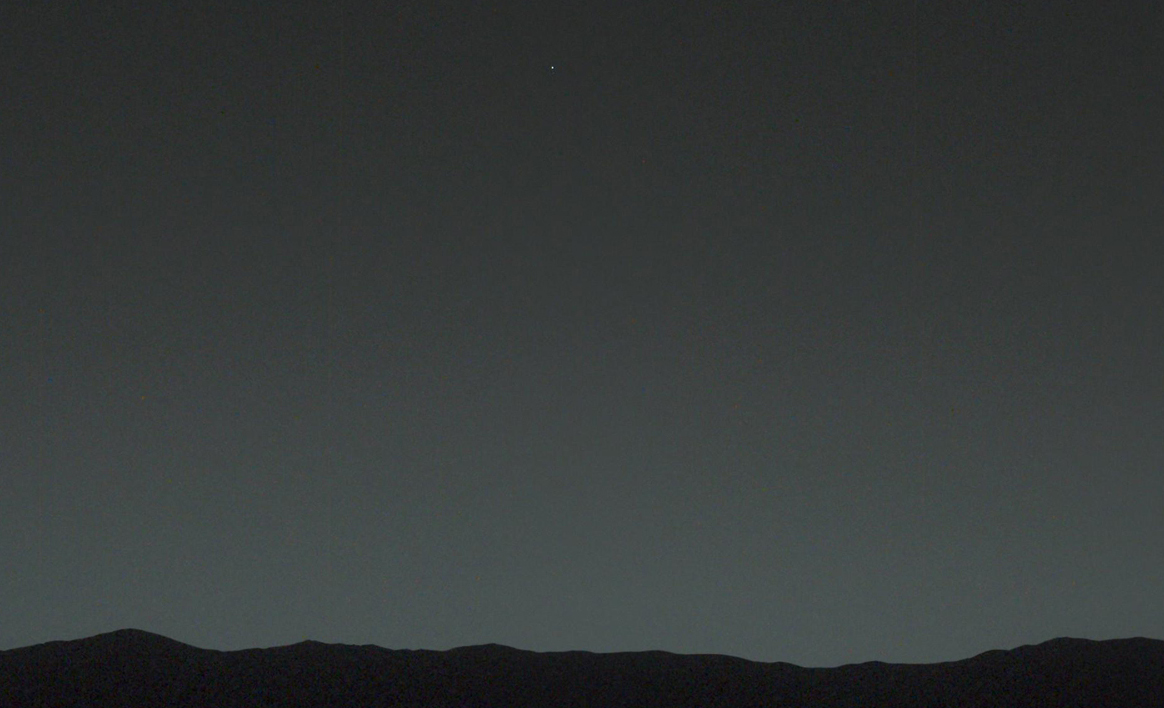
Fig. 1.1 Here, we are looking through the eyes of the Curiosity Rover, out over the rim of Gale crater, through Mars’s frigid atmosphere towards Earth, which is suspended in the top centre of the image. The Moon is visible faintly below Earth. Seeing the Curiosity rover look back at out planet emphasises that our exploration of the cosmos is necessarily rooted in the understanding of physics, chemistry and biology gleaned from Earth. Credit: NASA/JPL-Caltech/MSSS/TAMU.#
The PSLU core course asks two major questions:
How did life emerge on Earth?
How do we find life elsewhere?
To answer these questions requires bringing together expertise from the Astrophysics, Earth Sciences, Chemistry, and Biology communities. They are questions that need us to reconstruct Earth’s own history, from its assembly in the sun’s protoplanetary disk, through to its earliest climate, and on to the emergence of animals and technological life. By comparison to Earth’s terrestrial neighbours, and their strikingly different geological fates, we need build models of how planets may acquire and maintain habitability. As exoplanetary science has shown us, the diversity of worlds outside the solar system is striking, so the frontier of habitability may lie in conditions unlike any we have experience of from the solar system.
These questions test our creativity and imaginations in searching for life elsewhere. The PSLU Core Courses are designed to provide an overview of the key contributions that multiple disciplines can make to this search.
1.1. Table of contents for the module introductions#
The core course is split into four modules of 12 lectures each. Each module is also introduced with an overview lecture, placing the subsequent 12 lectures in their broader context. The notes for these overview lectures are given here:
1.2. How to use the course notes#
The notes presented here are a complementary resource to the lectures. They are not intended to be a verbatim account of what is said in the lectures. Instead, they offer an additional resource that touches on material in the lectures from the distinct angle afforded by written, as opposed to oral, communication. The notes may share common graphs with the lectures, or choose different images to illustrate the same concepts. We hope that by seeing similar content in different forms, you will find a style that best fits your learning. Importantly, you also have access to the lecture recordings and the lecture slides through moodle to use alongside these notes.
Each lecture is accompanied by notes that you will find on this site. If you find any errors or issues with the notes please contact the relevant lecturer (whose contact details will be at the top of the corresponding page) and the Course Coordinator so we can correct these.
The notes are accompanied by a glossary that attempts to define some of the more common terms in the highly diverse discipline of planetary science and life in the Universe. Undoubtedly terms are missing, and if you think a really important term should be added that is being used in the notes, please let us know and we would be happy to include it.