4. Origin and detection of life (C3)#
Life is inherently chemical, it must emerge from specific chemical environments, and through its metabolism brings about specific chemical transformations to those environments. In these 12 lectures we follow the chemistry of life from its beginnings in aqueous environments, the emergence of organic chemistry, explore atmospheres as chemical reactors both for forming life and detecting it, move further out to space and study the chemistry that happens there that may be relevant for fertilizing young planets with the ingredients for life, and finally bring this all together to look at discovering life from its chemical imprint on atmospheres.
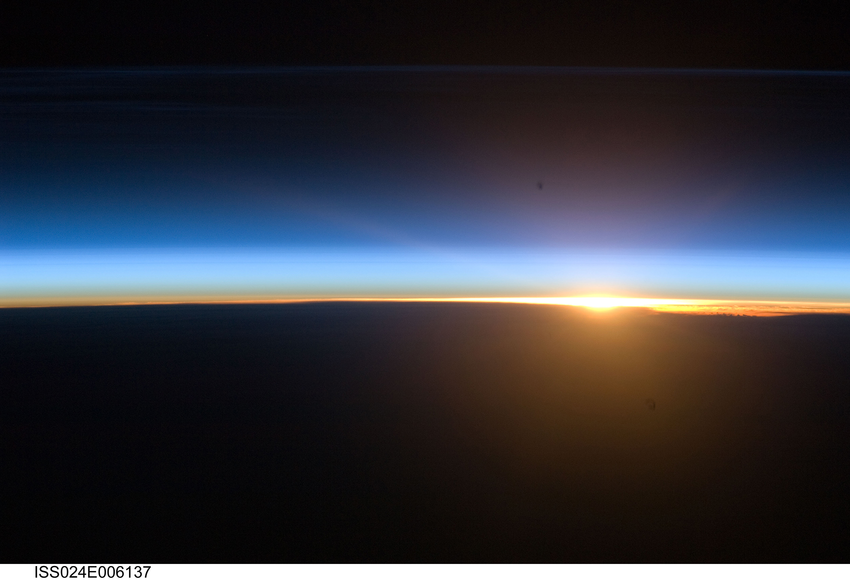
Fig. 4.1 Life has transformed the chemistry of Earth’s atmosphere, changing its very colour. Here we see the blue light of Earth’s limb from its stratospheric ozone layers. Image credit: Image Science & Analysis Laboratory, NASA Johnson Space Center.#
Learning outcomes
The overarching learning outcomes for this module are below, lecture-specific learning outcomes are included in the notes for each lecture.
Understand the basics of aqueous and organic chemistry
Understand the chemistry of atmospheres
Understand chemistry in astrophysical contexts
Be familiar with how the chemistry of environments can be used to detect life
Lectures
- 4.1. Fundamentals of organic chemistry I: How atoms fit together
- 4.2. Fundamentals of organic chemistry II: How molecules are different
- 4.3. Fundamentals of organic chemistry III: How molecules react
- 4.4. Why some chemical reactions happen
- 4.5. Astrochemistry: From the Insterstellar Medium to Comets
- 4.6. Atmospheric Chemistry I
- 4.7. Atmospheric Chemistry II
- 4.8. Fundamentals of Aqueous Geochemistry I
- 4.9. Fundamentals of Aqueous Geochemistry II
- 4.10. The Origins of Life as a Planetary Phenomenon
- 4.11. Detecting Biosignatures I
- 4.12. Detecting Biosignatures II