
3.5. Planetary cycles II: Plate tectonics#
Lecturer: David Al-Attar (Department of Earth Sciences)
Learning objectives:
Early observational evidence for continental drift and sea floor spreading.
Age versus depth model for the oceanic lithosphere.
Plate tectonics as a kinematic theory along with the supporting observations. The theory works well in the oceans, but only to a limited extent in the continents.
Plate motions do not relate directly to the flow of the mantle below.
The reason that plate-like behaviour emerges on the Earth is not fully understood, and cannot be self-consistently modelled.
The key concept that remains to be fully understood is the rheological behaviour of the lithosphere, and it is likely that subtle rheological effects account for the differing behaviours seen on the Earth, Venus, and Mars.
Continental drift#
Plate tectonics is often conflated with continental drift. The latter idea that the continents, somehow, move with respect to one another is principally associated with Alfred Wegener (1880-1930). Early evidence was largely geological, with people observing similarities in geological structures, rocks, and fossils between different continents. No plausible physical mechanism was proposed, with geologists evoking fantastical mechanisms without any understanding or care for known physics. It is relevant that an understanding of the solid-state creep mechanisms that allow the mantle to flow over geological time first emerged within materials science in the mid 20th century. Until these ideas were in place, the known forces acting on the Earth were vastly insufficient to account for large scale motion of the continents. Nevertheless, this remains, with, perhaps, some justification, an area in which geologists like to think they outsmarted arrogant geophysicists.
Sea floor spreading#
A key step towards plate tectonic theory was the sea floor spreading hypothesis due to Harry Hess (1906-1969) and Robert Dietz (1914-1995) in the USA. This is the idea that new ocean floor is produced in central ocean ridges and then spreads laterally, pushing the continents aside as it does so. Looking at a map of ocean bathymetry where we can see clear ocean ridges Fig. 3.39, this may seem obvious, but detailed maps of the ocean floor were only gradually becoming available following the second world war.
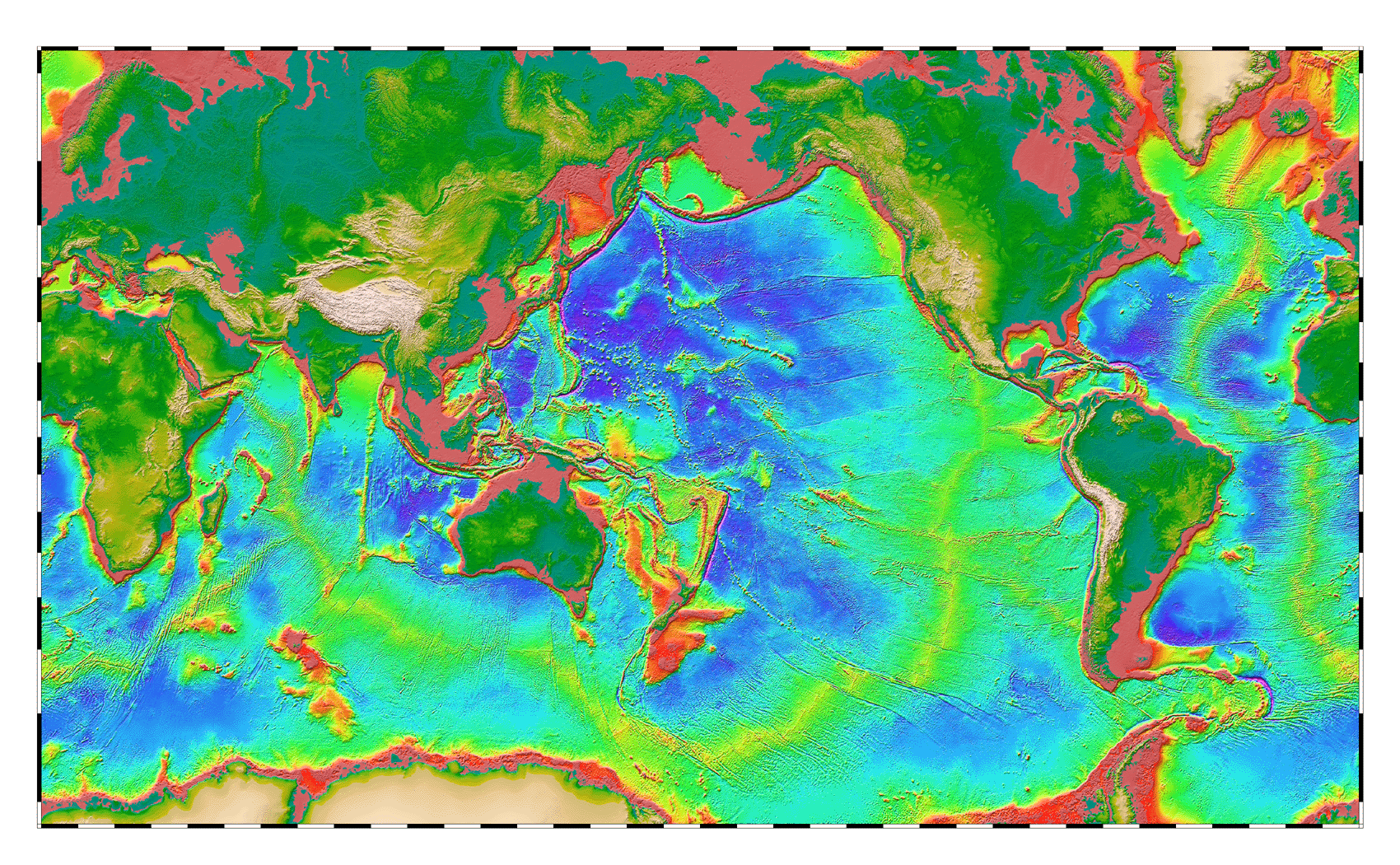
Fig. 3.39 Earth surface topography and bathymetry. Within the oceans clear ridge like structures can be seen. Figure taken from https://topex.ucsd.edu/marine_topo/text/topo.html#
The first conclusive evidence for sea floor spreading was provided through the work of Fred Vine (1939-2024), Drum Matthews (1931-1997) in the UK, and Lawrence Morley (1920-2013) in Canada. This idea depends on the observation that the polarity of the Earth’s magnetic field undergoes episodic reversals. These magnetic reversals can be recorded within certain types of rock (e.g., basaltic ocean floor which is comparatively rich in magnetic minerals), and their remnant magnetism can be measured. Careful study of such magnetic rocks coupled with radiometric dating of allowed for a detailed geomagnetic time-scale to be built back for hundreds of millions of years into the past.
Within the ocean basins, remnant magnetism could be measured from ships, and variations with position were progressively mapped out. As this was being done, a striking observation emerged. In sections transverse to ridge axes, a symmetric pattern of reversals could be seen on either side. These observations were clearly consistent with sea floor spreading from the ocean ridges, and, moreover, provided a quantitative means for dating the age of the ocean floor, and hence for quantifying the spreading rates.
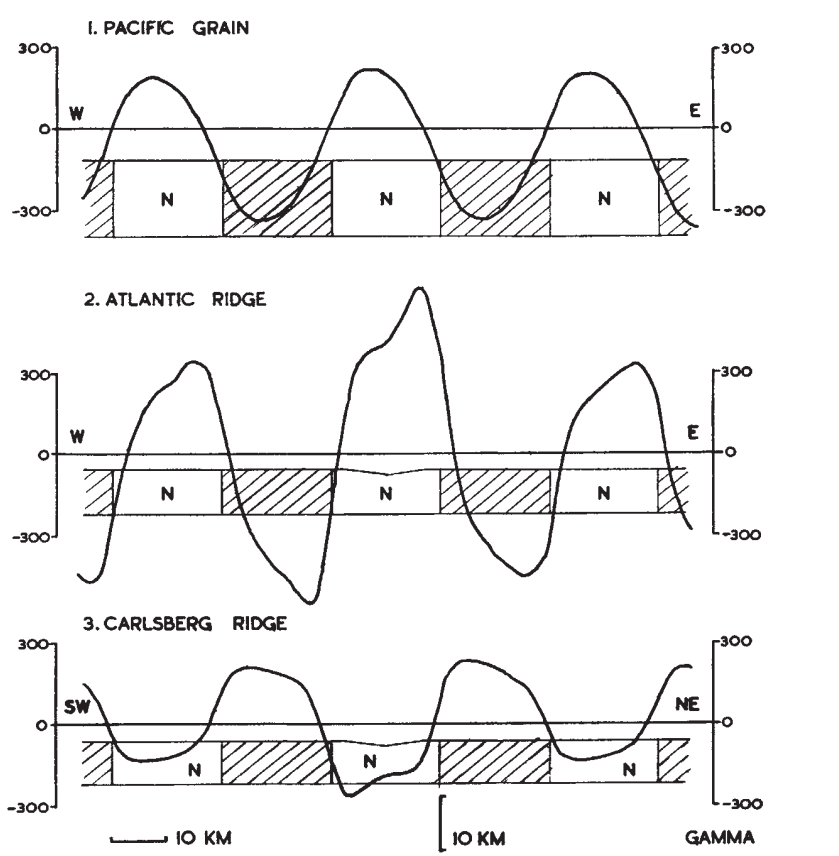
Fig. 3.40 Three magnetic profiles transverse to ocean ridges from the original paper by Vine and Matthews (1963). In each case, the ridge axis is in the centre of the profile, and on either side a symmetric pattern of reversals can be seen. Subsequent observations covering the entirety of the ocean basins confirmed the initial observations beyond any doubt.#
Age versus depth within the oceans#
Before turning to the development of plate tectonics, it will be useful to consider the relation between bathymetry and age within the ocean basins. As we have seen, magnetic reversals in the oceans provides a simple means for determining the age as a function of position on the sea floor. Such a plot is shown within Fig. 3.41, though note that the depth is plotted as a function of the square root of age. There is significant scatter, linked principally to dynamic topography, but an overall linear trend can be seen, with the depth systematically increasing with age.
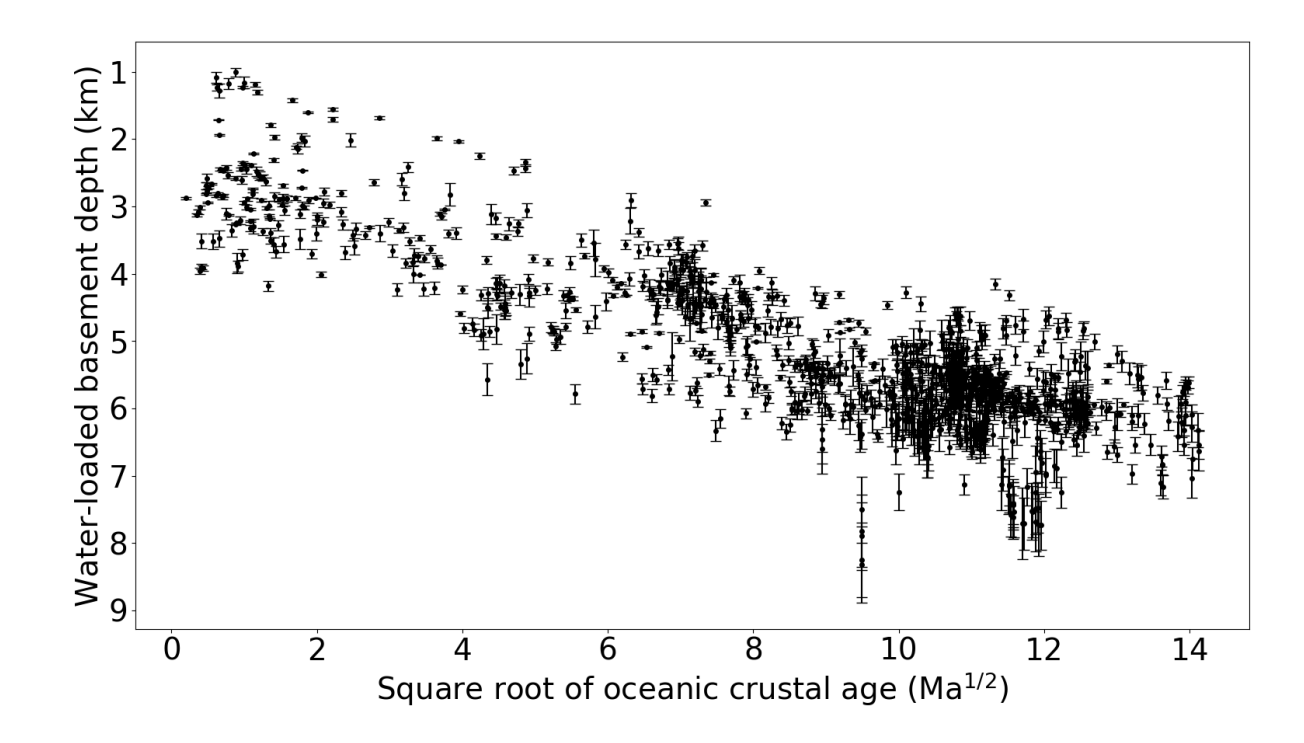
Fig. 3.41 A plot of water depth versus the square root of age from observations across the ocean basins. Data taken from Richards et al. (2018).#
A quantitative explanation for the observed behaviour can be provided at various levels of sophistication. Here we will apply a simple scaling argument along with an isostatic balance. This result is interesting in of itself, but it will also help us later understand one of the principal forces that drives plate motion.
Recall from the last lecture that the lithosphere comprises the crust and upper part of the mantle that are cool enough to behave elastically over geological time. As a result, heat transfer within the lithosphere is dominantly through conduction. We also showed last time that the time-scale for conductive cooling over a length-scale \(l\) is given by
with \(\kappa\) the thermal diffusivity.
At a mid ocean ridge new oceanic lithosphere is produced. This hot material then spreads laterally, and as it does so it cools, becomes more dense, and subsides. This is the basic mechanism that explains the observed age-depth relation. To quantify this, we assume that the lithosphere initially has the same temperature as the underlying mantle, and hence the same density, \(\rho_{m}\). Over a time, \(t\), this material will have moved laterally to a distance \(v t\) from the ridge, with \(v\) the spreading speed. In this time, a thickness, \(l \sim \sqrt{\kappa t}\), of the lithosphere will have cooled and become denser. The density increase is approximately \(\Delta\rho_{l} = \rho_{m} \alpha (T_{m} - T_{l})\), with \(\alpha\) the thermal expansivity and \(T_{l}\) the lithospheric temperature. This situation is summarised graphically in Fig. 3.42. Note that a more sophisticated treatment would solve the heat conduction equation to determine the variation of temperature, and hence density with depth.
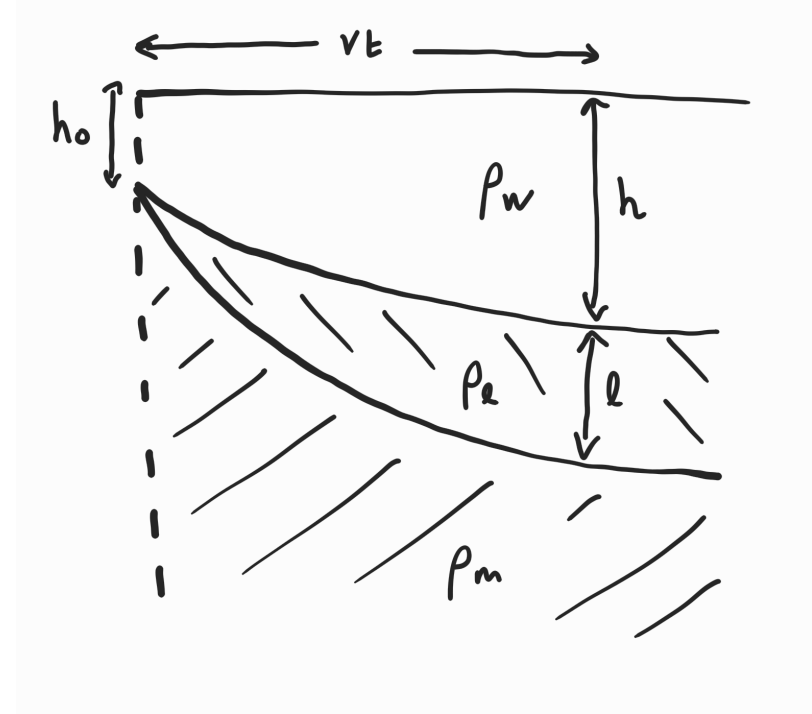
Fig. 3.42 The geometry for our simplified model for the cooling and subsidence of the oceanic lithosphere.#
To determine the subsidence associated with the cooling of the lithosphere, we apply an isostatic balance. This is the idea that at a certain compensation depth within the mantle the pressure within each vertical column should be equal. Assuming that the acceleration due to gravity does not vary significantly, equality of pressure is the same as the balance of mass per unit area, and hence we are led to the expression
where \(\rho_{w}\) is the density of water, and \(h_{0}\) the water depth at the ridge. Solving for \(h\), we find
and hence we arrive at
where we can see the square-root of time dependence.
The model just described predicts that the lithosphere gets thicker and thicker as it ages. In reality, the underlying mantle acts as a heat source. This places an upper bound on the lithospheric thickness, and the and the ocean floor is found to level off at large ages (greater than around 80 Ma).
Plate kinematics#
Plate tectonics views the surface of the Earth as being split into a relatively small number of rigid plates that undergo relative motion. In particular, the deformation necessary to accommodate this motion is limited to thin regions around the plate boundaries. Importantly, plate tectonics is a kinematic theory that explains the manner in which these plates must move, but it does not explain why they move.
It is worth remembering that the question of whether or not a planet has plate tectonics is asking whether a specific kinematic model is relevant to understanding its behaviour. Indeed, plate tectonics arose in the late 1960s, and by the 1970s it was clear that this theory is only really applicable within the oceans. The behaviour of the continents is significantly more complicated, with broad regions of diffuse deformation seen within their interiors. This led to the development of various theories for continental tectonics, though there is not time to discuss any of them.
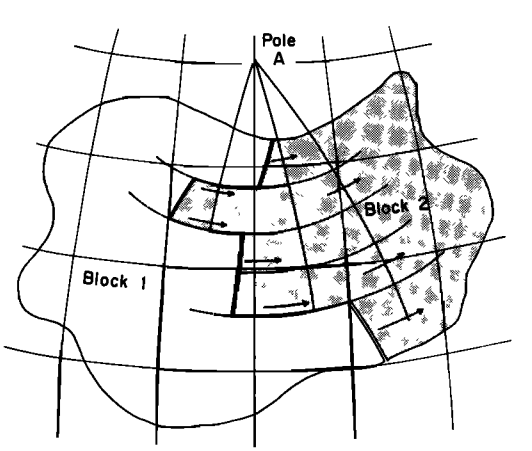
Fig. 3.43 A figure from Morgan (1968) showing graphically the constraint that the relative motions of rigid plates (or blocks in his terminology) on the Earth’s surface can be described by rotation about an axis through the Earth’s centre (represented by a pole on the surface).#
The central idea of plate tectonics is that the plates are rigid, which is to say that they do not undergo appreciable internal deformation. We can view each plate as an irregularly shaped spherical cap on the Earth’s surface. It is a result of geometry that the only possible motion of such a rigid spherical cap is a rotation about the Earth’s centre. Thus, at an instance in time, the kinematic description of plate motion is reduced to specifying a set of rotation axes and mangitudes. Using this geometric insight, McKenzie and Parker (1967) and Morgan (1968) independently showed that observed surface motions (inferred from a range of proxies) were consistent with the plate tectonic model.
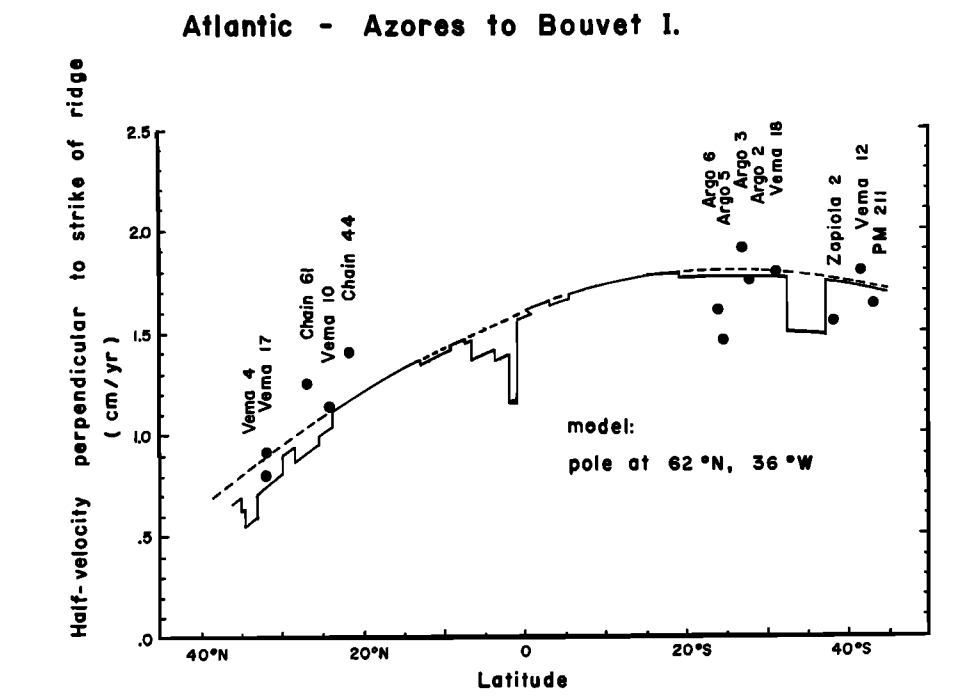
Fig. 3.44 An early quantitative test of the plate tectonics from Morgan (1968). If the relative motion across the mid Antlantic ridge is described by a rotation, then there should be a systematic variation of spreading rate with distance from the rotation pole. Here the predictions for a best fitting rotation pole are compared with spreading rates inferred from using magnetic anomalies.#
Earthquakes and Subduction zones#
Within the early history of plate tectonics, a prominent role was played by earthquake seismology. This is firstly because earthquakes occur at plate boundaries in response to their relative motion, and hence earthquake locations can be used to delineate plate boundaries. A modern example of such a map is shown in Fig. 3.45. As with the earlier plot of ocean bathymetry, when looking at such a figure it is hard not to think the reality of plate tectonics is entirely obvious, but global maps of seismicity were only just emerging when plate tectonic theory was developed.
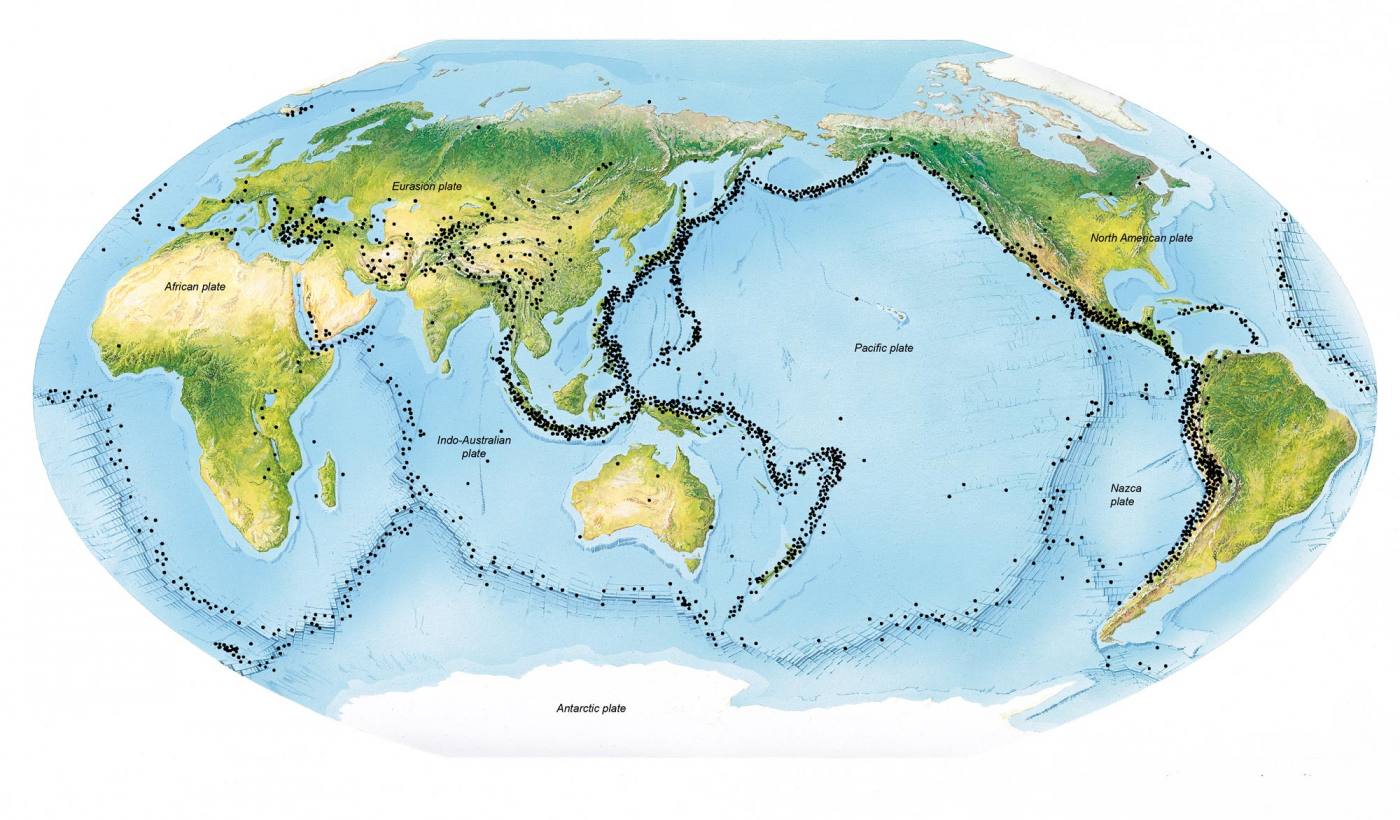
Fig. 3.45 A map of global earthquake distribution and their relation to the tectonic plates. Within the oceans, earthquakes are seen to sharply delineate the plate boundaries, but this simple correspondence breaks down in continental regions such as the Himalayas. Taken from the BGS.#
As well as locations, seismological methods also provide information on the sense of relative motion that caused an earthquake. There is not time to discuss how this method works, but the directions provided were data for testing plate tectonic theory, and hence for determining rotation poles for the different tectonic plates.
A particularly important example of this is in the study of subduction zones. More will be said about subduction zones later in the course, considering in particular their role in volcanism and in chemical cycles between the Earth’s surface and mantle. For the moment, we can think of them simplistically as areas, generally at the margins of ocean basins where the oceanic lithosphere has cooled sufficiently to become unstable and sink into the convecting mantle below. The path of these subducted slabs into the mantle is delineated by earthquakes, with the inferred senses of motions being consistent with our interpretation.
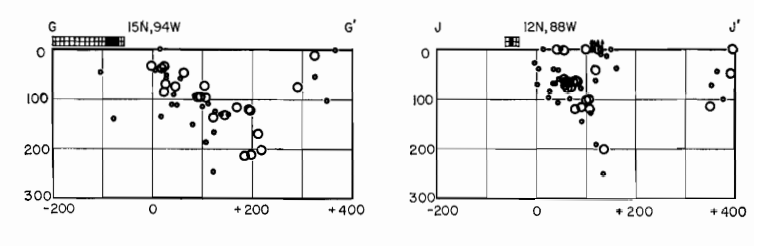
Fig. 3.46 Cross sections of earthquake locations along sections transverse to the subduction zone under Central America. The motion of the subducted slab is westward under the continent, and here we see its path into the mantle delineated by the increasing depth of the earthquakes while moving east to west. From Molnar & Sykes (1969).#
Plate dynamics#
We have now summarised the observational evidence that led people to accept plate tectonics as a kinematic theory that well describes the relative motions seen within ocean regions and some continental ones. But what causes this surface motion, and how does it relate to convection in the mantle below?
The first thing to say is that plate motions do not simply reflect convective motions in the mantle. Such a simplistic view is commonly shown in textbook cartoons, but observations show clearly that things are more complicated. For example, there are locations at the margins of the Pacific where mid ocean ridges are being actively subducted! It is for this reason that the speed at which plates move cannot be straightforwardly identified with the speed of the convecting mantle, though their orders of magnitudes are still expected to be similar.
There are thought to be three principle mechanisms that drive oceanic plates. In each case, simple quantitiative models can be developed, but we will just summarise the basic ideas.
First, there is ridge push. This is the force linked to the lateral pressure gradient that exists between the ridge axis and older sea floor that has cooled and subsided. The existence of such a force can be readily understood by looking back to Fig. 3.42.
The next force is known as slab pull. This is the negative buoyancy force transmitted from a subducted part of the slab to the rest of the plate.
Finally, there is viscous drag, this being the horizontal force applied to the base of the lithosphere by the flow of the underlying mantle.
The relative importance of these different forces can be assessed using a range of methods and observations. For example, if slab pull is important, we would expect the typical speed of plates to increase as a function of their boundary being subducted, and this indeed seems to be the case.
The key point for us to understand is that while the motion of the plates does, ultimately, result from the convection in the mantle, the precise relation between these processes is complicated, with plate speeds and directions not providing a direct view of the underlying mantle flow.
Is plate tectonics an inevitable consequence of mantle convection?#
No. This is shown clearly by looking at Mars and Venus. Both planets are of a similar size and age to the Earth, and it is certain that their mantles are undergoing active convection. But neither has plate tectonics. On Mars there are a few surface features that resemble those produced by plate tectonics, and it is possible that in the past its behaviour was more similar to the Earth. Venus, on the other hand, seems to be entirely different from the Earth, with no sign of tectonic plates.
The big question are, therefore, why the Earth has plate tectonics, why other similar planets do not, and what range of tectonic behaviours might arise. This is a difficult questions that can only be partially answered. At present, it is not even possible to self-consistently model and understand plate tectonics on the Earth. This is not an issue of the basic physics, but of the appropriate rheology for the Earth’s mantle and lithosphere. We have seen that within the lithosphere deformation is strongly localised to regions along plate boundaries. Within complicated numerical simulations, it has been possible to replicate this plate-like behaviour, but only by “hard coding” weak areas along the plate boundaries.
The precise mechanisms by which plate boundaries form is largely unknown. There are certainly good ideas, but none are yet conclusive. One interesting idea is that of a damage rheology, with lithospheric material being gradually weakened as it is deformed through processes such as grain size reduction (e.g., Bercovici & Ricard 2014). Areas that have been weakened undergo greater deformation in response to forcing, and hence tend to weaken further. This provides a feedback mechanism by which deformation can localise within narrow regions.
Rheological differences are, presumably, the factor that leads to different behaviour between the Earth and similar planets such as Mars and Venus. Here seemingly subtle points could be very important. For example, the Earth has surface water, with this water cycled through the mantle through ocean ridges and subduction. A small amount of water, in the form of hydrous minerals, within mantle material is known from experiments to have a substantial effect on their rheological behaviour. It is possible that Venus does not have plate tectonics because it lost its surface water early in its history, and as a result, its lithosphere is too strong to break into plates.
Clearly these are not settled matters. From the perspective of a planetary scientist musing about the interior dynamics of an exoplanet it is, however, important to know and remember that the behaviour of the Earth’s mantle is not fully understood and cannot be self-consistently modelled. This should serve as a note of caution for those inclined to run complicated numerical convection codes within a new parameter regime in the hope of learning something new.
Further reading#
Turcotte, D.L. and Schubert, G., 2002. Geodynamics. Cambridge university press.
References#
Bercovici, D. and Ricard, Y., 2014. Plate tectonics, damage and inheritance. Nature, 508(7497), pp.513-516.
McKenzie, D.P. and Parker, R.L., 1967. The North Pacific: an example of tectonics on a sphere. Nature, 216(5122), pp.1276-1280.
Molnar, P. and Sykes, L.R., 1969. Tectonics of the Caribbean and Middle America regions from focal mechanisms and seismicity. Geological Society of America Bulletin, 80(9), pp.1639-1684.
Morgan, W.J., 1968. Rises, trenches, great faults, and crustal blocks. Journal of Geophysical Research, 73(6), pp.1959-1982.
Richards, F., Hoggard, M., Crosby, A., Ghelichkhan, S. and White, N., 2020. Structure and dynamics of the oceanic lithosphere-asthenosphere system. Physics of the Earth and Planetary Interiors, 309, p.106559.
Vine, F.J. and Matthews, D.H., 1963. Magnetic anomalies over oceanic ridges. Nature Publishing.