2.3. Exoplanets III: Compositions#
Professor: Amy Bonsor (IoA)
Learning objectives:
Understand atmospheric characterisation of exoplanets as a key methodology.
Constraining the interiors of exoplanets from mass-radii alone.
The use of host-star composition in constraining planetary composition.
How white dwarf observations can provide information on exoplanet compositions
This lecture will discuss the composition of exoplanets and the best available means to characterise compositions from current observations. The lecture will start by discussing how mass and radii measurements characterise planetary interiors, but are limited by degeneracies in the modelling. Host-stars provide crucial insights that help to break these degeneracies. Spectroscopy of exoplanet atmospheres provide an exquisite window regarding individual exoplanets and their composition. Spectroscopy of white dwarfs that have accreted planetary material provide complimentary insights regarding bulk composition, crucial for investigating the mineralogy of rocky material and its geology.
Key Terms:#
Absorption Spectrum#
Light that passes through the atmosphere is absorbed by particles in the atmosphere leading to characteristic fingerprint in the absorption spectrum. These fingerprints can be identified with specific elements or molecules.
Emission Spectrum#
Photons from light excite atoms within the planetary atmosphere. As they transition (or decay) to a lower energy state, they emit photons of a characteristic wavelength. These emission features can be linked to the elements or molecules that produced them.
Primary transit#
The primary transit occurs when a planet passes infront of the star, blocking light from the star.
Secondary eclipse#
The eclipse of the exoplanet as it passes behind the host star.
Core, Mantle and Redox#
The core of planet is the Fe-Ni alloy often found at planet’s centre, surrounded by a mantle largely composed of silicate material. The availability of oxygen during the core formation (redox) determines the composition (size) of the planet’s core and mantle
Exoplanet Interior Characterisation#
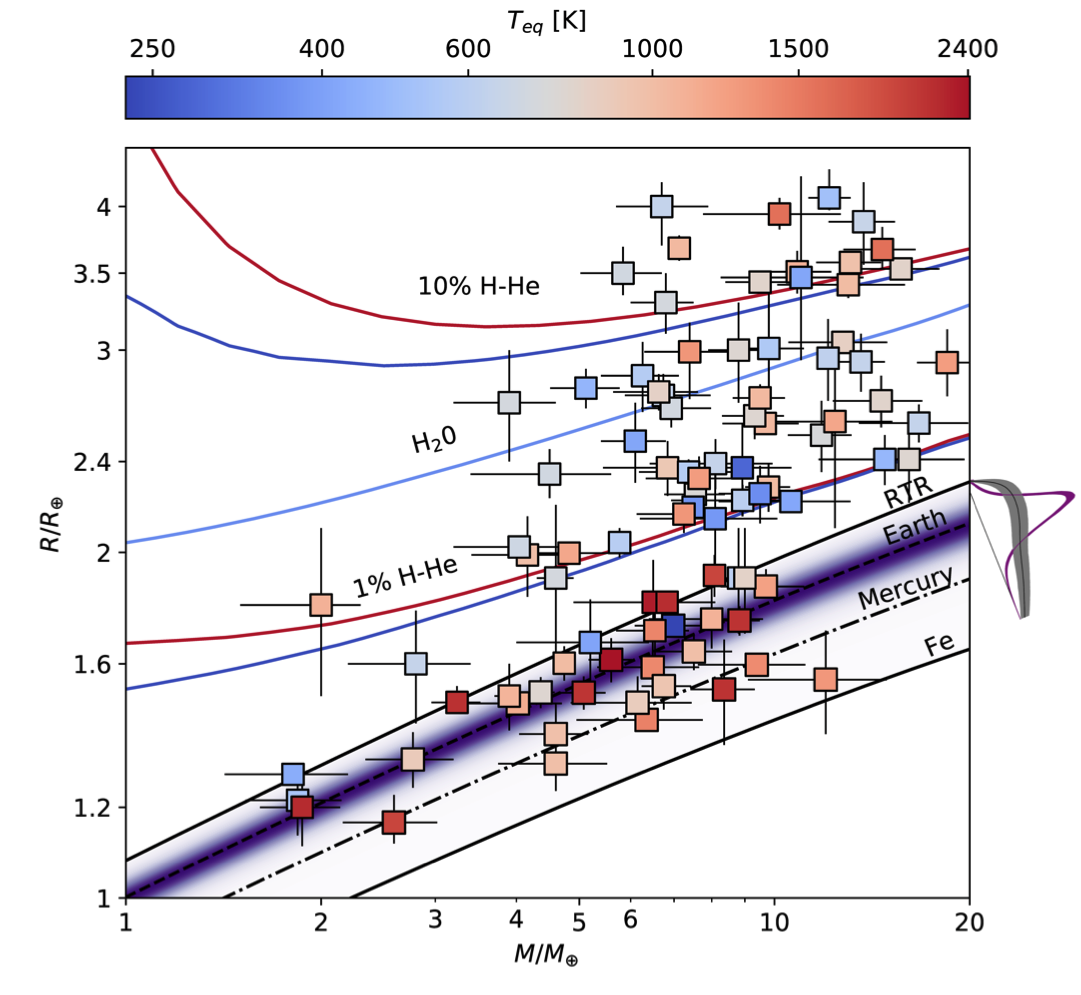
Fig. 2.15 The mass and radius of small exoplanets with measurement uncertainities, color coded according to their equilibrium temperature. Mass radius relations for pure Fe-Ni, Mercury-like (core mass fraction of 0.63), Earth (core mass fraction of 0.325), earth-like rock with 1% and 10% H-He by mass. Figure from Nettelman et al, 2021.#
For the sub-set of exoplanets with both mass and radius measurements, it is possible to characterise their interiors. Whilst broad characterisation can readily distinguish gas giants from smaller rocky planets, detailed characterisation, for example in the sub-Neptune regime, is limited by precision on mass-radius measurements, as well inherent degeneracies in using bulk density to characterise planetary interiors. Both transit and radial velocity observations rely heavily on a good knowledge of the stellar properties to provide precise measurements, as well as being limited by the small number of photons collected from distant exoplanets.
Fig. 2.15 shows the masses and radii measurements for a sub-set of small exoplanets, alongside mass-radius relations for planets of different compositions. There are clear differences in mass-radii between rocky planets and water-worlds and/or rock plus atmosphere, however, the latter two interior solutions lie in a similar parameter space. Bayesian methods are commonly used to find the most likely interior structure. The position of planets in the mass-radius plane poses many questions regarding their formation, particularly for sub-Neptunes that sit around the radius valley (as discussed in Lecture 9), but also for example for planets apparently more iron-rich than Mercury (super-Mercuries).
Models for planetary interiors most commonly assume a set of layers of rock, ice, water and atmosphere. The planetary interior expresses the balance between the downwards gravitational force and the upward differential pressure force at any point in the planet at a distance \(r\) from the planet’s centre of mass:
\(\frac{dP(r)}{dr} = - \rho(r) g(r),\)
where \(P(r)\) is the pressure, \(\rho(r)\) the mass density and \(g(r)\) the gravitational acceleration at a radial distance \(r\). Fig. 2.16 shows that interior pressures and temperatures can be significantly higher than in Solar System planets, highlighting the need to study the behaviour of relevant materials at these pressures and temperatures. The abrupt changes in density and pressure profiles occur at the boundary between the core and mantle.
Planetary cores are made predominantly of iron. The high temperatures found in the centre of terrestrial planets due to the accretional gravitational potential energy are sufficient to lead to large-scale melting at early times in the planet’s evolution. This large-scale melting leads to the segregation of the iron melt from the silicate mantle and the formation of a planetary core. The size of the core depends in a complex manner on the composition of the planet-forming material, its redox state and the formation process. Super-Earths may be significantly larger than Earth, but it is not a priori clear whether they have larger cores. The large core of Mercury may be down to the composition of the planet-forming material, or due to a late, violent collision during Mercury’s formation.
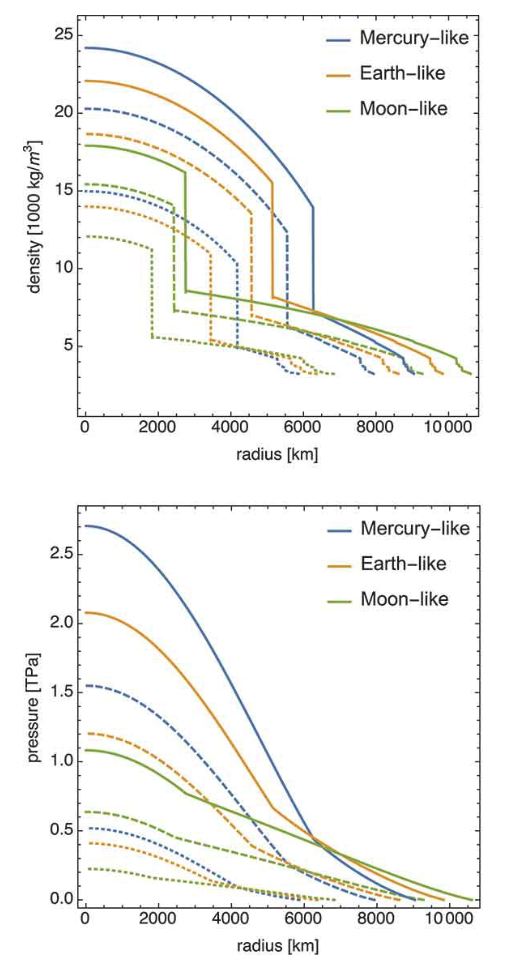
Fig. 2.16 The density (top) and pressure (bottom) as a function of radial distance inside a super-Earth, with 1 (dashed) 3 (dotted) and 5 (continuous) \(M_\oplus\) and a bulk-iron mass fraction of 35% (Earth-like), 5% (Moon-like) and 63% (Mercury-like). Figure from van Hoolst et al, 2019.#
Host-stars#
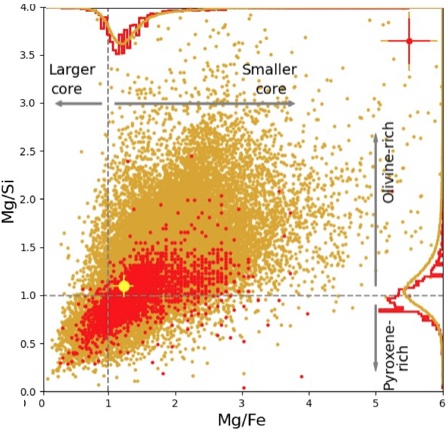
Fig. 2.17 The Mg/Si and Mg/Fe of FGK stars from the GALAH survey (yellow) and Hypatia (red). The availability of Mg/Si controls the silicate mineralogy whilst the availability of Fe controls the size of the iron core of a rocky planet. Figure from Guimond et al, 2024.#
Main-sequence stars can be readily characterised using optical or near-infrared spectroscopy. As planets and stars form out of the collapse of the same material, if their refractory compositions match, characterisation of the host-star composition can provide powerful insights regarding the exoplanet interior. A large number of studies have shown that using host-star compositions can provide significant insights regarding the minerals present in an exoplanet’s interior and the planet’s interior structure.
When characterising an exoplanet’s interior from mass and radii measurements alone, if it is assumed that the refractory composition of the planet matches that of its host-star, many degeneracies can be removed in modelling the interior structure (e.g. Dorn et al, 2015). Planetary mantles are composed predominantly of silicates. The bulk Mg/Si of the planet-forming material determines whether the silicate mineralogy is dominated by olivine (high Mg/Si) or pyroxene (low Mg/Si). Olivine dominated mantles with high Mg/Si have higher water storage capacity than those with low Mg/Si (e.g. Guimond et al, 2024, Wang et al, 2023).
Atmospheric Characterisation#
The next big frontier in exoplanetary research involves the characterisation of atmospheres. Atmospheric characterisation provides some of the best means to assess the state of an exoplanet, probe its interior and evolution. There are multiple methods to access data from the atmosphere of a planet: transmission spectroscopy, reflection spectroscopy and thermal emission.
Thermal Emission#
Radiation from an exoplanet can be directly detected. This method is best suited to hot, young exoplanets that orbit sufficiently far from their host-stars for the exoplanet’s light not to be confused with the stellar emission. Absorption of the emitted radiation by gases in the exoplanet’s atmosphere yields a particular fingerprint that can be associated with the composition of the exoplanet’s atmosphere. Direct imaging is limited by the angular proximity of the planet to the star, atmospheric turbulence and the high star to planet contrast ratio required. Hints of water were already seen in the spectrum of larger Jupiter mass planets imaged already more than 20 years ago, for example Chauvin et al, 2004, shown in Fig. 2.18. The real challenge for this field in order to image Earth-like planets is the contrast ratio between the star and planet, with future observatories such as the ELT and Habitable Worlds Observatory playing a crucial role.
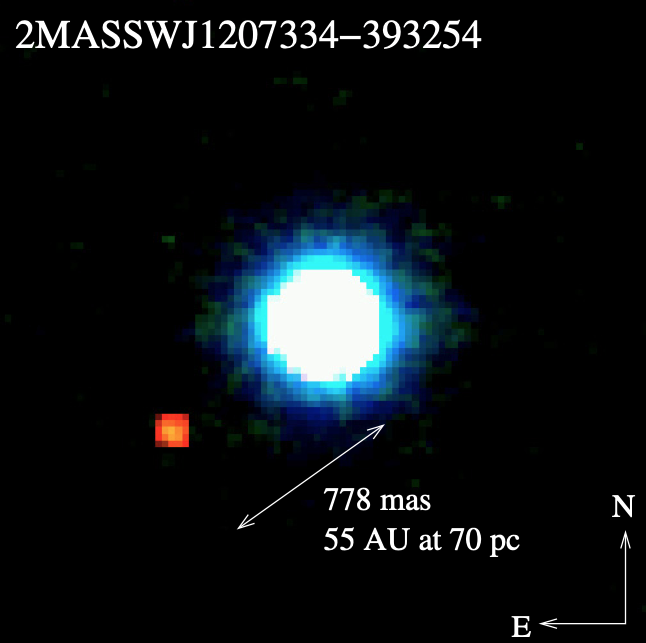
Fig. 2.18 The direct detection of a \(5\pm2\) M\(_J\) companion to the brown dwarf, 2MASSWJ1207334 Chauvin et al, A&A, 2004.#
Transmission Spectroscopy#
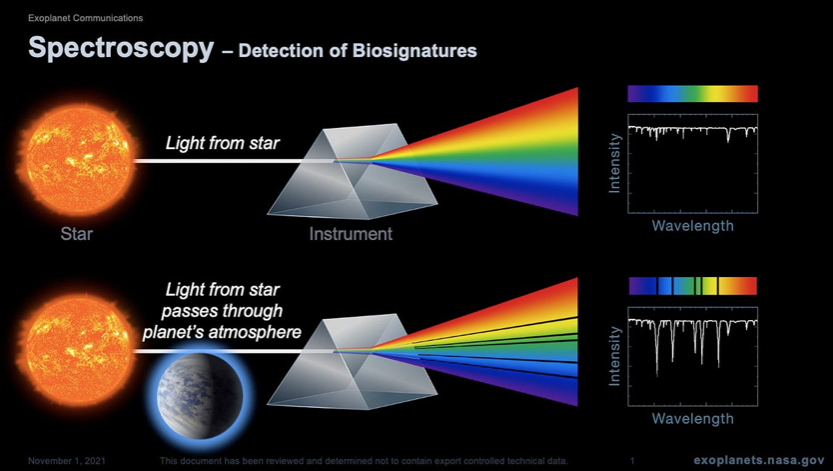
Fig. 2.19 The light from the star passes through the atmosphere of the star during a transit. Light is absorbed by molecules in the atmosphere leading to a particular fingerprint in the spectrum observed. Credit:NASA/JPL-Caltech.#
For those exoplanets that transit their host star, a small fraction of the star-light passes through the planetary atmosphere, as illustrated by Fig. 2.19. Particles in the exoplanet’s atmosphere absorb light at particular wavelengths, such that the shape of the transit changes as a function of wavelength. This variation in the shape of the transit as a function of wavelength can be interpreted in terms of the composition of the planet’s atmosphere.
Transmission spectroscopy of gas giants is now routine and with the JWST transmission spectroscopy is moving towards characterising the atmospheres of sub-Neptunes, such as the example of K 2-18b shown in Fig. 2.20 with the hope to reach Earth-like planets in the near future.
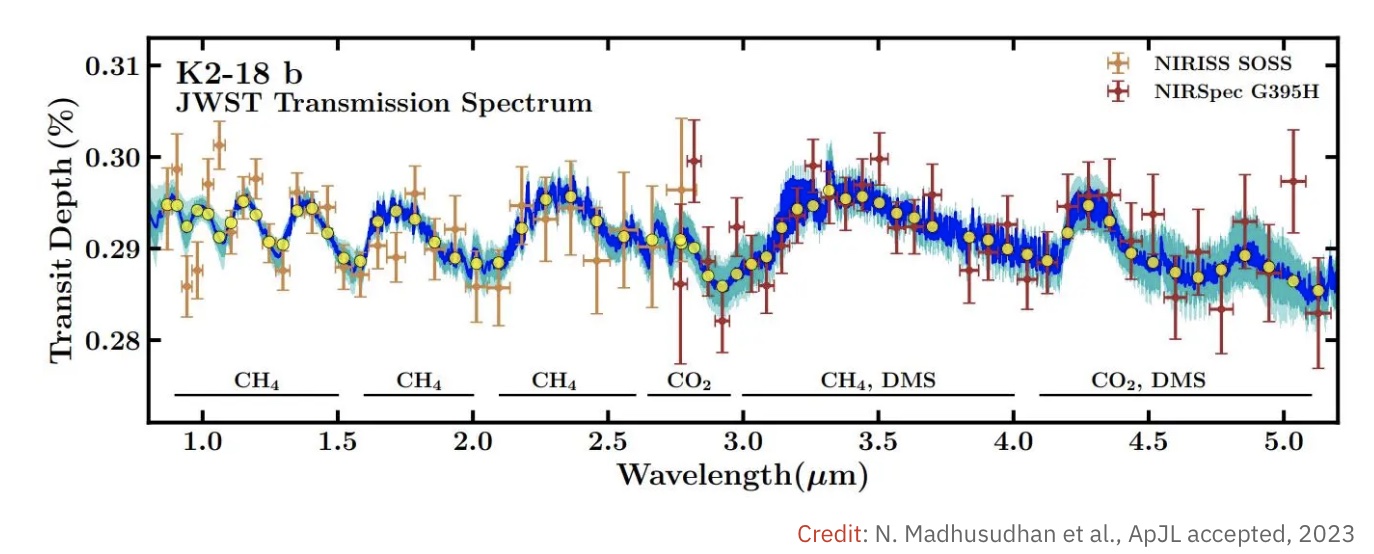
Fig. 2.20 The transmission spectrum of the exoplanet, K2-18b taken with JWST. Shown is the signal as data points with error bars, alongside the interpretation from Madhusudhan et al, 2023, including detection of CO\(_2\) and CH\(_4\)#
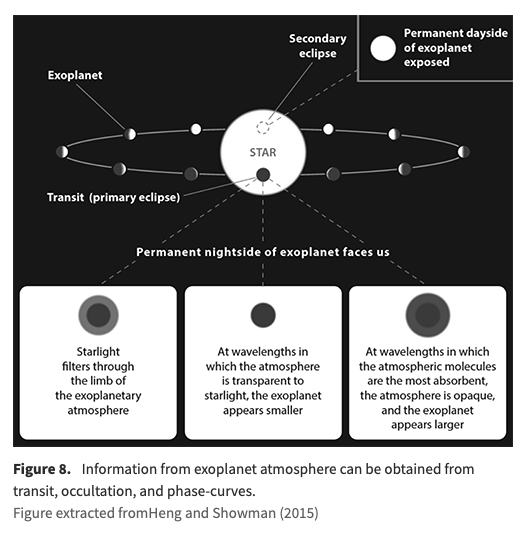
Fig. 2.21 The mass and radius of observed exoplanets tell us their bulk density and whether they are rocky or gas giants. (ref)#
Exoplanet Compositions from White Dwarfs#
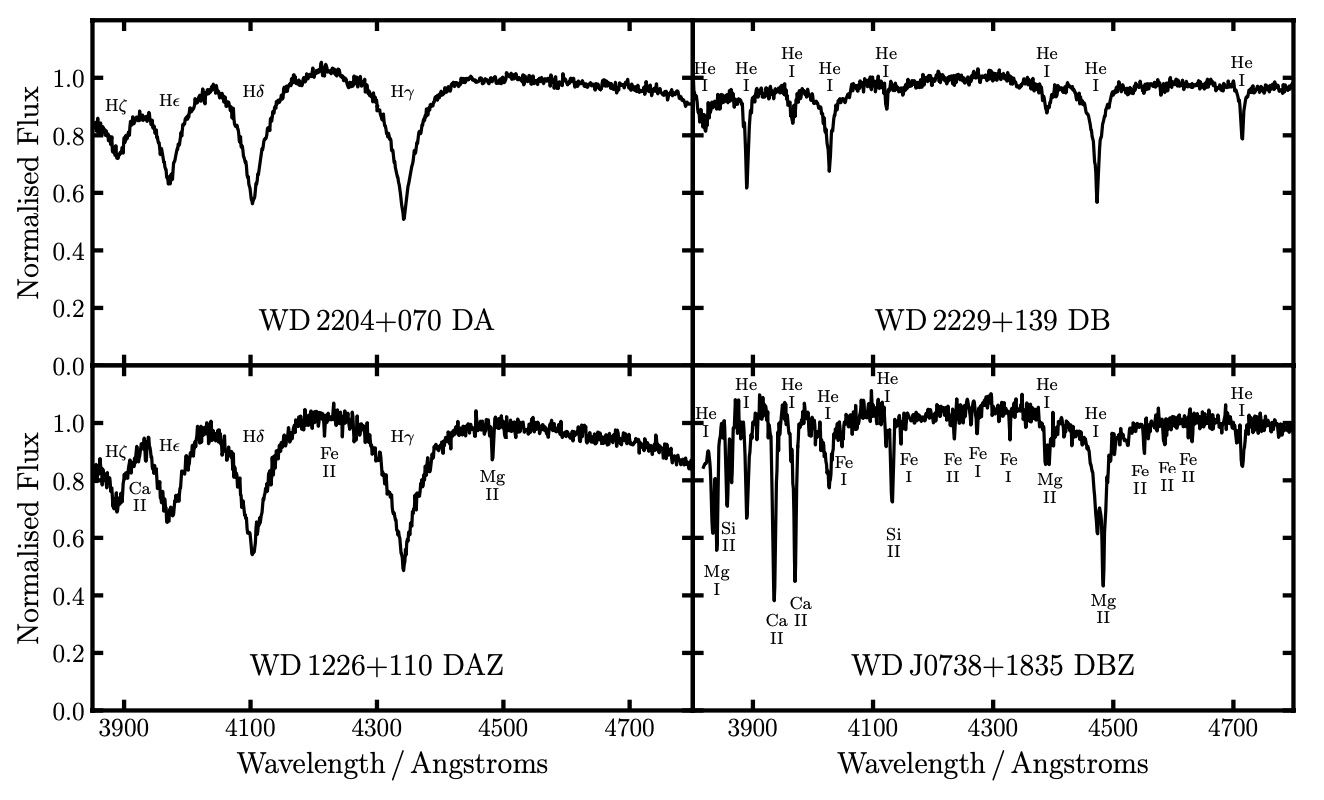
Fig. 2.22 The spectra of four white dwarfs with hydrogen (top panels) and helium-rich (bottom panels) atmospheres. The left-hand panels show typical white dwarfs with clean atmospheres, whilst the right-hand panels show the presence of metals from accreted planetary material. Coupled with a white dwarf atmosphere model, the absorption features can be interpreted in terms of relative abundances of each species in the visible atmosphere. Harrison et al, 2020.#
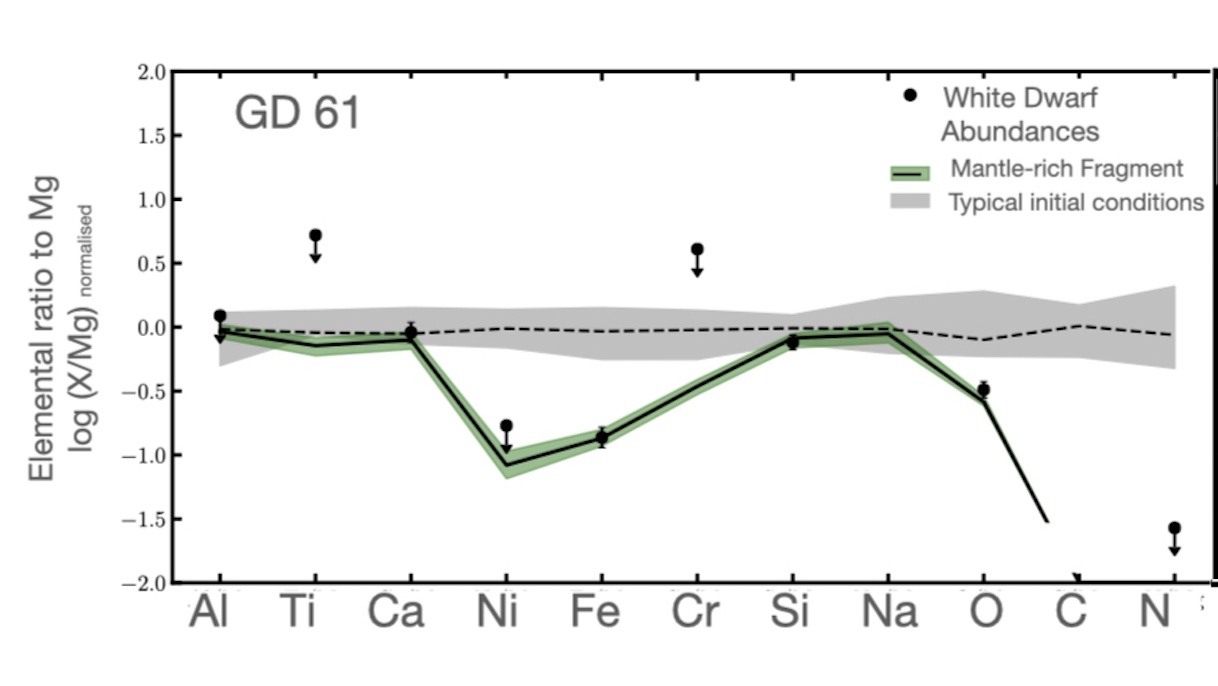
Fig. 2.23 An example of a white dwarf that has accreted planetary material whose compositions indicate the accretion of mantle-rich material (GD 61, data from Farihi et al, 2013). Xu & Bonsor, 2021.#
The faint remnants of stars like our Sun provide a unique opportunity to study bulk exoplanetary compositions. These tiny stars (about the size of Earth) have a very high surface gravity, leading to thin, stratified atmospheres. Any elmenets heavier than helium sink out of sight on timescales of days (hottest, hydrogen atmosphere white dwarfs) up to millions of years (coolest, helium atmosphere white dwarfs). If material from an asteroid or comet enters the planetary atmosphere, absorption features from metals show up in the white dwarf spectra as the planetary material sinks out of sight, as shown on Fig. 2.22. These absorption features provide the relative abundances of different elements in the planetary material.
Almost all exoplanet host stars will one day end their lives as white dwarfs. The outer planetary systems should survive the star’s evolution, whilst inner planets may be engulfed. Stellar mass loss leads to expansion and potentially destabilises the outer planetary system. Many small bodies (comets/asteroids) are scattered. Most are ejected, but occassionally some are scattered inwards. Anything that arrives within a solar radius of the white dwarf is torn apart by the strong tidal forces present here. Material from these disrupted bodies is accreted by the white dwarf, with the accretion in action witnessed via infrared emission from dusty material. emission features from hot metallic gas and transits from disrupting planetesimals.
White dwarf planetary systems provide bulk elemental compositions for exoplanetary material, in a way that might be compared to meteorites in the Solar System. They probe geological processes, and volatile loss. Key insights derived from white dwarfs include:
evidence for the formation of iron cores and silicate mantles
evidence for acretion of both rocky and water-rich asteroids or Kuiper belt-like objects
white dwarfs accrete predominantly chondritic material
evidence for volatile loss during planet formation, including both incomplete condensation and post-nebula volatilisation, as in the Solar System
evidence that refractory compositions of planets match their host stars, from white dwarfs in wide binary systems
potential evidence for spallation on exo-Moons
Further Reading#
JWST and its impact on exoplanet atmosphere studies https://webbtelescope.org/contents/articles/webbs-impact-on-exoplanet-research
Host-star compositions and their influence on exoplanets Hinkel N.~R., Youngblood A., Soares-Furtado M., 2024, RvMG, 90, 1. doi:10.2138/rmg.2024.90.01
Exoplanet Atmospheres Madhusudhan N, Knutson H, Fortney JJ, Barman T. Exoplanetary atmospheres. Protostars and Planets VI. 2014c:739–762. doi: 10.2458/azu_uapress_9780816531240-ch032.
Wordsworth, R., Kreidberg, L.\ 2022.\ Atmospheres of Rocky Exoplanets.\ Annual Review of Astronomy and Astrophysics 60, 159–201. doi:10.1146/annurev-astro-052920-125632
Exoplanet Interiors Nettelmann, N., Valencia, D.\ 2021.\ Exoplanetary Interiors.\ ExoFrontiers; Big Questions in Exoplanetary Science 16–1. doi:10.1088/2514-3433/abfa8fch16
White Dwarf Planetary Systems Bonsor, A., hapter for the ‘Encyclopedia of Astrophysics’ (Editor-in-Chief Ilya Mandel, Section Editor Dimitri Veras) published by Elsevier https://arxiv.org/abs/2409.13294
Xu, S., Bonsor, A.\ 2021.\ Exogeology from Polluted White Dwarfs.\ Elements 17, 241. doi:10.2138/gselements.17.4.241
References#
Chauvin G., Lagrange A.-M., Dumas C., Zuckerman B., Mouillet D., Song I., Beuzit J.-L., et al., 2004, A&A, 425, L29. doi:10.1051/0004-6361:200400056
Dorn C., Khan A., Heng K., Connolly J.~A.~D., Alibert Y., Benz W., Tackley P., 2015, A&A, 577, A83. doi:10.1051/0004-6361/201424915
Guimond C.~M., Shorttle O., Rudge J.~F., 2023, MNRAS, 521, 2535. doi:10.1093/mnras/stad148
Van Hoolst, T., Noack, L., & Rivoldini, A. (2019). Exoplanet interiors and habitability. Advances in Physics: X, 4(1). https://doi.org/10.1080/23746149.2019.1630316