
3.9. Mars II: Climate history#
Professor: Nick Tosca (Department of Earth Sciences)
Learning objectives:
Major characteristics of the Martian geological record and their implications for the early Martian climate
The nature of the Martian climate problem, and why significant greenhouse warming was required on early Mars
Proposed mechanisms for long-term and short-term warming of the early Martian surface and their consistency with geological observations
The goal of this lecture is to discuss ways in which geological data may be reconciled with models of atmospheric and climate evolution on early Mars.
Constraints on climate from the Martian geological record#
The last two decades of Mars exploration have shown that the planet preserves spatially extensive sedimentary rocks exposed at many locations across the Martian surface. In general, this record is older than any remaining rocks preserved on Earth and the data indicate that the degree of preservation is exceptional, with many examples nearly 4 billion years old sharing characteristics with recently deposited sediments on Earth.
The reason for the age and degree of preservation of sedimentary rocks on Mars is because, unlike the Earth, the planet apparently lacked any large-scale mechanism for continuously recycling much of the upper crust (e.g., plate tectonics). This is likely to have resulted in fundamental differences in the timing and nature of planetary-scale volatile cycling.
Ancient sedimentary rocks have been examined in detail by rover missions in three instances, which are briefly reviewed below. Each of these examples place constraints on climate, but their absolute ages are poorly known. Additional observations, derived largely from orbital data, also place constraints on climate and are briefly reviewed below.
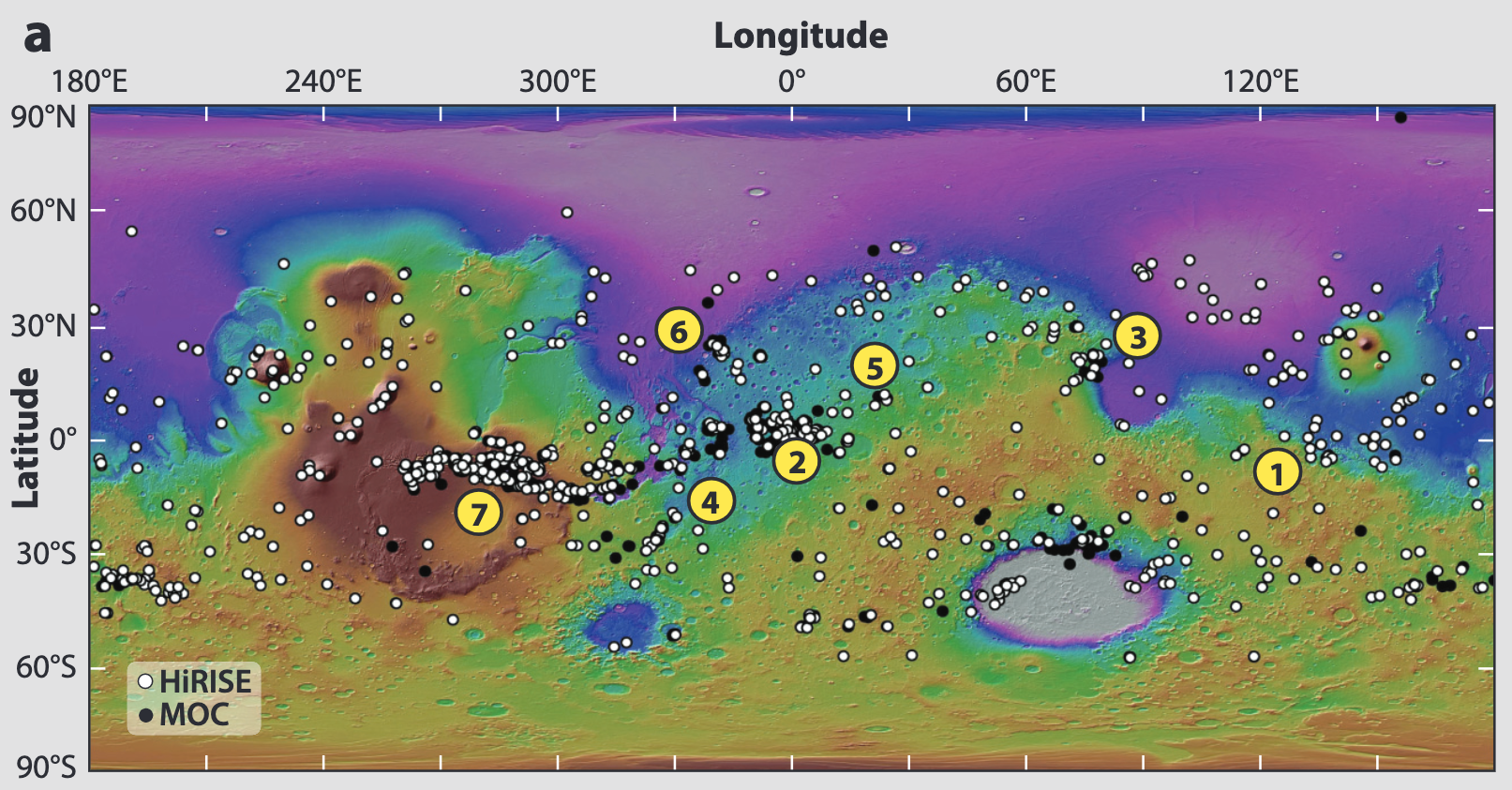
Fig. 3.63 Topographic map of Mars showing locations of likely sedimentary rocks from orbital images from the HiRISE (white dots) and MOC instruments (black dots). Numbered yellow circles correspond to the following stratigraphic sections: (1) Gale Crater, (2) Meridiani Planum, (3) Nili Fossae (near Jezero Crater), (4) Uzboi-Ladon systems, (5) Arabia Terra, (6) Martha Vallis, (7) Interior layered deposits of Valles Marineris. Credit: McLennan, S. M., Grotzinger, J. P., Hurowitz, J. A. & Tosca, N. J. The Sedimentary Cycle on Early Mars. Annu. Rev. Earth Planet. Sci. 47, 1–28 (2019).#
Sedimentary rocks at Meridiani Planum
In 2003, the Opportunity rover (one of two which were part of the MER mission) discovered layered sedimentary rocks exposed within impact craters at Meridiani Planum; these are distributed across the region at the km-scale.
The sedimentary rocks were classified largely as sandstones, with a number of sedimentary structures that indicated they were emplaced by wind, and some, within the upper portion of the sedimentary succession, indicating that they were deposited in the presence of flowing water (the key features here are the presence of a certain geometry of cross-stratification, or the shape and angle of sedimentary bedding relative to grain size).
These rocks were found to be composed of about 50% chemically-weathered basaltic material and 50% salt minerals dominated by Mg- and Fe-sulfates (which are highly soluble, attesting to the presence of concentrated brines), including Fe-oxide minerals such as goethite and hematite. One of these Fe-sulfate minerals was identified through Mossbauer spectroscopy as jarosite (KFe3(SO4)2(OH)6) which, based on equilibrium relationships with the Fe-oxides, is only stable at low temperature in an aqueous solution at pH between ~2-4.
The rocks also exhibit a number of features that show that the original sediments were influenced by a regionally-extensive groundwater table that fluctuated up and down several times over the course of sediment accumulation.
The absolute age of the sedimentary rocks is not well constrained but cratering statistics indicate ages of ~3.7-3.5 Ga (latest Noachian to early Hesperian)
The subsequent identification of regionally-extensive sedimentary rocks containing sulfate minerals by the OMEGA infrared spectrometer aboard the Mars Express orbiter gave rise to hypotheses that the early Martian surface was commonly characterised by acidic fluids (though note that only the Fe-sulfate minerals place pH constraints; other sulfate minerals are not pH-dependent).
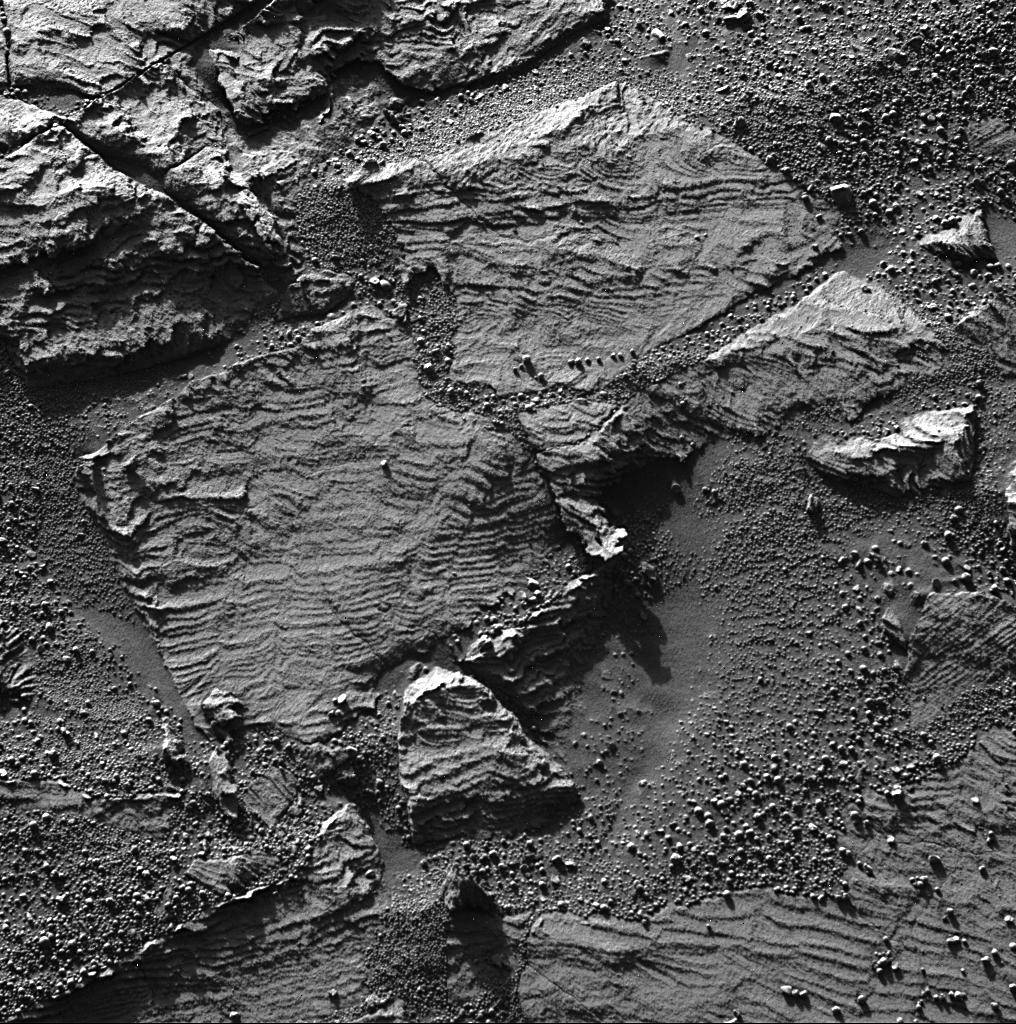
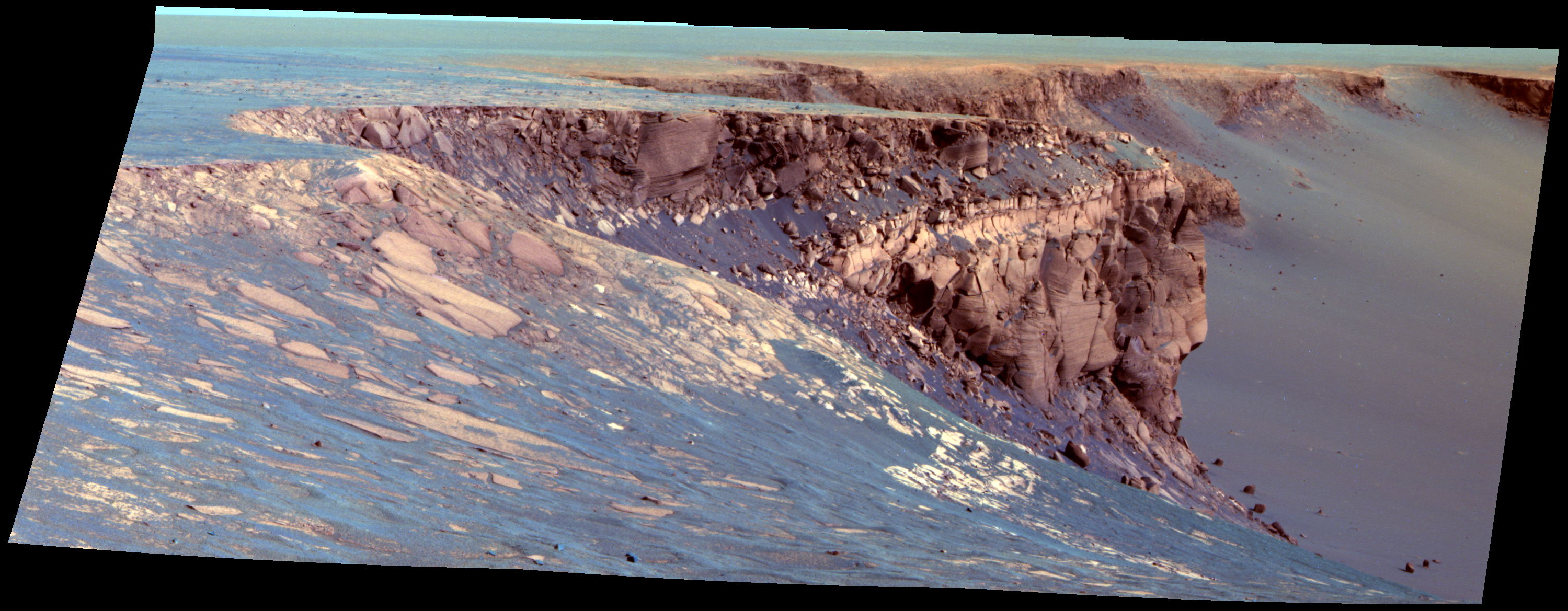
Fig. 3.64 Sulfate-rich aeolian sedimentary rocks exposed within Victoria Crater, Meridiani Planum. Credit: NASA/JPL/Caltech.#
Sedimentary rocks at Gale Crater
In 2012, the Curiosity Rover landed at Gale Crater, which contained a significant accumulation of sedimentary rocks in a central mound (which is thought to have been significantly eroded since initial deposition). Gale Crater is thought to have formed at ~3.8-3.6 Ga, with sedimentary rocks deposited before ~3.3-3.1 Ga (i.e., early Hesperian).
The rocks were found to be dominated by mudstones and sandstones and, based on geological relationships and sedimentology, interpreted to have been deposited in a system of alluvial fans that developed as rivers deposited sediments into a shallow lake system (perhaps including the development of more than one lake).
The rocks are composed largely of basaltic material but exhibit chemical trends that indicate negligible chemical weathering (i.e., highly soluble elements have not been leached or fractionated from igneous minerals). The presence of clay minerals and the absence of salt minerals at the base of the succession indicated deposition in relatively dilute water at near-neutral pH (because clay minerals are unstable at pH values outside this range). Together, regional changes in sedimentary mineralogy were interpreted to indicate that the shallow lake system exhibited redox stratification, with anoxic conditions developed in the deepest portion of the lake, and more oxic conditions developed in shallower settings.
The rocks exhibit a number of features which indicate that, similar to sedimentary rocks at Meridiani Planum, they were influenced by a regional groundwater table after deposition. These features include an increased abundance of magnetite, which is thought to have formed from pore water after sediment deposition, as well as Ca-sulfate-filled fractures.
Sedimentary rocks at Jezero Crater
The Perseverance Rover landed in 2021 and is currently exploring Jezero Crater, a crater that hosts an eroded delta deposit with clear evidence that sediments were deposited through a river system incised through the crater rim.
Rocks comprising the deltaic deposit exhibit inclined sedimentary rocks which indicate that deltas advanced into a lake as sediments accumulated. The uppermost delta deposit includes rocks comprised of much larger clasts and even boulders, implying deposition by high-energy floods. Together, the data indicate hydrologic activity in a stable lake environment and a transition to higher-energy short-duration episodes of deposition.
Delta rocks are composed largely of material physically eroded from the highlands to the NW of Jezero Crater, which includes igneous minerals and small amounts of Fe-Ca carbonate and poorly crystalline Fe-Mg silicate (together suggesting near neutral pH conditions). Fe- and Mg-sulfate minerals also occur in some strata, indicating episodes of drying and desiccation of a substantial portion of the water comprising the lake.
Orbital geological and mineralogical analysis
In addition to rover missions, a number of orbiters have conducted high-resolution imaging combined with spectroscopic analysis across much of the rest of the planet. These data indicate that sedimentary rocks have formed in ancient sedimentary rocks as vast sheets which can be correlated up to hundreds of kilometers. These data also indicate that sediment transport through rivers and deposition within lake systems was a dominant feature, with lake-dominated deposits occurring frequently in addition to alluvial fan settings.
Spectroscopic analysis also indicated that a variety of clay minerals are present in ancient rocks at the Martian surface. In particular, these data revealed an abundance of Fe/Mg-rich clay minerals primarily identified as nontronite and Mg-saponite, which appear to occur in crustal material exposed in craters, but also within material filling impact basins and as components within sedimentary rocks. Chlorites are also observed in material exhumed by impact cratering, and in several instances are associated with prehnite, zeolites, silica polymorphs, illite/muscovite, and lesser amounts of serpentine; these particular minerals, especially when observed together, indicate hydrothermal conditions. Kaolinite and Al-rich smectites appear less abundant in these data but do occur sporadically in craters and in sedimentary units overlying strata containing Fe/Mg-smectite. The origin of this latter observation has proven controversial but one hypothesis is formation through substantial leaching of cations through chemical weathering.
Orbital analysis indicates that rocks rich in sulfate minerals, including the Meridiani Planum example investigated by the Opportunity Rover, appear to be confined to a few regions at the surface, rather than evenly distributed across the entire planet.
A more extensive catalogue of geological features, mainly identified from orbit, that constrain climate parameters such as aridity, temperature, and timescale, are discussed by Kite (2019).
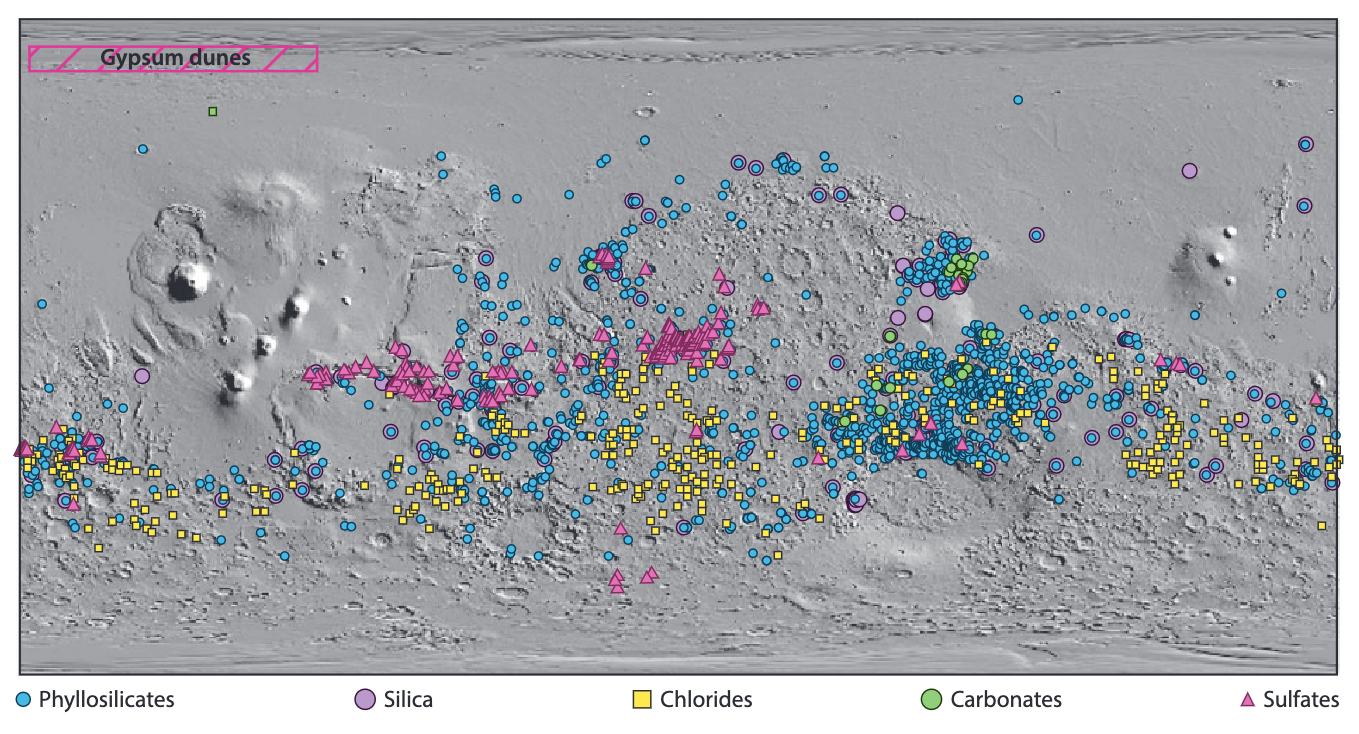
Fig. 3.65 Global distribution of the major classes of minerals that require the presence of liquid water to form. Credit: Ehlmann, B. L. & Edwards, C. S. Mineralogy of the Martian Surface. Annu. Rev. Earth Planet. Sci. 42, 291–315 (2014).#
Summary of geological constraints on climate:
In general, its clear that liquid water modified surface features on ancient Mars and drove the formation of several different minerals, largely in the late Noachian.
Orbital data show that much of the earliest crust contains clay minerals which reflect generally near neutral pH, but because clay minerals can form across a wide range of conditions (and temperatures), including, for example, formation through deep crustal hydrothermal systems, it is currently unclear how this observation constrains climate.
In-situ data from rovers indicate that sedimentary systems developed for substantial time intervals at the martian surface but some indicate very limited chemical weathering, which could occur under climates across a range of aridities and surface temperatures
The abundance of sulfate minerals in some strata has been interpreted to indicate large-scale aridification, with some regions of the ancient martian surface more prone to climate-driven evaporation.
In general, carbonate minerals are rarely exposed within Mars’s crust, which presents a conundrum. CO2 is expected to have dominated early atmospheres and is the major constituent in Mars’s thin 6 mbar atmosphere today. A variety of hypotheses have been proposed, but general expectations from geochemistry predict a larger abundance of carbonate minerals than observed currently.
The climate of early Mars#
The Martian faint young sun problem
The early sun was less luminous than today (about 75% of its current luminosity at 3.8 Ga) because hydrogen burning leads to increases in heat production within the core; this causes the rate of fusion, and thus luminosity, to increase over time.
Mars’s semimajor axis is equal to 1.524 AU, so it receives about 43% of the solar energy that Earth does.
Combined, these factors indicate that the equilibrium temperature would be 210 K (assuming planetary albedo of zero), which requires a minimum greenhouse effect of 65 K (double that of Earth today). Together, this has presented a major problem for understanding the early Martian climate, especially given an extensive geological record indicating the presence of liquid water (though the distribution of that liquid water in time and space is relatively unconstrained).
Greenhouse gases
One important constraint on how the surface of early Mars could have been warmed above the freezing point of H2O is the conclusion that a CO2-H2O atmosphere could not have sufficiently warmed the surface by itself. The reasons for this are because increasing atmospheric CO2 concentration leads to more scattering and increases in planetary albedo. In addition, CO2 condenses into clouds at low temperatures, which in turn leads to a reduced greenhouse effect at the surface.
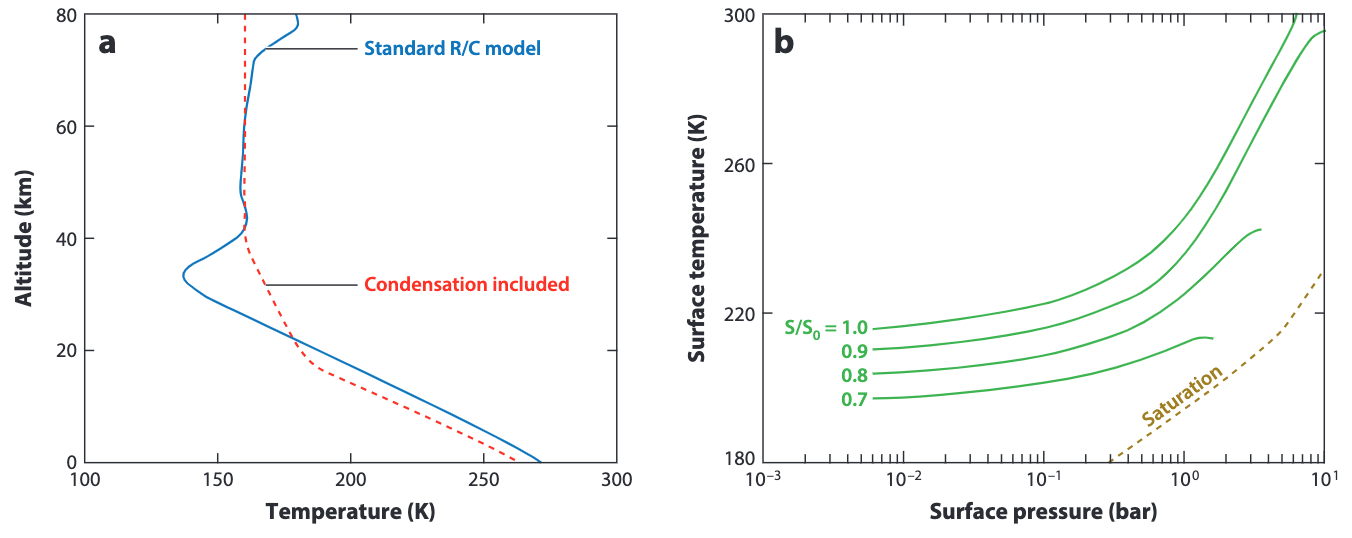
Fig. 3.66 (a) Temperature-pressure profile for the early Martian atmosphere assuming a surface pressure of 2 bar. The dashed line indicates calculation including the effects of CO2 condensation, which weakens the greenhouse effect. (b) Surface temperature versus pressure produced from a clear-sky 1D radiative-convective climate model for several values of solar luminosity relative to the present day. Dashed line shows saturation vapour pressure of CO2. Credit: Wordsworth, R. D. The Climate of Early Mars. Annu Rev Earth Pl Sc 44, 381–408 (2016).#
Many gases that may have contributed to the greenhouse effect on early Mars have been investigated, including:
CH4: Methane is not an effective warming agent on early Mars because of absorption effects as a function of temperature.
Ammonia and carbonyl sulfide: both are potentially stronger greenhouse gases but are photochemically unstable in the martian atmosphere and lack obvious formation mechanisms.
SO2/H2S: SO2 is photolyzed in the Martian atmosphere which limits its lifetime to under a few hundred years. Increases in SO2 also result in aerosol formation and scattering, which raises planetary albedo and produces a cooling effect rather than warming.
H2: In CO2-dominated atmospheres, H2 concentrations of up to a few mol percent lead to collision induced absorption (CIA), or the molecular interactions between pairs of atmospheric species and electromagnetic radiation. This has been shown to produce sufficient surface warming on early Mars, but lifetimes of H2-rich atmospheres are limited (on the order of 10^5^ years) due to H2 escape rates which tend to be relatively rapid.
Some have suggested that H2 could have been supplied by volcanism, but this requires very reducing conditions within the Martian mantle which generally lead to low outgassed CO2 concentrations. In theory, this problem could be reconciled if C concentrations in the mantle were generally higher than thought, but this has not been strongly constrained.
Serpentinization, or the reaction between H2O and olivine-rich rocks to produce serpentine minerals +/- magnetite, (hydr)oxides and H2, could have been an efficient mechanism. Geochemical considerations of serpentinizing more Fe-rich Martian olivine (compared to olivine in the Earth’s mantle) indicate that H2 production could have been more efficient on Mars, and the dominant serpentine mineral produced as a result may be present across extensive intervals of the martian surface (but is identical to an Fe-rich smectite mineral, complicating its unique identification); it is also present in serpentinized Martian meteorites and in Gale Crater sedimentary rocks.
Integrating climate scenarios with geological data#
There are several climate scenarios through which geological data from Mars can be reconciled. This is crucially dependent on the relative ages of climate-sensitive geological features, which are difficult to precisely constrain at present. One possibility is that early Mars experienced several climate swings/fluctuations through its history, which would imply that some climate-sensitive geological features occurred within discrete temporal intervals. Another interpretation is that the Martian climate was spatially and temporally variable, and thus climate-sensitive features need not correlate in age.
One conclusion appears relatively certain: over the long-term, most of Mars’s surface water was eventually locked into the crust through reactions between water and rock. The timing of this can be estimated by examining D/H isotopic ratios in ancient Martian crustal (hydrated) materials and the current Martian atmosphere. Available data indicate that most of the Martian surface water budget was locked away very early, which carries significant implications for long-term planetary habitability. This in turn may relate to the lack of an efficient mechanism to recycle water within the Martian crust (like plate tectonics) possibly because Mars is small and thus may cooled relatively quickly compared to the Earth.
Further reading#
Ehlmann, B. L. & Edwards, C. S. Mineralogy of the Martian Surface. Annu. Rev. Earth Planet. Sci. 42, 291–315 (2014).
Hurowitz, J. A. et al. Redox stratification of an ancient lake in Gale crater, Mars. Science 356, (2017).
Kite, E. S. Geologic Constraints on Early Mars Climate, Space Sci. Rev., 215 (2019).
Kite, E. S. & Conway, S. Geological evidence for multiple climate transitions on Early Mars.Nat. Geosci. 17, 10–19 (2024).
McLennan, S. M., Grotzinger, J. P., Hurowitz, J. A. & Tosca, N. J. The Sedimentary Cycle on Early Mars. Annu. Rev. Earth Planet. Sci. 47, 1–28 (2019).
Scheller, E. L., Ehlmann, B. L., Hu, R., Adams, D. J. & Yung, Y. L. Long-term drying of Mars by sequestration of ocean-scale volumes of water in the crust. Science 372, 56–62 (2021).
Tutolo, B. M. & Tosca, N. J. Observational constraints on the process and products of Martian serpentinization. Sci. Adv. 9, eadd8472 (2023).
Wordsworth, R. et al. A coupled model of episodic warming, oxidation and geochemical transitions on early Mars. Nat. Geosci. 14, 127–132 (2021).
Wordsworth, R. D. The Climate of Early Mars. Annu Rev Earth Pl Sc 44, 381–408 (2016).