Origin of Planets (C1)#
Course Organiser: Amy Bonsor (IoA)
In these 12 lectures we are going to look at how planets form. Our search for life is centred on planets, as these provide the only known environments life is likely to form in: planets host the pressures, temperatures, and chemical conditions required for life as we understand it to emerge and survive. An appreciation of why, how, and what planets form in the universe is thus a key first step in our search for habitable and inhabited environments.
As we now know, planet formation is a very common occurrence. Most, if not all, stars host planetary objects around them. However, for a long time the only direct evidence we had for planets forming around stars was our own solar system. This left us to wonder from a theoretical perspective whether planet formation was likely at all, and whether planets and planetary architectures like our solar system’s were the inevitable outcome.
Here, we will consider the properties of the universe that allow planet formation to occur, the processes that synthesize elements planets are built out of, how those elements assemble into vast cosmic structures that progressively condense into stars and planets, how planets grow from this material, and how the debris left over modifies the final chemical and physical state of planets. In this, we learn about the planetary population we have discovered to date, and the methods we have used to identify them. With this knowledge, we are able to place the solar system in its galactic context.
Learning outcomes
The overarching learning outcomes for this module are below, lecture-specific learning outcomes are included in the notes for each lecture.
Where the material for planets comes from.
How planet forming material produces planetary systems.
The modes of planetary accretion.
The structure of planets.
The architectures of planetary systems.
How we observe planetary systems.
The role of planet forming debris in early planet evolution.
This lecture introduces you to the C1 module ‘Origin of Planets’. We will look at some foundational concepts for this part of the course, focussing on an overview of where the building materials for habitable planets came from and how they are incorporated into planets during the planet formation process.
How C1 links to the course’s major questions#
A major question we ask in this course is: is there life elsewhere in the Universe?
We have seen during the introduction to the course that we can break this down into at least two separate questions, that get a bit closer to the research questions we might like to undertake. With the core courses we are getting into some of the disciplinary specifics of how these questions relate to what we understand, and what we do not understand, about the physical, chemical, and biological sciences underpinning these questions. We can therefore reduce these questions down further here, to questions rooted in the origin of the elements, the formation of stars and planets and our knowledge of planetary systems beyond the solar system; questions relevant to what we will learn in C1:
How did life emerge on Earth? |
How do we find life elsewhere? |
|---|---|
What made the Universe suitable for life? |
How do we find Earth-like planets? |
How did the Solar System form? |
How do we characterise the planetary systems best suited to life? |
How did Earth form as a habitable planet? |
Where else might there be habitable environments around other stars? |
C1 will touch on these questions from an astronomy perspective. In this introduction lecture we look at foundational concepts that will help you engage with the following lectures. The discussion starts with a basic summary of stellar evolution, which will support much of the following discussion. The elements required for a habitable planet like our own all formed from astrophysical processes that will be summarised next.
Stellar evolution#
Stars form out of the collapse of clouds of molecular gas. Most stars form in binary systems, with many forming in systems of higher multiplicity, within dense stellar clusters. We refer to a star on the main-sequence, as a star with stable nuclear burning, like our Sun. The main-sequence can be significantly shorter for stars more massive than our Sun. As stars evolve off the main-sequence, their envelopes expand. Our Sun will become a giant star whose envelope extends out to Earth’s orbit. Once burning is complete, the core collapses to form a white dwarf, whilst the outer layers float off as a planetary nebula. For stars significantly more massive than the Sun, this collapse is less gently, leading to violent explosion as a supernova, leaving behind either a compact neutron star or black-hole. Core-collapse supernova occur at the death of stars with masses \(> 8M_\odot\) and can be known as Type II, Ib, Ic. Supernova explosions also occur in white dwarfs where too much material has been added and the electron degeneracy pressure can no longer support the white dwarf against collapse. Type Ia supernovae occur when white dwarfs in binary systems accrete material from their companion.
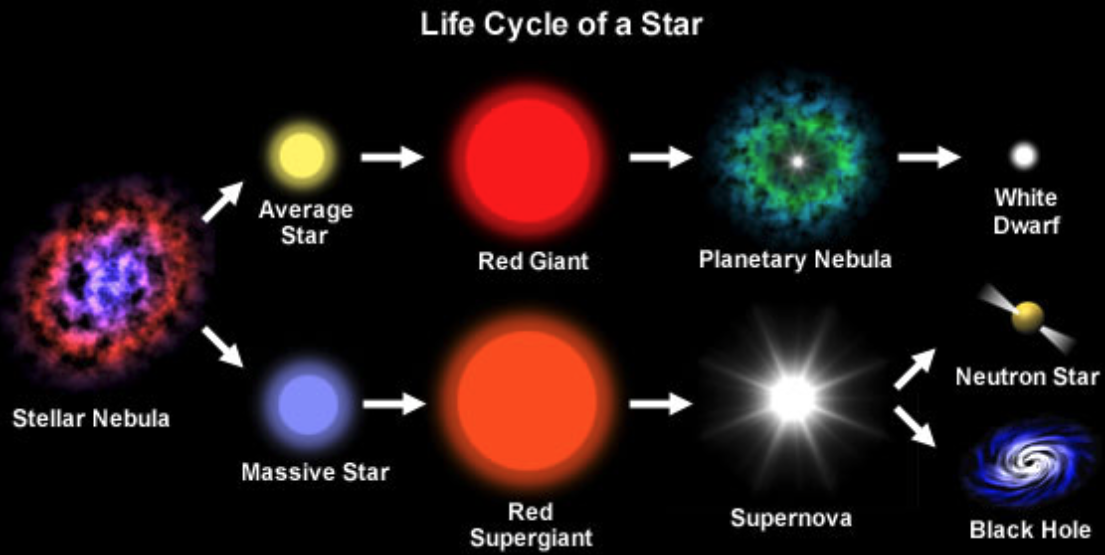
Fig. 1.9 A cartoon to illustrate the evolution of stars less massive than 8\(M_\odot\) that end their lives as white dwarfs and the evolution of stars more massive than 8\(M_\odot\) that explode as supernova.#
The origin of elements#
The building blocks required to support a habitable planet were formed early in the Universe’s evolution. Both hydrogen and helium were formed shortly after the start of the Universe in what is known as primordial or Big Bang nucleosynthesis, occurring within the first 20 minutes (H, D, He, Li). The first stars form about 100 million years after the big bang. These stars were likely significantly more massive and luminous than the stars that populate the Universe today. In Lecture 3 you will learn about the processes that occur within stars that build the periodic table. He, C and N are produced in nuclear burning in low mass stars. These low mass stars die as carbon-oxygen white dwarfs. Massive stars produce alpha elements (O, Ne, Mg, S, Si and Ca), some Fe, and some light s-process elements, when they explode as core-collapse supernova. Elements heavier than iron require neutron capture process that occurs in AGB stars (s-process) and supernovae (r-process). Many elements around the iron-peak are produced in Type Ia supernovae. These occur when a white dwarf forms in a binary system with another star, and material from the companion star is accreted by the white dwarf. If sufficient material is accreted, this is larger than the white dwarf can support (with the electron degeneracy pressure). The white dwarf explodes as a Type Ia supervova. These exploding white dwarfs lead to the production of many iron-peak elements. The merger of two neutron stars is a potential site for r-process nucleosynthesis for elements heavier than iron. Fig.Fig. 1.10 shows the periodic table, indicating the origin of each element.
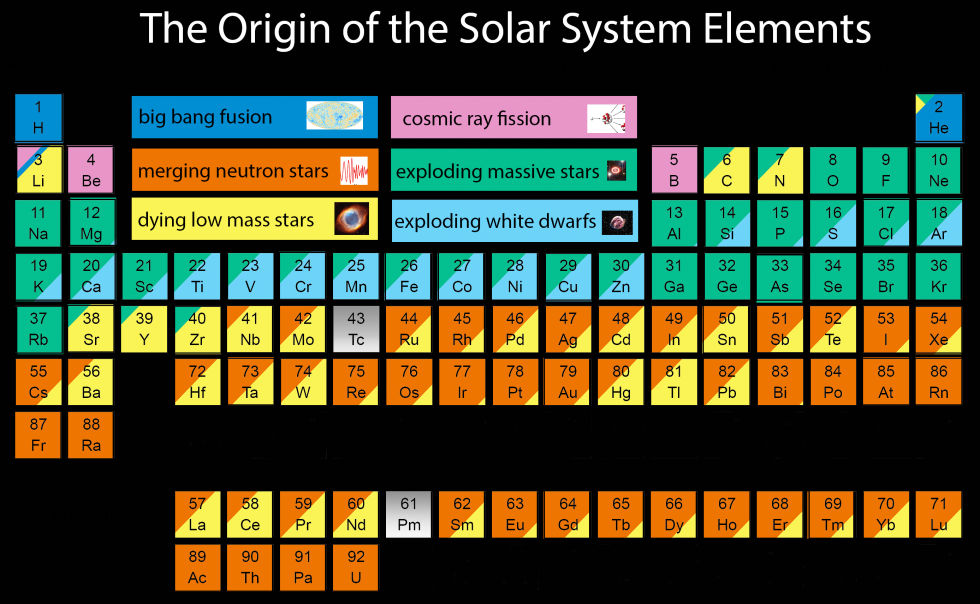
Fig. 1.10 The periodic table indicating the astrophysical source for each of the elements, color-coded between those formed in big bang nucleosynthesis, in exploding massive stars, exploding white dwarfs, dying low mass stars and merging neutron stars. Credit: Jennifer Johnson.#
Star and planet formation#
Stars form out of the collapse of clouds of molecular gas. The composition of the cloud, resulting from galactic chemical evolution and the enrichment of the inter-stellar medium from successive generations of star formation, determines the availability of material for star and planet formation. The simplest trend is composition is that of metallicity, normally quantified by the iron abundance of the gas ([Fe/H]). Metal poor stars formed earlier in the Universe’s history and have less solid material available for star and planet formation that more metal-rich stars that formed more recently. Observations of star and planet-forming regions include images, although noting that many proto-stars are deeply embedded and thus, hidden from direct observations, spectral energy distributions, tracing the distribution of the emission across wavelength space and providing indications the structure and spectra, tracing the kinematics of particular gas species.
Planet formation starts with the growth of the first dust grains, via low velocity sticking collisions. Higher velocity collisions lead to bouncing or even fragmentation, but at the low velocities present in the mid-planes of planet-forming discs particles should grow from \(\mu\)m to cm or even metre sizes. Planet-forming discs are dominated by the gas that is accreting onto the star. Dust particles feel a head-wind associated with the gas, which orbits at slower speeds than the dust. This head-wind slows down the dust and causes its orbits to spiral in towards the star. This in-spiral is known as radial drift. The smallest dust particles, of size \(\sim \mu\)m, are well coupled to the gas. They follow the evolution of the gas and migrate only slowly towards the star. Larger particles (mm to cm sized) migrate inwards the fastest, whilst the very largest bodies in the disc (kms) are no longer significantly influenced by the gas. In fact, cm and metre-sized particles migrate in so fast that they do not have time to grow via collisions before they migrate towards the star. This is known as the metre-sized barrier and is the reason that planet formation is thought to skip these intermediate sizes and go straight to km-sized bodies and larger. Streaming instabilities are an instability in the disc related to its turbulent properties and result in the gravitational collapse of planetesimals of km to 100skm in diameter.
The next stage of planet formation involves growth from planetesimals to planets. The cores of giant planets, such as Jupiter, must form well within the lifetime of the gas disc (< a few Myr), such that there is time for the accretion of large gaseous envelopes. Accretion of planetesimals from collisions can lead to growth, but this process is too slow for the cores of giant planets. Within the gas disc, there is a large population of pebbles, tiny particles of mm to cm in size that have grown via sticking collisions. These particles drift rapidly towards the star, but can be ‘caught’ by a proto-planet on the way. The accretion of pebbles leads to rapid growth from planetesimals to planetary cores. Once cores reach the pebble isolation mass, growth stops. Runaway accretion of large gaseous envelopes leads to gas giants. Stalled cores may explain the formation of ice giants such as Uranus and Neptune.
There is currently a debate in the field regarding whether pebble or planetesimal accretion dominates planet formation, particularly terrestrial planet formation. Planetessimal accretion, involving predominantly sticking collisions between planetesimals is the traditional method for the formation of rocky planets, taking hundreds of millions of years after the end of the gas disc. Pebble accretion, on the other hand, would form proto-planets that contain most of the mass of a rocky planet very rapidly, before the end of the gas disc (~few Myrs). Giant impacts dominated the final phase of planet formation for the Solar System terrestrial planets, with a critically important impact leading to the formation of the Earth-Moon system.
Exoplanetary systems#
This lecture course will take us through star and planet formation to probe what we can learn about planetary systems around stars other than our Sun. Many of these systems are clearly very different to our own planetary system, but should in principle be governed by the same basic principles that control their formation and evolution. The discovery space for exoplanets is ever expanding, but is intrinsically limited by our observational capabilities. Most exoplanet detections lie on orbital periods interior to Earth and the majority have masses significantly above \(1M_\oplus\). Exoplanet characterisation is the next frontier. Whilst interior models are limited to observational constraints on bulk density, atmospheric characterisation of gas giants is now commonplace and the field is looking towards lower and lower mass planets in the near future.
Exoplanetary systems have long been characterised by their large and bright emission in the infrared from dust. This dust, known as debris belts results from collisions between larger planetary bodies, such as comets or asteroids. Many planetary systems have dust belts orders of magnitude brighter than the Solar System’s Kuiper belt. Studying these belts tells us about the overall architecture of the planetary system, hinting at the presence of hidden planets on longer period orbits.